My guess would be that UDH hanger doesn't allow for adjustability unless you do what RAWW does and have the entirely different rear dropout. Plus they...
My guess would be that UDH hanger doesn't allow for adjustability unless you do what RAWW does and have the entirely different rear dropout. Plus they were one of the first brands to really commit to size specific chainstays, so they probably decided there wasn't enough people who would buy and swap dropouts, to warrant the investment in developing, producing and stocking those parts.
I think the bigger thing is the horst link design for the Reya. Though they opted to not do the different dropouts like the dreadnought/supernought (all of which are udh compatible) on the Druid.
There is also the idea that they may just think they have the design pretty dialed since it is 29 only (and the druid had specific rear triangles for mx or 29).
Interesting back to back testing between 29'' and 32'' wheels hard-tails on XC loop from French magazine Vojo.
the result shows faster times for the 32'' wheels in every loop parts ranging from almost 2% to almost 5% in the different sections (flat, uphill and downhill).
That’s been available for years. I have one in my basement that I throw on when I’m feeling weird and want to change it up.
How are they? I've never really gelled with any Schwalbe tires because they tend to feel too rounded off compared to Maxxis or Conti. The only Nobby Nics I tried were the lightest sidewall in the cheapest compound on a borrowed trail bike and they felt unbelievably unsupportive and had no grip. Obviously that's a function of the casing and compound but they somehow felt worse than any similar looking VeeTire, Maxxis, or Conti trail tire setup.
Interesting back to back testing between 29'' and 32'' wheels hard-tails on XC loop from French magazine Vojo.the result shows faster times for the 32'' wheels...
Interesting back to back testing between 29'' and 32'' wheels hard-tails on XC loop from French magazine Vojo.
the result shows faster times for the 32'' wheels in every loop parts ranging from almost 2% to almost 5% in the different sections (flat, uphill and downhill).
To go along with this, John Karrasch has been doing a lot of tire testing (via Chung method) and recently posted this one for free on his Patreon. 32" Aspen STs over rough cobbles were ~6% faster when you include rolling resistance (9% faster) and aero drag penalty of the larger wheel system.
As I've said previously, if these two tests are showing 2-6% performance gains from going to 32" wheels, those with them this season will have a MASSIVE advantage. XC World Cups are won/lost by seconds these days. <1min sometimes encompasses the top 15 riders. 1 minute over the course of an 80-minute race is 1.25%. Marginal gains (aero parts, lighter lube in hubs) that these teams work for net racers WELL under 1% advantage. And these wheels will likely be netting riders 2-6% gains. Even if in the real work that that number is as low as 2%, that will be a gigantic advantage with the competitiveness of current World Cup racing. We've seen this play out with 26" > 29". No one would dare show up on a 26" wheel at a modern race, they'd automatically be out of contention.
I didn't look into these tests, but do they account for the extra effort (energy) required to accelerate a larger wheel? Would that even be a thing? Could it be that 32" is superior in short tests, but over the course of a longer test it wears you out? Actual question, not trolling.
Theoretically, would these test results be the same direction if you pitted an even larger wheel against the 32"?
I didn't look into these tests, but do they account for the extra effort (energy) required to accelerate a larger wheel? Would that even be a...
I didn't look into these tests, but do they account for the extra effort (energy) required to accelerate a larger wheel? Would that even be a thing? Could it be that 32" is superior in short tests, but over the course of a longer test it wears you out? Actual question, not trolling.
Theoretically, would these test results be the same direction if you pitted an even larger wheel against the 32"?
That last question is really intriguing. I know we all want to stick with the existing standard (26 ain't dead), but for the big XC teams, they are chasing every last little gain, though there has to be a limit somewhere. At some point, making larger wheels won't be faster, but where is that point? Until last year, everyone thought it was 29, but here we are, and 32 is faster. The rate of change is still positive, but the second derivative is probably negative at this point, where going up from 29 to 32 isn't as big a change as from 26 to 29. I wonder where the global maximum of the wheel size vs performance gains is. The current local max is 32, but does it keep going up (green or green and orange, or does it get slower after this point (red).
Does anyone have a good source comparing speeds for 26, 27.5, and 29 for XC? With 3-4 data points we can plot a polynomial regression to try to find the optimal wheel size. Before data for 32 wheels it was harder because with a linear regression there is no global maximum for the ideal size.
PS: The optimal wheel size is the one you have that is the most fun to ride. I don't like product development just to sell stuff but I'm also a nerd that finds stuff like this interesting. (Even though I don't watch XC)
I didn't look into these tests, but do they account for the extra effort (energy) required to accelerate a larger wheel? Would that even be a...
I didn't look into these tests, but do they account for the extra effort (energy) required to accelerate a larger wheel? Would that even be a thing? Could it be that 32" is superior in short tests, but over the course of a longer test it wears you out? Actual question, not trolling.
Theoretically, would these test results be the same direction if you pitted an even larger wheel against the 32"?
That last question is really intriguing. I know we all want to stick with the existing standard (26 ain't dead), but for the big XC teams...
That last question is really intriguing. I know we all want to stick with the existing standard (26 ain't dead), but for the big XC teams, they are chasing every last little gain, though there has to be a limit somewhere. At some point, making larger wheels won't be faster, but where is that point? Until last year, everyone thought it was 29, but here we are, and 32 is faster. The rate of change is still positive, but the second derivative is probably negative at this point, where going up from 29 to 32 isn't as big a change as from 26 to 29. I wonder where the global maximum of the wheel size vs performance gains is. The current local max is 32, but does it keep going up (green or green and orange, or does it get slower after this point (red).
Does anyone have a good source comparing speeds for 26, 27.5, and 29 for XC? With 3-4 data points we can plot a polynomial regression to try to find the optimal wheel size. Before data for 32 wheels it was harder because with a linear regression there is no global maximum for the ideal size.
PS: The optimal wheel size is the one you have that is the most fun to ride. I don't like product development just to sell stuff but I'm also a nerd that finds stuff like this interesting. (Even though I don't watch XC)
I'm curious if 32" advantages will be course dependent this year (i.e. better for courses where momentum can be carried for longer periods) or if the weight penalty for spinning up the larger wheel is not a large enough factor to prevent it from outperforming 29" for every course. We'll just have to see how the results are this year and if a trend develops for riders able to use 32" starting to occupy a high % of podium finishes, especially if those same riders were consistently outside the podium in prior years on 29". Along the same lines, it will be interesting to see if any of the top men's and women's racers who are on the shorter side and unable to use 32" start to drift down outside of their typical/historical podium finishes.
How are they? I've never really gelled with any Schwalbe tires because they tend to feel too rounded off compared to Maxxis or Conti. The only...
How are they? I've never really gelled with any Schwalbe tires because they tend to feel too rounded off compared to Maxxis or Conti. The only Nobby Nics I tried were the lightest sidewall in the cheapest compound on a borrowed trail bike and they felt unbelievably unsupportive and had no grip. Obviously that's a function of the casing and compound but they somehow felt worse than any similar looking VeeTire, Maxxis, or Conti trail tire setup.
How are they? Wellllllll, they can be great- given the correct pressure to not be bouncy and not so low to be unsupportive for your weight. I always ride tacky chans, so it’s a fun little change to roll just slightly faster and have a more rounded profile with less defined edge blocks. You just have to adjust your grip expectations and not rip into loamy steeps expecting to be able to stand on the corner knobs
they had different prices earlier that day for the 2 options, one was +500eur, probably already said too much so removed it again. so new avinox motor most likely same mounting holes.
I didn't look into these tests, but do they account for the extra effort (energy) required to accelerate a larger wheel? Would that even be a...
I didn't look into these tests, but do they account for the extra effort (energy) required to accelerate a larger wheel? Would that even be a thing? Could it be that 32" is superior in short tests, but over the course of a longer test it wears you out? Actual question, not trolling.
Theoretically, would these test results be the same direction if you pitted an even larger wheel against the 32"?
That last question is really intriguing. I know we all want to stick with the existing standard (26 ain't dead), but for the big XC teams...
That last question is really intriguing. I know we all want to stick with the existing standard (26 ain't dead), but for the big XC teams, they are chasing every last little gain, though there has to be a limit somewhere. At some point, making larger wheels won't be faster, but where is that point? Until last year, everyone thought it was 29, but here we are, and 32 is faster. The rate of change is still positive, but the second derivative is probably negative at this point, where going up from 29 to 32 isn't as big a change as from 26 to 29. I wonder where the global maximum of the wheel size vs performance gains is. The current local max is 32, but does it keep going up (green or green and orange, or does it get slower after this point (red).
Does anyone have a good source comparing speeds for 26, 27.5, and 29 for XC? With 3-4 data points we can plot a polynomial regression to try to find the optimal wheel size. Before data for 32 wheels it was harder because with a linear regression there is no global maximum for the ideal size.
PS: The optimal wheel size is the one you have that is the most fun to ride. I don't like product development just to sell stuff but I'm also a nerd that finds stuff like this interesting. (Even though I don't watch XC)
Doesn't it seem obvious that the optimal wheelsize for XC racing would be:
1. The biggest wheelsize you can fit into your frame and fork without significantly jeopardizing bike fit, and
2. The biggest wheelsize that's still available with a competitive tire (casing/compound/tread)
If you can check both of those boxes, I don't see why it wouldn't be faster than running a smaller wheel. I'm sure we would see diminishing returns for 36", 39", or even 42" wheels (as you mentioned), but diminishing returns are still positive returns. As long as you can build a wheel with featherlight spokes and rims, and 170 tpi super light fast rolling tires, I don't think the added weight is ever going to overcome the benefits of rolling faster, because the added weight is so low and the benefit of faster rolling speed is so great.
This is why I'm a grouch in favor of UCI regulations to level the playing field. If 32" wheels really are so much better than 29", and if 36" wheels would be even better still, then that's a huge and unfair advantage for taller athletes. One of my favorite things about cycling has been the fact that tall and short athletes both win races. It would be lame if we created a version of MTB where short or even average height people didn't have a chance at winning a race. 29" already barely fit in some pro rider's bikes. 32" will be a non-starter for a huge portion of the field.
Do motorbikes have engines or motors? Asking for a friend.(also, in some/many/most? languages, there's no distinction between those two words or no such commonly used synonyms...
Do motorbikes have engines or motors? Asking for a friend.
(also, in some/many/most? languages, there's no distinction between those two words or no such commonly used synonyms exist)
Combustion powered = engine. Motorcycles have engines. Motor is not referring to power source but comes from the Latin word "movere" meaning "to move."


Dayum they nailed it. Kinda want to downsize from my Druid now. 🙃
Wonder how that new forbidden runs with an o-chain?
Personally, I feel that would defeat the purpose of the bike
Personally, I think it would be hella rad.
Canfield does it with a flip chip.
https://youtu.be/kbYJInKOlhk?si=4DTGexSSNoCvfs_F
I wonder how fast the Santa Cruz V10 would be with Aspen STs
I think the bigger thing is the horst link design for the Reya. Though they opted to not do the different dropouts like the dreadnought/supernought (all of which are udh compatible) on the Druid.
There is also the idea that they may just think they have the design pretty dialed since it is 29 only (and the druid had specific rear triangles for mx or 29).
Nobby nic ultrasoft coming?
Forbbiden E-Dreadnouth
E-Dreadnouth? Gee, that sure sounds like an odd name.
Oh come on... These bad AI images have been floating around ever since before the Druid E was launched.
Interesting back to back testing between 29'' and 32'' wheels hard-tails on XC loop from French magazine Vojo.
the result shows faster times for the 32'' wheels in every loop parts ranging from almost 2% to almost 5% in the different sections (flat, uphill and downhill).
https://www.vojomag.com/notre-vtt-32-pouces-face-au-chrono-vraiment-plus-rapide-29-pouces-prototype/
That’s been available for years. I have one in my basement that I throw on when I’m feeling weird and want to change it up.
How are they? I've never really gelled with any Schwalbe tires because they tend to feel too rounded off compared to Maxxis or Conti. The only Nobby Nics I tried were the lightest sidewall in the cheapest compound on a borrowed trail bike and they felt unbelievably unsupportive and had no grip. Obviously that's a function of the casing and compound but they somehow felt worse than any similar looking VeeTire, Maxxis, or Conti trail tire setup.
To go along with this, John Karrasch has been doing a lot of tire testing (via Chung method) and recently posted this one for free on his Patreon. 32" Aspen STs over rough cobbles were ~6% faster when you include rolling resistance (9% faster) and aero drag penalty of the larger wheel system.
More 29” v 32” Aspen testing… Rough Cobblestones ✅ | Patreon
As I've said previously, if these two tests are showing 2-6% performance gains from going to 32" wheels, those with them this season will have a MASSIVE advantage. XC World Cups are won/lost by seconds these days. <1min sometimes encompasses the top 15 riders. 1 minute over the course of an 80-minute race is 1.25%. Marginal gains (aero parts, lighter lube in hubs) that these teams work for net racers WELL under 1% advantage. And these wheels will likely be netting riders 2-6% gains. Even if in the real work that that number is as low as 2%, that will be a gigantic advantage with the competitiveness of current World Cup racing. We've seen this play out with 26" > 29". No one would dare show up on a 26" wheel at a modern race, they'd automatically be out of contention.
I didn't look into these tests, but do they account for the extra effort (energy) required to accelerate a larger wheel? Would that even be a thing? Could it be that 32" is superior in short tests, but over the course of a longer test it wears you out? Actual question, not trolling.
Theoretically, would these test results be the same direction if you pitted an even larger wheel against the 32"?
That last question is really intriguing. I know we all want to stick with the existing standard (26 ain't dead), but for the big XC teams, they are chasing every last little gain, though there has to be a limit somewhere. At some point, making larger wheels won't be faster, but where is that point? Until last year, everyone thought it was 29, but here we are, and 32 is faster. The rate of change is still positive, but the second derivative is probably negative at this point, where going up from 29 to 32 isn't as big a change as from 26 to 29. I wonder where the global maximum of the wheel size vs performance gains is. The current local max is 32, but does it keep going up (green or green and orange, or does it get slower after this point (red).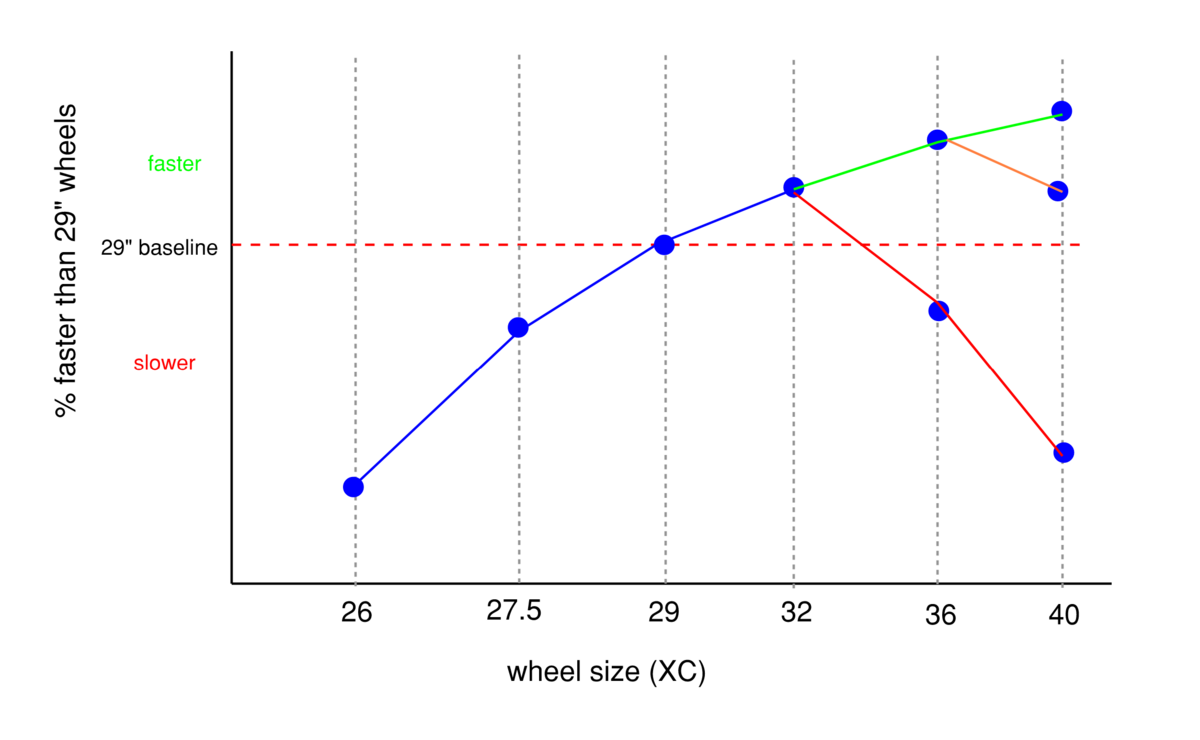
Does anyone have a good source comparing speeds for 26, 27.5, and 29 for XC? With 3-4 data points we can plot a polynomial regression to try to find the optimal wheel size. Before data for 32 wheels it was harder because with a linear regression there is no global maximum for the ideal size.
PS: The optimal wheel size is the one you have that is the most fun to ride. I don't like product development just to sell stuff but I'm also a nerd that finds stuff like this interesting. (Even though I don't watch XC)
I'm curious if 32" advantages will be course dependent this year (i.e. better for courses where momentum can be carried for longer periods) or if the weight penalty for spinning up the larger wheel is not a large enough factor to prevent it from outperforming 29" for every course. We'll just have to see how the results are this year and if a trend develops for riders able to use 32" starting to occupy a high % of podium finishes, especially if those same riders were consistently outside the podium in prior years on 29". Along the same lines, it will be interesting to see if any of the top men's and women's racers who are on the shorter side and unable to use 32" start to drift down outside of their typical/historical podium finishes.
whyte avinox ebike
How are they? Wellllllll, they can be great- given the correct pressure to not be bouncy and not so low to be unsupportive for your weight. I always ride tacky chans, so it’s a fun little change to roll just slightly faster and have a more rounded profile with less defined edge blocks. You just have to adjust your grip expectations and not rip into loamy steeps expecting to be able to stand on the corner knobs
https://berriabikes.com/en/pages/nexxen
and another brand i never heard of with an avinox bike
Hmmm, do I choose DJI Avinox or DJI Avinox motor?
It might be just the translation but any time an emtb motor is called an engine it really...
they had different prices earlier that day for the 2 options, one was +500eur, probably already said too much so removed it again. so new avinox motor most likely same mounting holes.
1: Gonna need your stance on “panini.”
that was the one that helped me shed the bulk of my asshole pedantry
B: are you similarly affected by NASCAR types saying “motor?” Crate motor restrictor plate motor etc
Do motorbikes have engines or motors? Asking for a friend.
(also, in some/many/most? languages, there's no distinction between those two words or no such commonly used synonyms exist)
Doesn't it seem obvious that the optimal wheelsize for XC racing would be:
1. The biggest wheelsize you can fit into your frame and fork without significantly jeopardizing bike fit, and
2. The biggest wheelsize that's still available with a competitive tire (casing/compound/tread)
If you can check both of those boxes, I don't see why it wouldn't be faster than running a smaller wheel. I'm sure we would see diminishing returns for 36", 39", or even 42" wheels (as you mentioned), but diminishing returns are still positive returns. As long as you can build a wheel with featherlight spokes and rims, and 170 tpi super light fast rolling tires, I don't think the added weight is ever going to overcome the benefits of rolling faster, because the added weight is so low and the benefit of faster rolling speed is so great.
This is why I'm a grouch in favor of UCI regulations to level the playing field. If 32" wheels really are so much better than 29", and if 36" wheels would be even better still, then that's a huge and unfair advantage for taller athletes. One of my favorite things about cycling has been the fact that tall and short athletes both win races. It would be lame if we created a version of MTB where short or even average height people didn't have a chance at winning a race. 29" already barely fit in some pro rider's bikes. 32" will be a non-starter for a huge portion of the field.
Combustion powered = engine. Motorcycles have engines. Motor is not referring to power source but comes from the Latin word "movere" meaning "to move."
verbrennungsmaschine!
Post a reply to: 2026 MTB Tech Rumors and Innovation - Longer and Slacker