



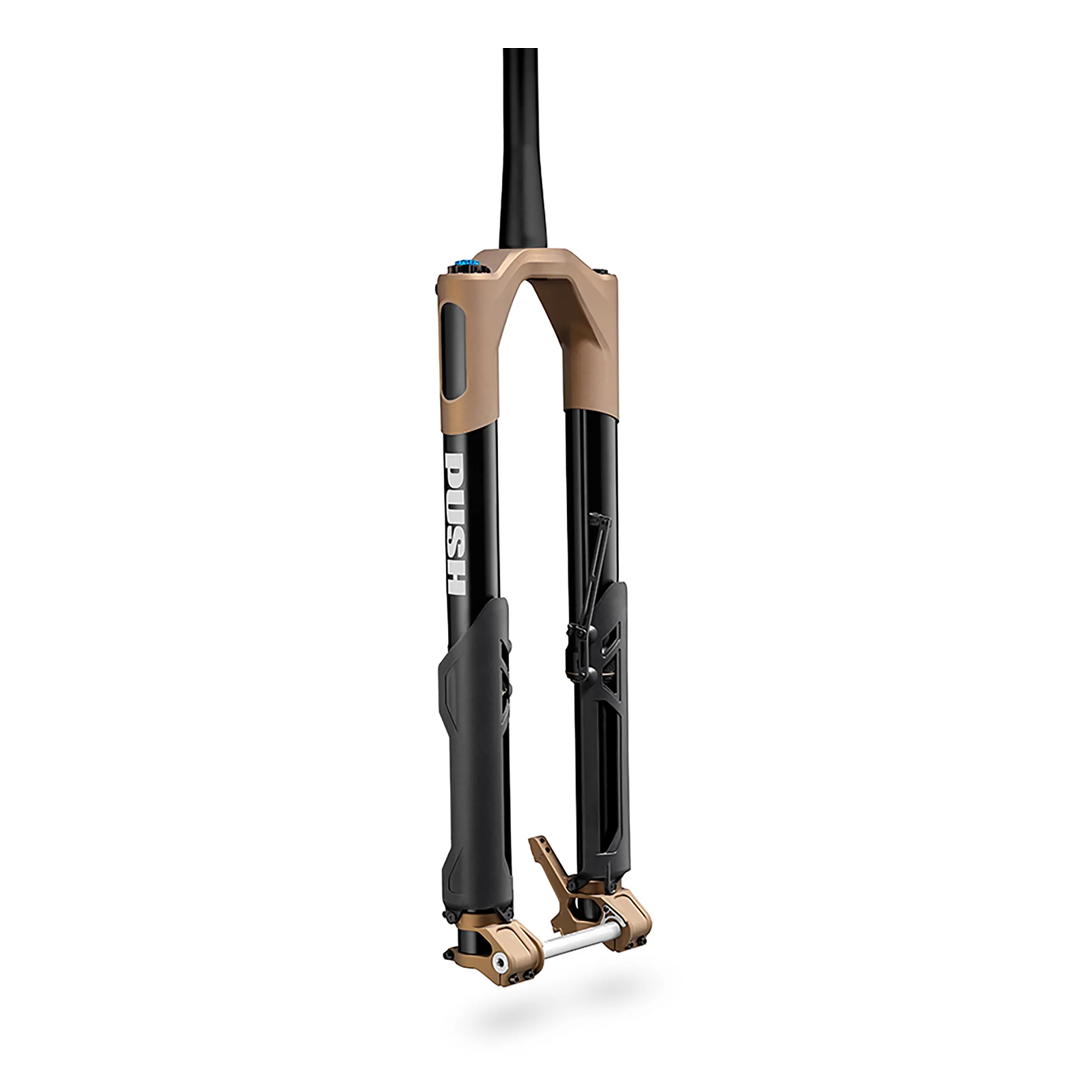
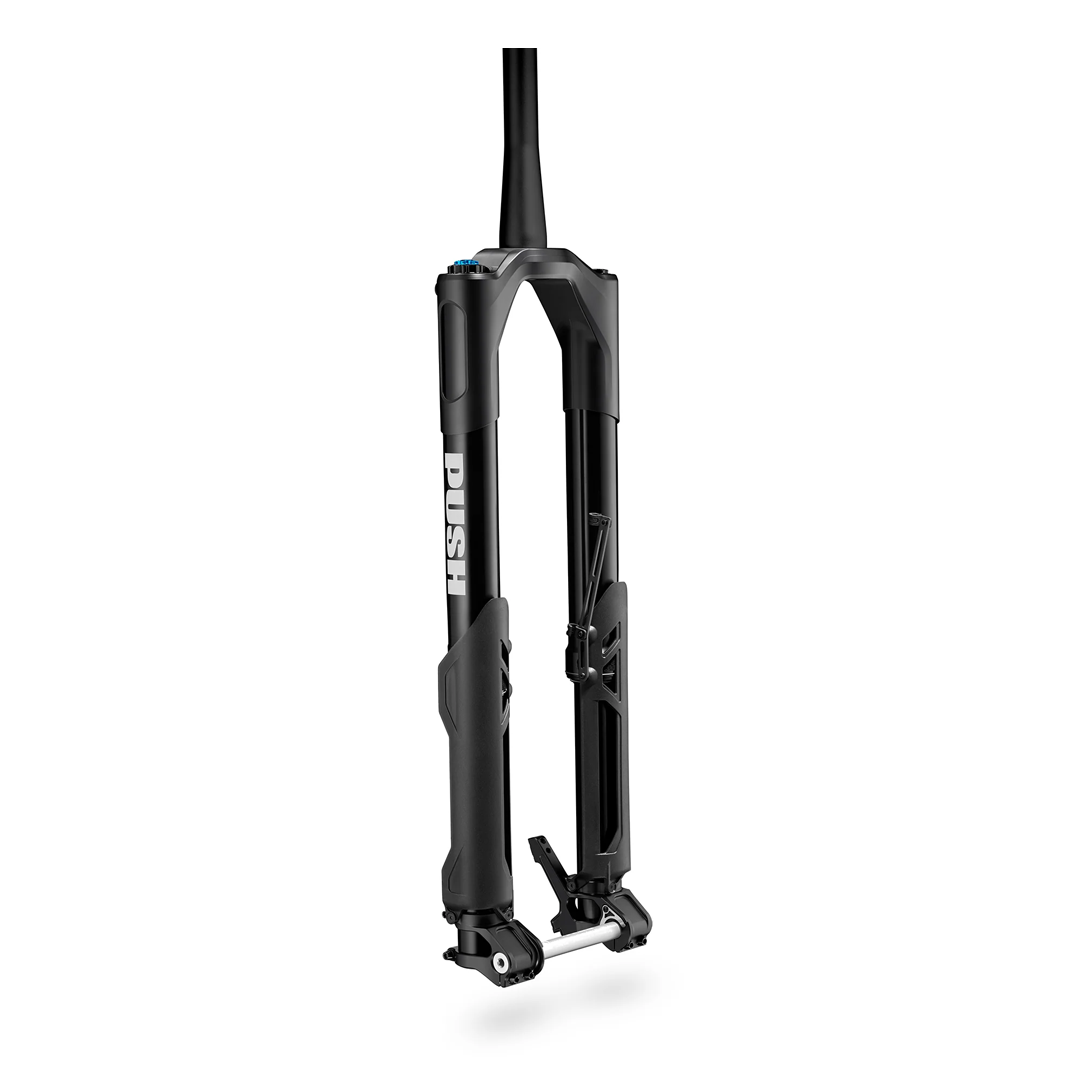
W hat do you get when you cross a big block of billet aluminum with a bunch of robots and bike nerds in Loveland, Colorado? You get one of the coolest and simultaneously one of the most exclusive mountain bike products on the market today. With its inverted design, enormous one-piece crown, coil spring, and dual-bottom out systems, the Nine One is also one of the most unique suspension products we've seen in a long time.
Do you need it? Do you want it? Is it any good? Read more and watch to hear my impressions after four months on the Nine One, but note that this is only part one of the review, as the fork has been sent back to Push for even more fine-tuning and tweaking in round two. Most importantly, don't forget to head to the comments below and tell me why I'm wrong.
The PUSH Nine One is an expensive, high-tech fork, and Team Robot likes to go deep to make sure anyone considering a piece of equipment like this has as much information as possible to be properly educated.
We've added links to the section so you can jump around.
- Highlights, Strengths, Weaknesses
- What's New with the Nine One (Sub Chamber, HBO, tech details)
- Initial Impressions (All About Flex and Fork Weight)
- On the Trail - Sentinel and Megatower
- Push's Exceptional Customer Service
- Who is the Nine One For and a Discussion about Price
- Closing Thoughts on Torsional Stiffness
- What's the Bottom Line?
- Jump to the Comments
Highlights
- MSRP: $2,250 USD
- Travel: 140mm-170mm in 10mm increments. User adjustable
- Coil sprung with 7 different spring rates available for riders 105-255 pounds, including “silent-surround noise canceling technology”
- Externally adjustable LSC, HSC, and LSR
- Two different bottom out systems: a unique “Sub-Chamber” air chamber to create air ramp and a separate externally adjustable hydraulic bottom out damping circuit
- Axle: 15mm x 110mm floating through axle, Torque Cap compatible
- Axle Clamp: Oversized 38mm clamp area, 4 bolt design
- MTB and E-MTB compatible for 29" or 27.5" front wheels
- Made in Colorado
- 2,950 grams
Strengths | Weaknesses |
|
|

Back to the Top | Jump to Comments
What's New with the Nine One - Getting Tech
The team at Push have made a few updates to the Nine One since the V1 was released a year ago. One update we don’t see very often in our corner of mountain biking is that the price has actually come down by $350 on the new model, from an eye-watering $2600 on version one to $2250 for version two. In addition to the lower cost, the V.2 also features not one but two new bottom-out devices, replacing the ABS pneumatic bottoming system featured on the old model.
A new HBO damping circuit is the first of the two new bottom out features. It’s the only bottom out system of its kind that I’ve ever seen, because it mixes shim-based damping with externally adjustable air pressure. The HBO circuit uses a pressurized IFP to manage fluid displacement (instead of a coil spring or bladder), and by changing the pressure in the IFP you can increase damping force in the speed sensitive shim HBO circuit.

To take a trip in the wayback machine, the air pressure-backed IFP is actually similar to the second generation of Fox’s “Boost Valve” (not the earlier position sensitive Boost Valve that sucked) that showed up on the RC4 downhill shock, circa 2009-2015. The RC4 also uses an air-backed IFP damper that allowed you to adjust the air pressure and the volume of the IFP to change the damping force AND the shape of the damping curve, which created a dizzying array of adjustments for the home mechanic or struggling-but-solidly-upper-mid-pack-racer like me. The Push HBO circuit is more streamlined than my old RC4’s, and unlike that old Boost Valve design that shifted the whole damping curve of the shock, the Push HBO circuit is separate from the main fork damper and only comes into effect in the last 70mm of travel. IFP pressure in the Push bottom out circuit is adjustable from 10-40 psi, and because of the very small size of the IFP chamber, that small difference in air pressure is EXTREMELY noticeable on the trail. 10 psi in the HBO chamber feels very different than 40.

The second new bottom out feature is what Push calls the “Sub Chamber,” which is an air chamber in the spring-side fork leg that can be opened or closed to create more or less spring force in the bottom 30% of travel. All forks, including coil forks, have air pressure build up as the fork compresses. The bigger the chamber, the less that pressure will ramp up as you near the end of travel, and the smaller the chamber, the more it ramps up. This is the same reason why long travel air-spring single crown forks like the RockShox Zeb can be so darn tough to bottom out for some riders. Push took that same dynamic and packaged it into a setting that you can toggle on or off. No shock pump needed. When the sub chamber is open, air inside the spring side stanchion has the volume of the whole leg to work with and doesn’t notably ramp up. When you flip the lever and close off the Sub Chamber, it’s like adding tokens to an air fork, creating an air spring ramp in the last 30% of travel and increasing bottom out force.
It begs the question: why make two different parallel bottom out circuits? And for that matter, when would a rider want to use one over the other? Or use both at the same time?

The Sub Chamber will be especially helpful where the bumps are harsh and traction isn’t at a premium, like mid-summer at a bike park.
The Sub Chamber is going to be more rider and terrain-dependent, and everything that’s ever been written about tokens or progressive vs. linear rear suspension designs will apply here. By making the fork’s spring curve more progressive, closing the Sub Chamber will cater to steeper terrain, large stair steps in the trail, and creating support when facing lower frequency, bigger bumps. The Sub Chamber will be especially helpful where the bumps are harsh and traction isn’t at a premium, like mid-summer at a bike park. The flipside is that the Sub Chamber is going to be harsher on smaller and higher frequency bumps and will likely produce less absolute grip, so it won’t be great for most riders in slippery conditions when you’re looking for max traction, such as lower speed natural tech trails.

The HBO is more likely to be a hit with all riders, because it mostly exists to make up for the biggest downside of using a linear coil spring in a fork: the loud clank when you bottom out. Because it doesn’t produce spring force like a token or volume reducer would, it doesn’t add any damping force at lower shaft speeds, meaning the circuit will only be active when you’re smashing through travel and you need it to be. Medium-sized impacts that only graze the last 70mm of travel won’t encounter any added resistance, meaning no added harshness. By comparison, a progressive “token” setup on an air spring or the Sub Chamber on the Nine One will be agnostic to shaft speeds and will always be harder to push against, regardless of the shape or type of bump you’re hitting. It also means you don’t have to compromise your spring rate or compression setup just to prevent harsh bottom outs. Murphy gave the example of trails on the Colorado Front Range with harsh 2x4’s buried across the trails, where the impact is normally so violent and jarring, but the HBO mutes the compression force. Without the HBO circuit, riders would have to choose between running a stiffer spring and compression setup everywhere else just to mellow out those occasional violent impacts, or running the ideal setup everywhere else and have to get used to hammering their hands a few times every ride.

It’s also worth mentioning that upgrading the V2 to have two separate bottom out systems resulted in a 180 gram increase in weight from the V1, which tells you that suspension performance was a bigger priority than weight for Push when they were designing the V2.

Lastly, Push released a very tidy fender to complement the V2, addressing another one of the downsides of inverted forks. By mounting to the fork guards and securely hugging the front tire, the fender can stay relatively small and still keep mud and other assorted gunk out of your eyes, unlike some other recent Kawasaki-inspired inverted fork fenders.

Back to the Top | Jump to Comments
Initial Impressions
When you're buying the fork, there’s a brief survey questionnaire to fill out with Push to help shape the tune they’ll recommend. When the fork arrives, it comes with a setup guide listing the settings that Push recommended for me, and the fork was shipped with those settings already configured. The setup guide also lists the signatures of the employees who assembled and tested the fork. In this way, buying a Nine One is similar to the experience of buying a high-end shock like a Vorsprung Telum or a Push Elevensix, where the settings are predetermined and preset for you out of the box. However, I’m not aware of another fork manufacturer that offers the same kind of service for a fork.
The fork shipped with a 50 pound spring installed, which Push recommends for riders 185-210 pounds. My set up notes that I shared with Push mentioned that I prefer stiffer forks and more stability, so the fork also came with a 55 pound spring for riders 210-235 pounds, and I loved having the option.

The fork looks and feels substantial and well-made. Things like the axle, dropouts, and various caps and knobs fit together nicely, and the hose routing for the front brake is great. I wish every fork was that easy to install or remove a brake from. It looks and feels like an expensive product.
I use the o-ring pretty heavily to gauge what my suspension is doing on the trail, so I felt a little naked riding the fork with no idea of how much travel I was using.
Unfortunately, the steerer tube was shorter than the one it replaced, at 210mm vs. 230mm. I had to lower my headset spacer height by 5mm, but luckily that didn’t end up being a deal breaker on the trail. When I asked Darren about this, he said the steerer tube requires an “extremely complicated and expensive process that happens out of house” and that steerer tube length hasn’t been an issue for anyone. However, it was an issue for me, so I think what he means is that there hasn’t been a head tube so long that the fork couldn’t be run. Another thing that bugged me was the lack of an o-ring on the stanchion to measure sag and track travel usage. I use the o-ring pretty heavily to gauge what my suspension is doing on the trail, so I felt a little naked riding the fork with no idea of how much travel I was using.
All About Flex
After installing the fork, I did the obligatory “twisting the handlebar while holding the front wheel” torsional stiffness test. According to my highly un-scientific methods, it felt like it had noticeably more torsional flex than a Podium, but a similar amount to the Intend Hero and Edge forks I’ve had the chance to “test.” According to Push, using their own custom torsional stiffness jig, the Nine One sits between a 36 and 38 in torsional stiffness. Coincidentally, that’s exactly what Fox told us about the Podium at the product launch. However, Push also used multiple accelerometer sensor locations to measure flex on the trail (relative position of sensors in real time) using independent channels. Darren said his team found that the forces that would create torsional flex in a fork are much more often going to create slippage at the contact patch and move the contact patch at the tire, more than creating flex at the hub, in the wheel, or at the fork.

Instead, what Push found was that flex at the axle was much more likely to come vertically than torsionally, caused by a difference in displacement by the two stanchions as they cycled through travel at different speeds. This stems from the fact that most forks, including the Nine One, only have a spring on one side. In a standard fork, the leg with the spring in it wants to compress at a different rate than the spring with the damper, but because both legs are connected by a one-piece magnesium lower and a fork arch, the unit is forced to move as one. On an inverted design, the two legs are completely separate, and only held together by the axle. If there’s any vertical flex allowed at the axle, the two fork legs will compress at different rates, which flexes the front wheel towards the spring-side fork leg.

The solution for Push was to dial in their axle interface to reduce side to side vertical flex, and you can see in the pictures that they’ve gone with a huge axle and dropout dimension to combat flex. Darren said “We are extremely confident in our chassis stiffness,” however, it’s worth mentioning that the Nine One doesn’t play well with all front hubs, because the hub actually serves as a member of the axle structure, holding the two fork legs together. Industry Nine’s Hydra hub, Shimano’s new XTR and XT hubs, Chris King hubs, and Torque caps are all Push-approved methods for minimizing any unwanted vertical flex.

Fork Weight - Nine One vs. Other Forks
Also worth mentioning again, it's heavy. That may not be a deal breaker for you (it's not for me), but in the name of transparency, here's how the Nine One stacks up against its competition:
- Boxxer Ultimate with Smashpot: 3380 grams (estimated with 50 pound spring)
- 40 Grip X2 with Smashpot: 3245 grams (estimated with 50 pound spring)
- EXT Vaia: 3195 grams
- Push Nine One: 2,950 grams
- Zeb w/ Smashpot: 2906 grams (45 pound spring)
- Boxxer Ultimate: 2880 grams
- 40 Grip X2: 2745 grams
- Podium Grip X2: 2695 grams
- Intend Flash 38: 2620 grams
- Marzocchi Z1 Coil: 2525 grams
- 38 Grip X2: 2314 grams
- Zeb Ultimate: 2324 grams
- 36 Grip X2: 2130 grams
Easy to Service
A big part of the reason it's so heavy is the coil spring. Luckily, switching springs is relatively easy, even with the fork on the bike, and regular fork service is a breeze. Each fork leg has oil ports at the bottom of the leg, near the seals, which interface with threaded syringes to make basic service easy. Push calls this the “50 hour speed service,” and it means that you can perform on-bike oil changes, with no need to remove the fork to service it. If you haven’t seen how it works, you have to watch the video (the good part starts at 46 seconds). After three 50 hour “speed services” or roughly 200 hours of ride time, it’s time for the 200 hour service kit, which is available to users, and requires no special tools. The damper kit is available for 300 hour service, including tools and videos for at home damper rebuild.

Back to the Top | Jump to Comments
On The Trail
Two Test Bikes - Transition Sentinel and Santa Cruz Megatower
There were two distinct phases to this fork test. The first phase saw the Nine One bolted to the front of my Transition Sentinel, which has been tastefully assembled in what I would describe as an all-mountain or “festive trail” build, with carbon wheels, medium weight tires, and a lighter build kit. The second phase of the test took place on my Santa Cruz Megatower, which is built up as a pure bred descending machine with heavy tires, heavy wheels, the biggest brakes I can get, etc.
It had the Goldilocks quality of being plusher over bumps but more stable under my body weight...
The fork is heavy, and I noticed the increased weight on the front of the bike as I was loading it on the bike rack, on the first spin around the parking lot, and for the first 100 feet of the trail. After that, I honestly never thought of it again. The Nine One replaced a 160mm travel 2025 Fox 36 on the front of my Sentinel, and on the trail the Nine One was instantly better in every way. It had the Goldilocks quality of being plusher over bumps but more stable under my body weight, and I was able to ride familiar trails faster on the first lap compared to the 36.

However, it wasn’t perfect on the first ride. Notably, it dove a lot on steeps with harsh compressions. My first instinct was that the fork probably needed a stiffer spring rate or maybe more compression damping, but when I got home I consulted the manual and talked to my friend Lars Sternberg, and we agreed to play with the Sub Chamber and HBO instead. That ended up being perfect. On the next ride, riding exactly the same steep and rough sections, I did a run with the Sub Chamber turned on, and then on the next lap bumped the HBO up to the max 40 psi, and with those two changes, the diving characteristics of the fork had basically disappeared. It was awesome. One of the benefits of these two systems is that they only affect the bottom half of the travel, meaning that I didn’t have to tweak any of my top-end feel to get the support I was looking for.
I would characterize myself as a “very fast rebound” kind of guy, and the recommended rebound speed from the Push setup guide felt significantly slower than what I’m used to running. Interestingly, the slow rebound didn’t bother me on the trail. The fork feel was different than what I’m used to, but it worked really well. The fork erased a lot of the rough holes and bumps that are everywhere on the trails down here, and the slower rebound speed made the fork feel muted and glued to the ground. What’s interesting is that the fork was extremely active under use, as evidenced by the amount of trail chatter eaten up, but it felt very neutral and stable. Murphy used the word “muted” to describe the intended trail feel for the standard Nine One rider tune, and if that was their goal, I’d say Push nailed it.

The Nine One Compared to Other Systems
In terms of ride feel, the Nine One reminded me of two other forks I really enjoyed: the Ohlins RXF38 M.2 and the Fox Podium. The Ohlins RXF38 M.2 stands out in my memory as being the most “damped” feeling fork I’d ever ridden up to that point, and I loved it. It was planted, predictable, and arguably a little harsh. I loved it because it gave me such a stable platform to cantilever my body around on the bike. The Nine One has all of those same qualities as the RXF38 M.2, except for the harsh part. While it’s stable to push against and has a very damped feel on trail, it doesn’t transmit a lot of the small bumps that the Ohlins did. Instead, it turns those bumps into shag carpet. It’s simultaneously supple and stable. and the harder I pushed it, the better it felt.
For both forks, they both feel kind of weirdly soft to me in the parking lot, like they’re too soft to possibly work, but then when I get out on the trail they both do a fine job of holding my weight.
That both/and nature of the Nine One is why it reminds me of the Fox Podium, because both forks demonstrate the best qualities of an inverted chassis. In my time on both forks, they’re just better at absorbing bumps than regular upright designs. I don’t know if that’s a result of fore/aft stiffness, or increased bushing overlap, or the fact that the bushings get closer to the ground as you cycle through travel. Maybe it’s all three of those things. Either way, the Podium and Nine One are both able to be supple and stable at the same time, without having to choose between one or the other as I find myself doing with virtually every other fork I’ve ever owned. For both forks, they both feel kind of weirdly soft to me in the parking lot, like they’re too soft to possibly work, but then when I get out on the trail they both do a fine job of holding my weight. In fact, the harder I pushed them, the better they felt, probably because they weren’t binding in hard compressions and during hard braking the way I’ve become accustomed to on traditional rightside up forks. By comparison, the Podium and Nine One both felt similar to the way dual crown forks inspire confidence and eat up rough brake bumps and deep holes.

Still, I was curious to try a stiffer spring rate on the Nine One. This won’t sound like a valid complaint to many of our readers, but the very top 20-30mm of travel was so crazy light that it felt active to me. It was so active that I always felt a little weird when I was pumping, jumping, turning, and doing other body weight movements on the Nine One, like I couldn’t tell exactly where the support would hit when I was near the top of travel. It left me with a niggling feeling that the stock 50 pound green spring might be too soft and active for me. Even though the HBO and Sub Chamber had erased the diving, which was the biggest symptom leading me to think “too soft,” and even though the sag measurement was pretty close to what I normally run.
I was excited to try the 55 pound black spring for comparison, and I got that chance when I moved the fork over to my Santa Cruz Megatower. Replacing a 180mm Zeb on my 175mm travel Megatower meant that the Nine One was being tested in a completely different travel and trail bracket than on my more trail-oriented Sentinel, and I immediately swapped springs to the heavier 55 pound black spring in anticipation of higher speeds, steeper trails, bigger impacts, and bigger brakes.

You can check out the Nine One Review video linked at the top of this article for a more complete breakdown of my experience with the Nine One on the Megatower, but in summary, it was good but not perfect. The stiffer spring was great, and the Nine One’s HBO was especially beneficial on the long travel application. The fork felt more composed than any other fork I’d ever ridden at Telonics… that is, until I swapped to a Fox Podium for the second half of the day. The Nine One wasn’t bad anywhere, but the Podium felt stiffer through the steep berms at the bottom, and it felt like it consistently rode higher in the travel than the Nine One. Although, it’s worth mentioning that the Nine One blew the Podium out of the water in terms of bottom out composure.
Back to the Top | Jump to Comments
Push and Exceptional Customer Service
But the biggest learning for me happened after the on-trail testing period was over. Before hitting publish on this review I reached out to Darren Murphy at Push to talk about my experience. When he heard where and how I was riding the fork, he actually wasn’t surprised, and said a few interesting things. First, the Nine One isn’t primarily intended as a mini-DH fork. It can be configured that way, but it’s primarily intended to be an all-around kind of fork for mixed mountain bike use, which is part of the reason why it’s offered in travel increments all the way down to 140mm.

If it doesn’t feel perfect out of the box, Push is available over phone or email to sort out the settings at no additional cost, up to and including swapping springs or re-tuning the fork.
Second, and most importantly, the fork I received in the mail, which was built and tuned for me by Push, was configured for all-around mountain bike use and not for smashing DH-laps on a long travel super enduro bike. I feel stupid for saying this, but that hadn’t really occurred to me. My whole life’s worth of experience with other forks has obviously shaped my approach to bike setup, and how I approached the Nine One test. Mass-market forks like the 38 or Zeb are sold as a homogeneous product, with the same SKU, tune, and internals for all customers. It’s up to customers like me to roll up their sleeves and make all of the adjustments needed to turn a homogeneous generic fork into their personal fork. As a customer, you’re kind of on your own to figure it out, which is something I’ve become reasonably proficient in.
But that’s not the Push business model. Instead, Push charges more than the mass market manufacturers, but Push also sends you a fork that’s tuned for your specific weight, needs, and riding style, right out of the box. If it doesn’t feel perfect out of the box, Push is available over phone or email to sort out the settings at no additional cost, up to and including swapping springs or re-tuning the fork.

This led to the third big ah-ha of our conversation, that the “unique sales proposition” for Push isn’t even the product itself, it’s their customer service. When you read up on the Nine One, you’re going to see a lot of information about the technologies and features in the fork. This review, for instance, is guilty of that, with thousands of words used to distill the finer points of position vs. speed sensitive bottom out systems, torsional flex, rebound damping speed, and more. But the unique sales proposition for Push is that you don’t need to read mutli-thousand word articles like this or know anything about fork tuning to get your fork feeling great. Instead, for $2250, you can let Push worry about it.
So that’s what I’m doing. I’m letting Push worry about it. After a long chat with Darren to discuss my time on the Nine One so far, he suggested that I ship the fork back to Colorado for a stiffer re-tune to better cater to mini-DH riding instead of general use trail riding. We’re also going to try out a stiffer spring rate, too. Apparently, this level of customer service and fine tuning isn’t special because I’m media, it’s standard for all Push customers. If the stock damper tune is limiting a customer's adjustment range or fork performance, Push can re-tune the shims in the compression base valve, the rebound piston, and the mid valve of the Nine One, and every fork and shock from Push carries a 60 day performance guarantee to ensure that the rider is on exactly the right setup. The 60 day guarantee includes free spring swaps and damper tuning to dial in ride feel.

So really, this is only part one of the Nine One Review. Part two is coming soon, and I’m really excited to take another crack at this fork.
For instance, it’ll be interesting to see how my experience with torsional flex on the Nine One changes after swapping spring rates and damper tunes. One of the things Darren and I talked about for a while was torsional flex, and how hard it is as a tester to nail down exactly what sensation is coming from where. For instance, when I got into the nasty steep turns at the bottom of Telonics and the fork felt like it was twisting, what was I really feeling? How much of what I was experiencing as fork twist was coming from the fork chassis, and how much was from actually the fork tune diving? With a new fork tune in the Nine One, I’ll be able to isolate variables and answer that question better. And, fingers crossed, the new fork tune from Push, tailored to my Megatower at Telonics, will be sick.

Back to the Top | Jump to Comments
Who Is The Push Nine One For?
The Nine One fork is probably the best fork in the world for the customer and application that Push designed it for, but I don't think it's intended to be “the fork” for every rider and every application.
So who is the Nine One for? For starters, it sure ain’t cheap. You could pick up a Marzocchi Super Z for $500 right now from Jenson, which means the Nine One costs four and a half times more. If you're shopping for a bargain, the Nine One isn’t.
But if you bought the Marzocchi Super Z, you’d have to know how to set it up. In fact, one of the selling points of the Super Z is that it only has two knobs to turn. Its simplified damper features a lone low speed compression knob at the top of the fork leg and one low speed rebound knob at the bottom. Having fewer knobs is a great way to get most riders honed in on a decent, rideable setup quickly. But what if you wanted more than a suspension tune that was more than “decent and rideable”? If you’re chasing outright performance, you may replace the stock damper in the Marzocchi with an MRP Lift for $420, or send the damper to get re-tuned at an aftermarket suspension tuner. Similarly, if you bought the Marzocchi, you may want to buy an aftermarket air spring kit to lower fork travel to match your bike’s travel. Or you might pursue a coil spring upgrade, like Vorsprung’s Smashpot, which also retails for around $400 USD.

All of those upgrades cost money, but more than that, they take time and attention. Each of the products and upgrades I mentioned represents a decision, likely informed by lots of research. Each product comes from different vendors, and even after acquiring all of those upgrades, they still have to be installed and configured by someone. For instance, there isn't a shop in the world where you can buy a tuned Smashpot/MRP Lift Super Z off the shelf. Of course, it goes without saying that there are plenty of riders who live for the joy of puzzling with and tweaking suspension, who live to get oil on their hands and eke out the most performance from a simpler and more humble fork chassis, and perhaps maximize their performance to dollar ratio along the way. I’m one of them. The Nine One certainly has the bells and whistles to be a great fork for tweakers and garage tuners like me. But, in my opinion, Push isn’t trying to cater to those customers.
Buying this fork is a little bit like buying happiness or certainty off the shelf.
This fork is great for the experienced all around mountain bike rider who loves riding, but who has a lot of other important things competing for their attention, and who has more money on hand than they have time or attention to burn. These are riders who are likely in their peak earning years and who want to maximize the quantity and quality of their on-bike time, and who have the money to remove some of the traditional obstacles in the way of those goals. Buying this fork is a little bit like buying happiness or certainty off the shelf. Despite the eye-watering price of the Nine One, I think there are enough of those customers to keep Push busy for a while.

Customers like this are increasingly common in the K-shaped or "barbell" economy that's come to define life in the 21st century. Sure, for myself and for many others, it’s not very often that I ever see $2250 in my bank account all at the same time, maybe once a month right before paying rent. But there are many, many people in my city and state for whom $2250 is a negligible expense for a hobby. Recently, on a ride on my gravel bike that I bought used for $400 off Facebook Marketplace, I got passed by more than 250 different Lamborghinis at an annual "Running of the Bulls" event hosted by a local Lambo dealership. An experience like that will do a lot to reset your sense of "normal" for price and income. $2250 for a fork is a hell of a lot less than buying a fast car, buying a second (or third) home, or taking an international vacation, especially if you have a family. For customers like this, the Nine One allows you to get a phenomenal fork setup with little to no time, attention, or suspension tuning knowledge. The fork shows up fully configured for your specific needs, and if it doesn’t feel perfect, you have direct access to the staff at Push for tuning, from minor tweaks and spring swaps all the way up to full ground-up damper re-tunes, and they can turn around a fork re-tune in 1-5 days, which is crazy.
I only had to tweak two settings from the tune that Push recommended for me out of the box, and it blew the 36 that it replaced out of the water for the mixed trail riding it was tuned for.
Again, I only had to tweak two settings from the tune that Push recommended for me out of the box, and it blew the 36 that it replaced out of the water for the mixed trail riding it was tuned for, It wasn’t until I took the fork to Telonics and started pushing the fork outside of its intended tuning window that I started to reach its performance limit. Even then, Push is able to re-tune the fork for me to match that new application. For these reasons, I think the Nine One actually offers more value to high tax bracket customers than the Podium, despite costing more. I love the Podium and I think it's a great fork, but I still can't understand why it costs so much more than Fox's other forks. With the Nine One, I can see exactly where that price is coming from, and I can see the value customers get from that price.

Back to the Top | Jump to Comments
Some Closing Thoughts on Torsional Stiffness
During the Nine One test, it occurred to me that I’m probably not the sort of rider who experiences a lot of torsional flex in a fork. Why? Some riders run pretty similar tire pressures front and rear, but I’m able to run much lower tire pressures in my front tire than in the rear. It takes me forever to wear through a front tire, and I can’t remember the last time I broke or bent a front wheel. Meanwhile, I wear out tires, wheels, spokes, and side knobs at the back of my bike at an alarming rate. On the trail, I can feel the flex from rear tires, wheels, and frame triangles bending in turns and compressions.
In contrast, most of my abuse on forks and front wheels seems to occur in the fore-aft direction, when I’m jamming on the front brake or smashing in a straight line through holes. Both of these reflections seemingly would make me an ideal candidate for inverted forks, which gain a lot of additional fore-aft stiffness and bushing alignment over their right-side up brethren at the cost of a little additional torsional flex.

Do I wish that the Nine One was a little stiffer in torsion? I do. Did it ever bother me on the trail? It didn't.
The torsional flex on the Nine One only became noticeable for me when I installed it on a bigger travel bike with bigger brakes and pushed it on the hardest trail I could find. Telonics in Laguna Beach, which was my test track for the Nine One video, is a frequent winter training spot for World Cup pros, and it was used by Santa Cruz Bikes as the primary test track for the development of the V10.8 that Jackson Goldstone won everything on last year. It's a trail that can push any bike to the limit.
Do I wish that the Nine One was a little stiffer in torsion? I do. Did it ever bother me on the trail? It didn't. Honestly, I didn't even notice the fork had been flexing until I switched forks for the back to back test. There are riders for whom the Nine One's torsional stiffness is going to be a deal breaker, but I think there are a lot more mountain bikers who would benefit from the various degrees and directions of flex and stiffness that the Nine One provides. There are a lot of riders for whom a Zeb or 38 chassis feels harsh, and I bet you they wouldn't feel the same way about a Nine One.

Back to the Top | Jump to Comments
What's The Bottom Line?
It’s not so much that the Nine One is a niche product, because I think most riders in the 140-170mm travel bracket would love it. Instead, it’s an unusual product that’s intended for a niche market. For those riders who have the means, who don’t particularly care about weight, and who want to maximize the quantity and quality of their on-bike time, the Nine One is going to be tough to beat. The quality of the suspension travel is phenomenal, and Push’s ability to fine tune the Nine One’s ride feel to your body type, terrain, and riding style is world class.
I’ll add in the caveat that larger, heavier, or harder-charging riders might want to think twice about the additional torsional flex of the Nine One’s inverted chassis before buying, but even as I say that, I think there are a lot of customers for whom the current crop of Zeb’s and 38’s are too stiff in torsion, and who would benefit from more torsional flex. For a lot of riders, the Nine One is going to be stiff and confidence-inspiring in all the right directions, but compliant and forgiving in all the other ones. The Nine One is different than your average mountain bike fork, but in this case, different works.
In the words of Ferris Bueller, “If you have the means, I highly recommend picking one up.”
Back to the Top | Jump to Comments
View key specs, compare, and review Push Industries in the Vital MTB Product section.
About the Tester
Charlie Sponsel- Age: 36 // Years Riding MTB: 26 // Height: 6’3” (189 cm) // Weight: 190 lbs (86 kg)
Charlie aka TEAM ROBOT loves building jumps and berms, smashing rocks in a straight line, and he's good at breaking stuff. He sounds grumpy when he talks about the bike industry, but we swear he's a happy guy underneath it all.
| Where To Buy | |||
|---|---|---|---|

|
Free U.S. shipping on everything.
International shipping available. Some exclusions apply. |
Free U.S. shipping on everything.
International shipping available. Some exclusions apply. $2,250.00
|
|
|
|||
|
|
|||
|
|
|||
|
|||
|
|
|||
|
|
|||
|
|
|||
|
|
|||
|
|
|||
|
|
|||
|
|
|||
|
|
|||
|
|
|||
|
|
|||
|
|
|||
|
|
|||

|
Free shipping on orders over $50 (continental U.S. only).
International shipping available. Some exclusions apply. |
Free shipping on orders over $50 (continental U.S. only).
International shipping available. Some exclusions apply. $80.00
|
|
|
|||
|
|||
2/10/2026 9:43am



View replies to: Push Nine One Inverted Fork Review, Part 1
Comments