

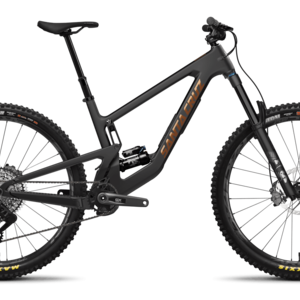
2026 RMU Outdoors Nighttrain XT Di2 FOX Factory Bike


If you’re not big into skiing, you’d be forgiven for thinking Rocky Mountain Underground must have something to do with industry veteran Rocky Mountain Bicycles. On the contrary, this is RMU’s first-ever bicycle. Born of a self-described obsession with mountain biking, RMU aims to bring its boutique manufacturing passion to mountain biking with the Nightrain—a 170mm, 29-inch “freeride/enduro crossover machine.”
While no single feature of the Nightrain is particularly out of the box in 2026, its combination of 6-bar, mid-pivot, dual-chain, dual-idler, flex-pivot, size-specific geometry, and industrial looks offers plenty to gnaw on for those infatuated with the obscure.
Nighttrain Highlights
- 170mm of rear wheel travel // 170 to 190mm fork travel
- Mid-pivot, 6-bar flex-stay Orion suspension platform with dual idler drivetrain layout
- 6066-T6 aluminum frame
- 29-inch wheels (mullet compatible)
- 63° head tube angle
- Size-specific chainstay lengths
- 12x157mm SuperBoost rear spacing
- Four sizes: S1, S2, S3, S4
- Lifetime frame warranty
- Weight (size S4 w/o pedals): XT Di2 - 37.8 lb (17.15 kg)
- MSRP (USD): XT Di2 - $7,499 | Frameset w/ FOX Factory X2 or Cane Creek Kitsuma shock - $2,499
Strengths | Weaknesses |
|
|

Rocky Mountain Underground started selling limited handmade skis out of a Breckenridge garage in 2008, quickly growing to full production runs within two years. Nearly two decades later, they’re entering the mountain bike scene ostensibly following the same path with the Nighttrain, the first of a whole line of mountain bikes to use Dave Weagle’s Orion suspension.
Orion Suspension Design
When I first read the press release for the Nighttrain, I admittedly thought it was a joke at Dave Weagle’s expense. How many gimmicks could possibly be stuffed into one bike? It was an easy ‘yes’ to test the bike.
Dave Weagle and RMU make a lot of colorful, if not ambiguous, claims about what the Orion suspension platform offers—more balance, more compliance, more predictability. It’s not clear what the baseline is or how much more is being offered, but it is clear they’re using all the tools at their disposal to achieve it.


While little is known about the Nighttrain's kinematics, the heart of the suspension platform is the mid-pivot dual-idler. By splitting the drivetrain into two, Weagle claims he had more freedom to design a bike free from compromise. There was a lot of confusion around the Nighttrain's chainstay growth when it was first announced. A 30mm number got thrown around erroneously and has since been scrubbed from the internet. While total horizontal chainstay growth isn’t published, RMU provides the chainstay length at static and 40% travel, with a 13mm growth across all sizes.
The Orion platform is designed to be drivetrain brand agnostic; however, the use of a proprietary 27T chainring available exclusively in Raceface Cinch and SRAM 8-bolt significantly limits crank options.
Geometry
The Nighttrain's geometry is firmly contemporary. Average stack, a steep seat angle, and a roomy front end should all be familiar to anyone that’s ridden a mountain bike from this decade. Size-specific chainstays that grow 11mm across the four sizes show RMU is tapped into current trends, and a 63° head angle reveals the bike’s intent.
Despite being so buzzword-dense, the bike has no geometry adjustments. RMU officially lists the Nighttrain as mullet-compatible and recommends a +1.0° angleset headset to maintain steering characteristics; however, the absence of flip chips means shorter riders seeking more rear tire clearance will likely compromise bottom bracket height and seat angle.

Other Frame Details
One small detail that sets the Nighttrain apart, and hints at its target demographic, is the option to run cables internally or externally—home mechanics rejoice. All four sizes can fit a slammed 200mm dropper post, again alluding to the bike’s intentions. UDH ensures compatibility with all the key drivetrain players, while a Super Boost 157mm rear hub may limit complete wheel options. In addition to affirming the structural value of Super Boost, Weagle claims 157mm was necessary to let RMU use the same rear triangle with some yet-to-be-announced E-bikes that are to follow.


Build Kits
The Nighttrain is primarily available as a frameset for $2,499 that includes a FOX Factory Float X2 or Cane Creek Kitsuma shock. The frameset includes a RaceFace or SRAM chainring, and you can add RaceFace Turbine cranks or switch to EXT suspension—both with an upgrade fee. One complete build option—the XT Di2 FOX Factory build—starts at $7,499. It features a FOX Factory 38 fork, Shimano XT Di2 drivetrain, TRP EVO Pro brakes, RaceFace Turbine wheels, a OneUp V3 dropper post, and Maxxis EXO+ casing tires.
RMU has consolidated its build options and adjusted pricing since launch—the Deore and Saint DH builds have been eliminated, and the XT Di2 gets some upgrades and a $500 price correction. Our test bike came fitted with an assortment of parts that differ from the available build, and it weighed 37.8 pounds (17.15 kg).
On the Trail
Climbing Performance
No one is buying an aluminum 29-inch freeride bike expecting it to be light. Still, there is no getting around the heft of the Nighttrain. At 37.8 pounds (17.15 kg) with Maxxis EXO+ casing tires, the Nighttrain isn't destined to rocket to the top of any ascent.
Dave-Weagle claims the Nighttrain is an exceptionally efficient climber thanks to the freedom enabled by the dual-idler suspension layout. That may be true; once you overcome the bike's weight, any extra pedal power seemed to go straight to the tire—a modest bob while pedaling indicated that the suspension was active rather than standing up or becoming explicitly firm. I got the sense that chain tension had little to do with the Nighttrain's pedaling stability; instead, it relied on the linkage layout to deliver the appropriate anti-squat.

The seated position was upright and comfortable without feeling cramped when pedaling out of the saddle. The 451mm chainstay of my S4 kept weight on the front wheel, combating any wheel wander from the 63° head tube angle. Once I settled on 23% sag (more on that later), the 348.5mm bottom bracket and 27T chainring provided tons of ground clearance, making technical climbs a breeze. Speaking of that 27T chainring, it's actually more like a 31.5T chainring thanks to the 20T/17T idler pulley combination. While that's likely more than reasonable with mullet wheels, I found it too large for the 29-inch rear wheel. Unfortunately, there is no alternative, as RMU only offers the one chainring size.
Descending Performance
The Nighttrain fit was upright, balanced, and comfortable. The 451mm chainstay on the S4 paired with the chainstay growth from the mid-pivot made it easy to stay centered when diving into corners or pushing through g-outs.
I found the Orion suspension to be quite linear. The Nighttrain easily used all 170mm of its travel, sinking deep under braking, and packing up over consecutive compressions. After confirming I was comfortably within RMU’s suggested sag of 25-30%, I looked for a damping solution. More compression to resist bottom out, less high-speed rebound to avoid getting stuck deep in the travel. This corrected the bottom bracket height through low-speed events, but it made the bike feel unsettled during high-speed events. Ultimately, increasing pressure was the solution, and I settled at 23% sag. Following this change, the Nighttrain started to make a lot of sense to me.

The Orion suspension made light work of big compressions and square edge hits, maintaining exceptional traction over harsh chatter while effortlessly holding a line. Despite a significant increase in spring rate, the suspension stayed supple off the top. The aluminum chassis was comfortable and predictable without being noticeably stiff or excessively compliant. I found the bike to be very responsive to pumping, returning energy instead of swallowing it like other high pivot bikes can be known to do. That responsiveness also translated to the bike’s trail manners, effortlessly popping off side hits and airing out of corners.
The Nighttrain still tended to squat into its travel when braking, sending some feedback through the chassis. However, some of what I experienced may be due to the subpar Shimano XT Di2 drivetrain—the lack of spring tension in the derailleur allowed the chain to collide with the chainstay, exposing a gap in the integrated frame protection and sending unpleasant feedback through the aluminum chassis.

One thing I couldn’t tune my way out of was excess noise when descending. Because the RMU can’t use a narrow-wide chainring due to the odd number of teeth, there is more room between the chainring teeth and chain. This allows the primary chain to audibly slip forward and back ever so slightly. The Nighttrain’s internal frame routing also contributed to the noise out on the trail. The absence of any internal guide tubes or cable-securing port clamps allowed the dropper and brake housing to rattle freely inside the frame. Luckily, the Nighttrain also features external cable guides for those who value easy maintenance over a slightly cleaner aesthetic.
Build Kit Analysis
The main commonalities between our test bike and the offered build are the XT Di2 drivetrain and FOX Factory suspension. My experience with FOX has been hit or miss in recent years; quality control issues have tainted what was once a very positive experience with the brand. Luckily, the Nighttrain's suspension was free of binding or premature wear, delivering a consistent, reliable experience.

I consider the current generation of XT drivetrain to be a pretty big miss from Shimano. The derailleur proved sensitive to strikes that SRAM Transmission would have shrugged off, and the excessive derailleur noise is so distracting it's hard to focus on anything else. The overall experience aligns with my memory of early GX drivetrains that came on significantly cheaper bikes nearly a decade ago. Because of this, I would not consider buying the complete build. At $2,500, the frame-only option is much more competitive with contemporary alloy frames such as Transition’s Spire, and significantly cheaper than other boutique frames with 6-bar designs like Atherton’s A.170. That said, RMU’s target customer is probably the type of rider who wants to build their own bike anyway.
Long-Term Durability
The frame hardware stayed in place throughout testing, and no creaks or roughness developed in any of the many links and bearings. The idler pulleys and extra chain proved to be sensitive to lubrication but otherwise remained trouble-free—though cleaning the inner 17T pulley after a mudder may be a headache. If I were building one of my own, I would use the frame's external cable routing and run a SRAM drivetrain to cut noise and let the Nighttrain’s calm demeanor shine.

What's The Bottom Line?
The RMU Nighttrain is an exceptional first attempt at a mountain bike, delivering nimble handling and raw downhill prowess. Despite flashy gimmicks, the Nighttrain can satisfy the needs of most core big-mountain enduro riders. While I wasn’t too jazzed with the performance and noise of the XT Di2 build, the approachable price point of the frameset gives customers willing to look past the weight the freedom to get the most out of the chassis. Those looking to build a modern, unique, capable enduro bike—or hoping to do double duty at the bike park and on their nastiest enduro trails—should consider RMU for their next purchase.
Vital Rating: 4.3/5
- Fun Factor: 4.5
- Descending Performance: 4.5
- Climbing Performance 4.0
- Frame Details: 4.0
- Value: 4.5
About The Reviewer
Blake Motley - Age: 27 // Years Riding MTB: 17 // Height: 6'2 (1.88m) // Weight: 190 pounds (86.2kg)
Coming from a long tradition of Socal never-was downhill racers, Blake has spent the better part of the last decade complaining about the bike industry. A full-time engineer during the day and part-time van bum on the weekends, he usually spends his free time riding E-bikes and telling forum users their bars are too low.

Specifications
• Chainstay lengths at 40% travel: 440mm (S1/SM), 443mm (S2/MD), 447mm (S3/LG), 451mm (S4/XL)
• Compatible with mixed ("Mullet") wheels: 29" front, 27.5" rear
• All specifications listed are with 170mm travel fork
Options: EXT Vecta Coil, EXT Storia V4
Rotors: TRP RS05E, 2.3mm thick, 203mm
Rear: Maxxis Minion DHR II, 3C MaxxTerra compound, DoubleDown (DD) casing, 29" x 2.4"
Drop: 150mm (SM), 180mm (MD), 210mm (LG), 240mm (XL)
• Universal rear drivetrain compatibility by physically decoupling the crankset from the rear shifting system, with dual idler layout
• Compatible with mixed ("Mullet") wheels: 29" front, 27.5" rear
• External cable routing with internal dropper seatpost routing
• Weight listed for size S2/MD
• Includes RMU Outdoors Pint Bag for on-trail essentials
• Includes tubeless valves and sealant
• Photos show custom build




40 comments
Post a reply to: RMU’s Inaugural Nighttrain Tested