Hey Jerry,
Seems like its the black version thats going forward then... you wouldn't happen to have noticed if any of them were running a new...
Hey Jerry,
Seems like its the black version thats going forward then... you wouldn't happen to have noticed if any of them were running a new brake lever?
Ever since the Trickstuff and Cascade boutique stuff came on the scene, I've thought it was only a matter of time until sram made a brake that could at least equal the supposed power of trickstuff but at a more realistic price point.
I run the Cascade North Fork calipers and they do feel more powerful, but I wouldn't say its an enormous night and day difference. I've never tried the Trickstuff Maximas but do wonder how much better they can really be.
The fact that Cascade basically just made a caliper using larger pistons to be used with the code lever, I've always been expecting Sram to simply do the same with something mass produced and probably kill off Cascades caliper. Nothing stopping them from doing it...
The new black caliper does somehow look a lot bigger than the current code caliper. I'm wondering how big those pistons will be.
I've got to say I've always expected a new Code caliper to pop up that does the same thing as ours. Hasn't happened yet. Kind of...
I've got to say I've always expected a new Code caliper to pop up that does the same thing as ours. Hasn't happened yet. Kind of funny considering it's specifically designed to work with Sram parts you can find in bike shops. Whatever this new Sram brake is will determine the future of our Code caliper.
I think the upper limit on brake power will be set by what is a reasonable amount of pad retract. I can't foresee people being okay with pad rub all the time so I don't think pad retract can get much less that what we use on our calipers. If you assume all calipers can be fitted with pads that have the best possible stopping power, braking power then just becomes a ratio of piston area to master cylinder area. The larger you make that ratio the more lever throw you have for a given pad retract. The only way to keep lever throw in check with a larger ratio is decreasing pad retract. Stuff like Swinglink can help, but the more aggressively you make it move through low end braking the more hand fatigue you get riding trails where you're trailing the brakes a lot. This is something we are pretty transparent about with our brake cams. You could potentially have a brake caliper with higher ultimate braking power than another that actually results in a higher average finger force in typical riding conditions. That's when this sort of mechanism would have gone too far. Max braking might be a 3000ish psi but more often than not you're at 1/2 to 3/4 of that. It's really only accessible when you're braking in a compression or the wheels just lock up.
Anybody working on increasing the friction coefficient between the pads and the rotor? Seems like this would be a possible path towards more power (if it's really needed considering the grip issue you mention). Or towards more pad retraction.
The latest photos of the unreleased sram caliper, the black one that looks a bit like the original Code caliper. It seems to look quite different...
The latest photos of the unreleased sram caliper, the black one that looks a bit like the original Code caliper. It seems to look quite different from the previous prototype that was red with paint splat effect over it. The shapes around the pistons are different, the latest black one is flatter and the red one had some unusual looking shapes on it. The piston area had bulges in the middle that the latest black one doesn't have.
I'm guessing the current Code is staying and this will be released as a dh specific brake, but it's interesting that theres been no spy shots of any completely new lever designs to go with this new caliper.
I know the new code lever is different but its only changed to be closer to the bars, apparently the internals have not changed.
Does anyone know if the red one is still being spotted being tested out in the wild by pros? Anyone have any ideas on what the bulges on the red one were all about?
I'm hoping the eventual production version looks more like the red one but it seems the black one has a model name which suggests thats the version they are going with?
The latest photos of the unreleased sram caliper, the black one that looks a bit like the original Code caliper. It seems to look quite different...
The latest photos of the unreleased sram caliper, the black one that looks a bit like the original Code caliper. It seems to look quite different from the previous prototype that was red with paint splat effect over it. The shapes around the pistons are different, the latest black one is flatter and the red one had some unusual looking shapes on it. The piston area had bulges in the middle that the latest black one doesn't have.
I'm guessing the current Code is staying and this will be released as a dh specific brake, but it's interesting that theres been no spy shots of any completely new lever designs to go with this new caliper.
I know the new code lever is different but its only changed to be closer to the bars, apparently the internals have not changed.
Does anyone know if the red one is still being spotted being tested out in the wild by pros? Anyone have any ideas on what the bulges on the red one were all about?
I'm hoping the eventual production version looks more like the red one but it seems the black one has a model name which suggests thats the version they are going with?
Completely new lever you were saying hasn’t been captured. Surprised no one seemed to cover it. (I posted this same picture on here like 2 weeks...
Completely new lever you were saying hasn’t been captured. Surprised no one seemed to cover it. (I posted this same picture on here like 2 weeks ago)
Isn't that the new lever that's already out? Someone mentioned earlier it's just a "pushed back" Code RSC. The fat part looks just like my normal Code RSC lever.
GODDAM this is annoying. The whole point is that thanks to the rear mech mounting to the axle a hanger is NO LONGER NEEDED. The frames...
GODDAM this is annoying. The whole point is that thanks to the rear mech mounting to the axle a hanger is NO LONGER NEEDED. The frames still use a UDH mount and tolerances that have been in use for years now. How many UDH frames have you seen where the axle doesn't thread in due to mis alignment? how many frames have wheels off centre due to bad UDH tolerances? The square root of F'All. Most misalignment comes from poorly produced.....................hangers. If the mech is out of alignment with this system, there is a whole lot of F'wittery going on.
Now let's think about the whole direct mount ruining a frame. If you hit a rock hard enough to smash one of these deraileurs, I dare say your frame is going to be ruined anyway....
Some real world experience trickling in...
My buddy has a new SB160 with a set of 2022 Race Face Turbine wheels (straight pull Vault hubs) pulled from his previous bike (Orbea Rallon).
Shop goes to install XX transmission and when they tighten down the rear axle, the cassette rubs the transmission derailleur. After a bit of head scratching, the conclusion is the hub tolerances are off and the hub isn't wide enough on the drive side (my guess is less than .5mm, getting some very thin shims to test it out). Switched the cassette to a different wheel, all worked fine.
The transmission system expects there to be a very specific distance between the back of the cassette (where it contacts the hub) and the end of the hub (where it contacts the derailleur) in order for everything to line up. If those tolerances are off, you've got issues.
The shop called Race Face and they are aware of the issue. My guess is they'll need to manufacture some different end caps to solve the issue.
Oh that's an easy fix sir. Transmission was made to be simple to install for any customer and work well from the get go without complicated adjustments. It will adjust itself. Just tighten the axle properly, don't touch the wheel. If it seems to be rubbing, Transmission will push the dropout a little bit to create the necessary space it needs to work properly, and will keep this adjustment perfect forever. No need to play with shims or take out the grinder, just trust your new Transmission, go for an epic ride and enjoy your new trouble-free drivetrain.
The latest photos of the unreleased sram caliper, the black one that looks a bit like the original Code caliper. It seems to look quite different...
The latest photos of the unreleased sram caliper, the black one that looks a bit like the original Code caliper. It seems to look quite different from the previous prototype that was red with paint splat effect over it. The shapes around the pistons are different, the latest black one is flatter and the red one had some unusual looking shapes on it. The piston area had bulges in the middle that the latest black one doesn't have.
I'm guessing the current Code is staying and this will be released as a dh specific brake, but it's interesting that theres been no spy shots of any completely new lever designs to go with this new caliper.
I know the new code lever is different but its only changed to be closer to the bars, apparently the internals have not changed.
Does anyone know if the red one is still being spotted being tested out in the wild by pros? Anyone have any ideas on what the bulges on the red one were all about?
I'm hoping the eventual production version looks more like the red one but it seems the black one has a model name which suggests thats the version they are going with?
Isn't that the new lever that's already out? Someone mentioned earlier it's just a "pushed back" Code RSC. The fat part looks just like my normal...
Isn't that the new lever that's already out? Someone mentioned earlier it's just a "pushed back" Code RSC. The fat part looks just like my normal Code RSC lever.
Looks a lot more like a DB8 lever with the swing link and contact point adjustment and rotated under the bar.
Anybody working on increasing the friction coefficient between the pads and the rotor? Seems like this would be a possible path towards more power (if it's...
Anybody working on increasing the friction coefficient between the pads and the rotor? Seems like this would be a possible path towards more power (if it's really needed considering the grip issue you mention). Or towards more pad retraction.
Hm, aren't there already plenty of pad manufacturers selling pads with varying CoF? And brake rotors with different designs? Like a lot of small holes vs few big holes etc.
Oh that's an easy fix sir. Transmission was made to be simple to install for any customer and work well from the get go without complicated...
Oh that's an easy fix sir. Transmission was made to be simple to install for any customer and work well from the get go without complicated adjustments. It will adjust itself. Just tighten the axle properly, don't touch the wheel. If it seems to be rubbing, Transmission will push the dropout a little bit to create the necessary space it needs to work properly, and will keep this adjustment perfect forever. No need to play with shims or take out the grinder, just trust your new Transmission, go for an epic ride and enjoy your new trouble-free drivetrain.
Solid advice. I’m sure the wheel drag will disappear within the first few miles. Once some pesky metal wears away.
Anybody working on increasing the friction coefficient between the pads and the rotor? Seems like this would be a possible path towards more power (if it's...
Anybody working on increasing the friction coefficient between the pads and the rotor? Seems like this would be a possible path towards more power (if it's really needed considering the grip issue you mention). Or towards more pad retraction.
I'd be surprised if any innovation in this area came from mtb. Automotive (and motorsports) spends a lot more on r&d for this than bike companies ever could.
Anybody working on increasing the friction coefficient between the pads and the rotor? Seems like this would be a possible path towards more power (if it's...
Anybody working on increasing the friction coefficient between the pads and the rotor? Seems like this would be a possible path towards more power (if it's really needed considering the grip issue you mention). Or towards more pad retraction.
Hm, aren't there already plenty of pad manufacturers selling pads with varying CoF? And brake rotors with different designs? Like a lot of small holes vs...
Hm, aren't there already plenty of pad manufacturers selling pads with varying CoF? And brake rotors with different designs? Like a lot of small holes vs few big holes etc.
Holes don't really impact the situation that much, using a bigger rotor helps a lot more.
As for CoF, I was aiming at a paradigm shift, maybe using wholly different materials for the rotors or something like that. If possible. The idea was to for example double the CoF, that would allow pad retract to be twice as big or bigger than now and have a more linear brake characteristic which, based on Cascade comments, would make for a more predictable system with better modulation?
Anybody working on increasing the friction coefficient between the pads and the rotor? Seems like this would be a possible path towards more power (if it's...
Anybody working on increasing the friction coefficient between the pads and the rotor? Seems like this would be a possible path towards more power (if it's really needed considering the grip issue you mention). Or towards more pad retraction.
I'd be surprised if any innovation in this area came from mtb. Automotive (and motorsports) spends a lot more on r&d for this than bike companies...
I'd be surprised if any innovation in this area came from mtb. Automotive (and motorsports) spends a lot more on r&d for this than bike companies ever could.
Motorsports has a lot more tricks up their sleeves (carbon brakes for example). Motorsports isn't particularly relevant for either automotive or bicycle use though due to the nature of the use of the brakes (possibly applicable for DH if they could warm up their brakes...).
With automotive applications you either run a brake booster boosting the force applied to the master cylinder through the vacuum taken off the intake plenum, by a separate vacuum pump to drive the brake booster (early Teslas), electric brake booster (later teslas/EVs, once the production numbers got large enough for Tier1s to provide a system) or just use a brake by wire system.
TL;DR: automotive applications have multiple methods of increasing the power applied to the pedal itself which isn't applicable to bikes.
How does this problem look like with motor bikes? As far as I understand it one finger braking isn't really a thing with motorbikes?
Isn't that the new lever that's already out? Someone mentioned earlier it's just a "pushed back" Code RSC. The fat part looks just like my normal...
Isn't that the new lever that's already out? Someone mentioned earlier it's just a "pushed back" Code RSC. The fat part looks just like my normal Code RSC lever.
The bleed port has a much bigger screw, in line with the DB8 master cylinder:
The grommet for the hose is different, the general shape of the housing is different, sculpted differently, it's not just all black with the Code RSC being ground for the silver inlay.
Holes don't really impact the situation that much, using a bigger rotor helps a lot more.
As for CoF, I was aiming at a paradigm shift...
Holes don't really impact the situation that much, using a bigger rotor helps a lot more.
As for CoF, I was aiming at a paradigm shift, maybe using wholly different materials for the rotors or something like that. If possible. The idea was to for example double the CoF, that would allow pad retract to be twice as big or bigger than now and have a more linear brake characteristic which, based on Cascade comments, would make for a more predictable system with better modulation?
That or use a brake booster
I've read before, that it is pretty simple to make pads with a lot higher CoF, but it always comes with drawback, like a lot of brake dust, noise, and obviously loss of modulation. The last point imho is only issue with some brake brands (Shimano) that have poor modulation to begin with or beginner riders. Other than that, you will adapt to new power level in matter of few minutes of braking. What would be and really should be normal is stating on pads that are available what CoF is, ideally with graph for CoF/temp. Relationship. Just like most motorsport brands do.
You could boost your brake's abilities to shed heat by taping one of those handheld fans to your seatstay pointed at your brakes. Can't believe no one's tried that yet. Plus they come with a built-in watercooling feature, which is JDMAF.
Eh, simple. Make them electrically unclamped so the failsafe is full braking force (kinda like pneumatic brakes on a truck). Problem solved.
Since were all going to be riding E-bikes in 5 years anyway just use the engine braking as the failsafe, have the chain always moving, and the minute you stop pedalling it will turn the motor at the cranks into a generator, recharging your battery and slowing you down. Want to go faster? Just pedal, the minute you stop pedalling your start braking.
Oh that's an easy fix sir. Transmission was made to be simple to install for any customer and work well from the get go without complicated...
Oh that's an easy fix sir. Transmission was made to be simple to install for any customer and work well from the get go without complicated adjustments. It will adjust itself. Just tighten the axle properly, don't touch the wheel. If it seems to be rubbing, Transmission will push the dropout a little bit to create the necessary space it needs to work properly, and will keep this adjustment perfect forever. No need to play with shims or take out the grinder, just trust your new Transmission, go for an epic ride and enjoy your new trouble-free drivetrain.


Anybody working on increasing the friction coefficient between the pads and the rotor? Seems like this would be a possible path towards more power (if it's really needed considering the grip issue you mention). Or towards more pad retraction.
looks like the new caliper there as well
Isn't that the new lever that's already out? Someone mentioned earlier it's just a "pushed back" Code RSC. The fat part looks just like my normal Code RSC lever.
Some real world experience trickling in...
My buddy has a new SB160 with a set of 2022 Race Face Turbine wheels (straight pull Vault hubs) pulled from his previous bike (Orbea Rallon).
Shop goes to install XX transmission and when they tighten down the rear axle, the cassette rubs the transmission derailleur. After a bit of head scratching, the conclusion is the hub tolerances are off and the hub isn't wide enough on the drive side (my guess is less than .5mm, getting some very thin shims to test it out). Switched the cassette to a different wheel, all worked fine.
The transmission system expects there to be a very specific distance between the back of the cassette (where it contacts the hub) and the end of the hub (where it contacts the derailleur) in order for everything to line up. If those tolerances are off, you've got issues.
The shop called Race Face and they are aware of the issue. My guess is they'll need to manufacture some different end caps to solve the issue.
Anyone else run into similar hub issues yet?
Oh that's an easy fix sir. Transmission was made to be simple to install for any customer and work well from the get go without complicated adjustments. It will adjust itself. Just tighten the axle properly, don't touch the wheel. If it seems to be rubbing, Transmission will push the dropout a little bit to create the necessary space it needs to work properly, and will keep this adjustment perfect forever. No need to play with shims or take out the grinder, just trust your new Transmission, go for an epic ride and enjoy your new trouble-free drivetrain.
Looks a lot more like a DB8 lever with the swing link and contact point adjustment and rotated under the bar.
Hm, aren't there already plenty of pad manufacturers selling pads with varying CoF? And brake rotors with different designs? Like a lot of small holes vs few big holes etc.
Solid advice. I’m sure the wheel drag will disappear within the first few miles. Once some pesky metal wears away.
I'd be surprised if any innovation in this area came from mtb. Automotive (and motorsports) spends a lot more on r&d for this than bike companies ever could.
Holes don't really impact the situation that much, using a bigger rotor helps a lot more.
As for CoF, I was aiming at a paradigm shift, maybe using wholly different materials for the rotors or something like that. If possible. The idea was to for example double the CoF, that would allow pad retract to be twice as big or bigger than now and have a more linear brake characteristic which, based on Cascade comments, would make for a more predictable system with better modulation?
That or use a brake booster
Motorsports has a lot more tricks up their sleeves (carbon brakes for example). Motorsports isn't particularly relevant for either automotive or bicycle use though due to the nature of the use of the brakes (possibly applicable for DH if they could warm up their brakes...).
With automotive applications you either run a brake booster boosting the force applied to the master cylinder through the vacuum taken off the intake plenum, by a separate vacuum pump to drive the brake booster (early Teslas), electric brake booster (later teslas/EVs, once the production numbers got large enough for Tier1s to provide a system) or just use a brake by wire system.
TL;DR: automotive applications have multiple methods of increasing the power applied to the pedal itself which isn't applicable to bikes.
How does this problem look like with motor bikes? As far as I understand it one finger braking isn't really a thing with motorbikes?
Looks like an all black any-of-the-stealth levers to me. Which looks close to the normal Code SCR but "stealth".
Definitely not the same lever:

The bleed port has a much bigger screw, in line with the DB8 master cylinder: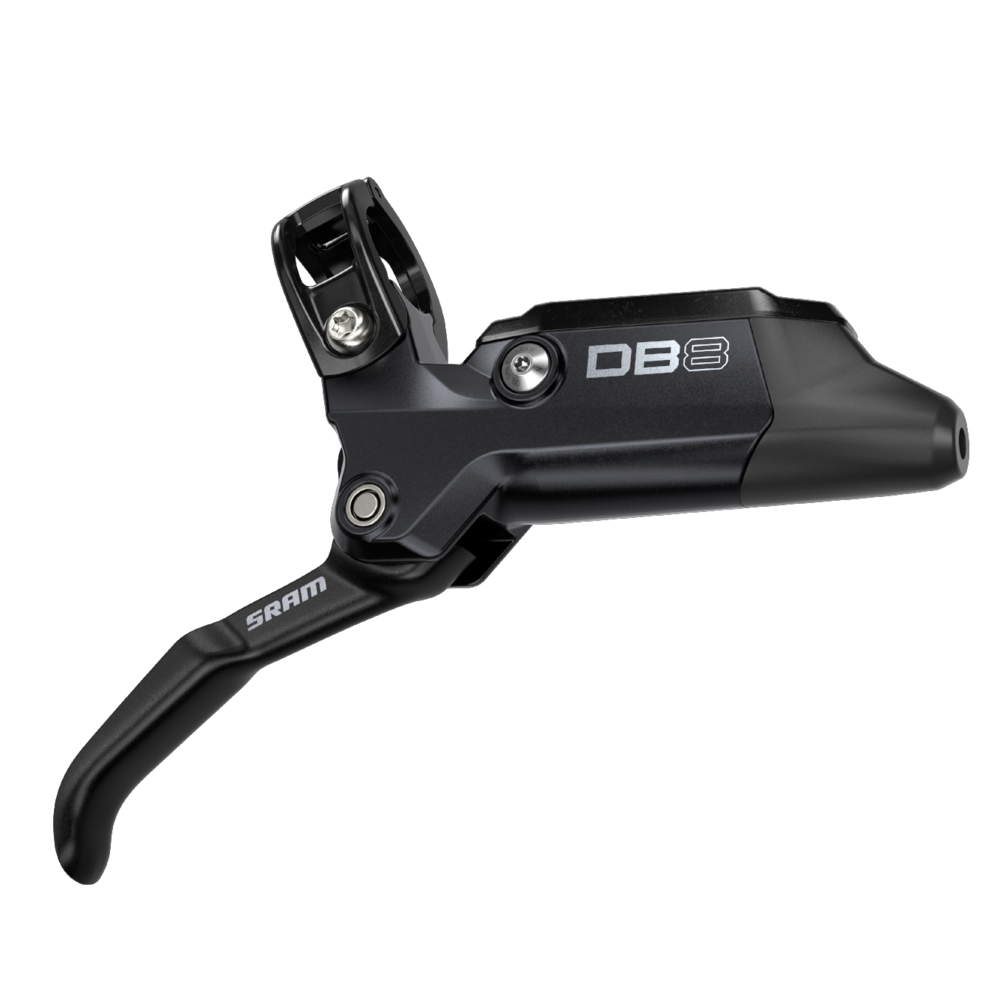
The grommet for the hose is different, the general shape of the housing is different, sculpted differently, it's not just all black with the Code RSC being ground for the silver inlay.
I've read before, that it is pretty simple to make pads with a lot higher CoF, but it always comes with drawback, like a lot of brake dust, noise, and obviously loss of modulation. The last point imho is only issue with some brake brands (Shimano) that have poor modulation to begin with or beginner riders. Other than that, you will adapt to new power level in matter of few minutes of braking. What would be and really should be normal is stating on pads that are available what CoF is, ideally with graph for CoF/temp. Relationship. Just like most motorsport brands do.
I really think someone needs to dive into the brake by wire solution for MTB. We’re already adding electronics so it seems like a logical evolution.
You could boost your brake's abilities to shed heat by taping one of those handheld fans to your seatstay pointed at your brakes. Can't believe no one's tried that yet. Plus they come with a built-in watercooling feature, which is JDMAF.
Everything can be electrical on a bike but brakes are a NO GO.
You can't afford to run out a battery on brakes and this isn't a car or a motorcycle where electricity is constantly generated.
Eh, simple. Make them electrically unclamped so the failsafe is full braking force (kinda like pneumatic brakes on a truck). Problem solved.
I think a lot of good sarcasm is being wasted on this thread.
hahaha can't wait to see you mid-run going "SpaceX" after your brakes decide to go full stop
Since were all going to be riding E-bikes in 5 years anyway just use the engine braking as the failsafe, have the chain always moving, and the minute you stop pedalling it will turn the motor at the cranks into a generator, recharging your battery and slowing you down. Want to go faster? Just pedal, the minute you stop pedalling your start braking.
My pleasure. Absolutely, it's engineered so that just the right amount of metal wears away to alleviate Tolerance Stacking.
I think you two forgot about carbon also wearing away
our automatic shifting and shift-without-pedaling xt di2 feature is here (for ebikes only)
https://www.vitalmtb.com/features/automatic-and-pedal-free-emtb-shiftin…
Forbidden IG story has team photo with new bike
I'm sure the new Forbidden flipped Horst-link (or whatever it is) functions better, but it definitely takes a hit aesthetically.
that bottom bracket area looks like it‘s housing a motor, way too massive!
Release must be getting closer, there are shops listing an alumnium entry model:
https://www.mtbiker.shop/shop/bikes/mountain-bikes/full-suspension/gt-s…
What brand is that? Doesn’t look like anything I could think of but has some similarities to a lot of current models