So this just came across my feed....steering linkage so you can have "shorter wheelbase, yet increased reach and stack".......apparently what's old is new again?
So this just came across my feed....steering linkage so you can have "shorter wheelbase, yet increased reach and stack".......apparently what's old is new again?
So this just came across my feed....steering linkage so you can have "shorter wheelbase, yet increased reach and stack".......apparently what's old is new again?
So this just came across my feed....steering linkage so you can have "shorter wheelbase, yet increased reach and stack".......apparently what's old is new again?
Is that front brake a 180mm rotor with single pistons? So some large rider that actually needs a 32" is going to get on this thing...
Is that front brake a 180mm rotor with single pistons? So some large rider that actually needs a 32" is going to get on this thing and get it rocking up to speed....an have absolutely no way of slowing it down. How not to sell bike from your demo rides 101.
I don't recall needing to go larger rotor size between 26 and 29. I'm still 150lbs and that's the main energy that needs to be dissipated...
I don't recall needing to go larger rotor size between 26 and 29. I'm still 150lbs and that's the main energy that needs to be dissipated. I don't see 32" bikes needing 200mm rotors for XC riding.
Leverage. That bigger wheel is a longer lever. That 180mm rotor that was okay on 26" has 19% less power (for the same hand force) on...
Leverage. That bigger wheel is a longer lever. That 180mm rotor that was okay on 26" has 19% less power (for the same hand force) on a 32" wheel. To get the same braking force on the 32" bike with the 180mm rotor you need to squeeze 23% more at the lever. That doesn't yet take into account a 200lb rider vs your 150lb.
I don’t think it works out quite that simply in practice but I could be wrong. And I’d agree a riders weight is going to be a much bigger input versus wheel and rotor size when it comes to braking forces.
In my experience bigger wheels offer more clearance from the ground and bigger rotors offer more surface area to dissipate heat and more mass to heat up in the first place. I don’t there is much more to it than that.
Bigger rotors provide more braking torque to the wheel hub. Bigger wheels do the same in the other way. Proportionally larger rotors on larger wheels will give the same braking force on contact patch if the braking force on the caliper stays the same.
No qualms from me if yall wanna spend your money on 30.5 but this does have me concerned for 27.5 rear wheels. I spent years and multiple bikes on full 29 and now years and multiple bikes on mullet and just prefer the smaller rear wheel, even on short travel bikes.
I’m out here for the turns, not for speed and “efficiency”
No qualms from me if yall wanna spend your money on 30.5 but this does have me concerned for 27.5 rear wheels. I spent years and...
No qualms from me if yall wanna spend your money on 30.5 but this does have me concerned for 27.5 rear wheels. I spent years and multiple bikes on full 29 and now years and multiple bikes on mullet and just prefer the smaller rear wheel, even on short travel bikes.
I’m out here for the turns, not for speed and “efficiency”
For riding steeps, I don't think 27.5 will go away for anyone remotely average height. Getting your rear buzzed by a 29er can be scary, I can imagine getting circular sawed by a 30.5/32 would be worse.
Only way I’m interested is if I can stuff a 30.5 in my 29 fork. No chance I’m buying any new standards, especially when these goofs...
Only way I’m interested is if I can stuff a 30.5 in my 29 fork. No chance I’m buying any new standards, especially when these goofs launch 2 new sizes at once.
Looked it up and Google says ETRTO for 30.5 is 642, so only 10mm larger radius than 29’s 622. Would be tight but seems like you...
Looked it up and Google says ETRTO for 30.5 is 642, so only 10mm larger radius than 29’s 622. Would be tight but seems like you could probably stuff a lower volume 30.5 tire in without contacting the arch/crown/downtube at full compression.
Obviously manufacturers will recommend against it because what’s the point of a new standard if not to sell more parts…
From pinkbike: Asa Vermette's upcoming signature grips from Burgtec. They're Longneck-like, but have a slightly raised portion in the center, and a knurled pattern on the outer edge for extra grip.
I'll admit to being no physicist, but again, would the weight of the rider not be the largest qualifier for how much energy a brake system...
I'll admit to being no physicist, but again, would the weight of the rider not be the largest qualifier for how much energy a brake system needs in order to stop? The leverage over the wheel is in context to how much mass the wheel has, which given 29 vs 32 XC wheelsets have probably 200~g of difference when they're like for like, the stopping force is focused on the rider, not stopping the wheel.
If someone could break down the maths, would appreciate it.
I stated the 150lb part as I was 150 on 26, 150 on 27.5, and 150 on 29, and I've never felt a need to increase rotor size.
What matters here is the ratio of wheel diameter vs. rotor diameter. While the overall kinetic energy converted to heat is about the same, the force you need to make the wheel slow down changes when your lever does. Say you lock the lever at some position and try to spin the wheel by hand. If you spin it by the tire, it's much easier than spinning it by the rotor. The closer to the center you go, the harder you have to push to rotate the wheel against the braking force applied at rotor. Since the ground is the one trying to spin your wheel, the bigger the wheel, the bigger the lever you provide for the ground to overcome your clamping force.
I'll admit to being no physicist, but again, would the weight of the rider not be the largest qualifier for how much energy a brake system...
I'll admit to being no physicist, but again, would the weight of the rider not be the largest qualifier for how much energy a brake system needs in order to stop? The leverage over the wheel is in context to how much mass the wheel has, which given 29 vs 32 XC wheelsets have probably 200~g of difference when they're like for like, the stopping force is focused on the rider, not stopping the wheel.
If someone could break down the maths, would appreciate it.
I stated the 150lb part as I was 150 on 26, 150 on 27.5, and 150 on 29, and I've never felt a need to increase rotor size.
What matters here is the ratio of wheel diameter vs. rotor diameter. While the overall kinetic energy converted to heat is about the same, the force you...
What matters here is the ratio of wheel diameter vs. rotor diameter. While the overall kinetic energy converted to heat is about the same, the force you need to make the wheel slow down changes when your lever does. Say you lock the lever at some position and try to spin the wheel by hand. If you spin it by the tire, it's much easier than spinning it by the rotor. The closer to the center you go, the harder you have to push to rotate the wheel against the braking force applied at rotor. Since the ground is the one trying to spin your wheel, the bigger the wheel, the bigger the lever you provide for the ground to overcome your clamping force.


A little more info on Asa’s bars coming
Makes me want a DH race series for cargobikes😅
I don’t think it works out quite that simply in practice but I could be wrong. And I’d agree a riders weight is going to be a much bigger input versus wheel and rotor size when it comes to braking forces.
In my experience bigger wheels offer more clearance from the ground and bigger rotors offer more surface area to dissipate heat and more mass to heat up in the first place. I don’t there is much more to it than that.
Bigger rotors provide more braking torque to the wheel hub. Bigger wheels do the same in the other way. Proportionally larger rotors on larger wheels will give the same braking force on contact patch if the braking force on the caliper stays the same.
No qualms from me if yall wanna spend your money on 30.5 but this does have me concerned for 27.5 rear wheels. I spent years and multiple bikes on full 29 and now years and multiple bikes on mullet and just prefer the smaller rear wheel, even on short travel bikes.
I’m out here for the turns, not for speed and “efficiency”
Might be able to talk race organizers at SOC into a cargo-bike dual slalom event. They've done some other pretty ridiculous demo races.
For riding steeps, I don't think 27.5 will go away for anyone remotely average height. Getting your rear buzzed by a 29er can be scary, I can imagine getting circular sawed by a 30.5/32 would be worse.
Dust off that old 29+ fork tooling, yo!
paging Kirt Voreis
From pinkbike:
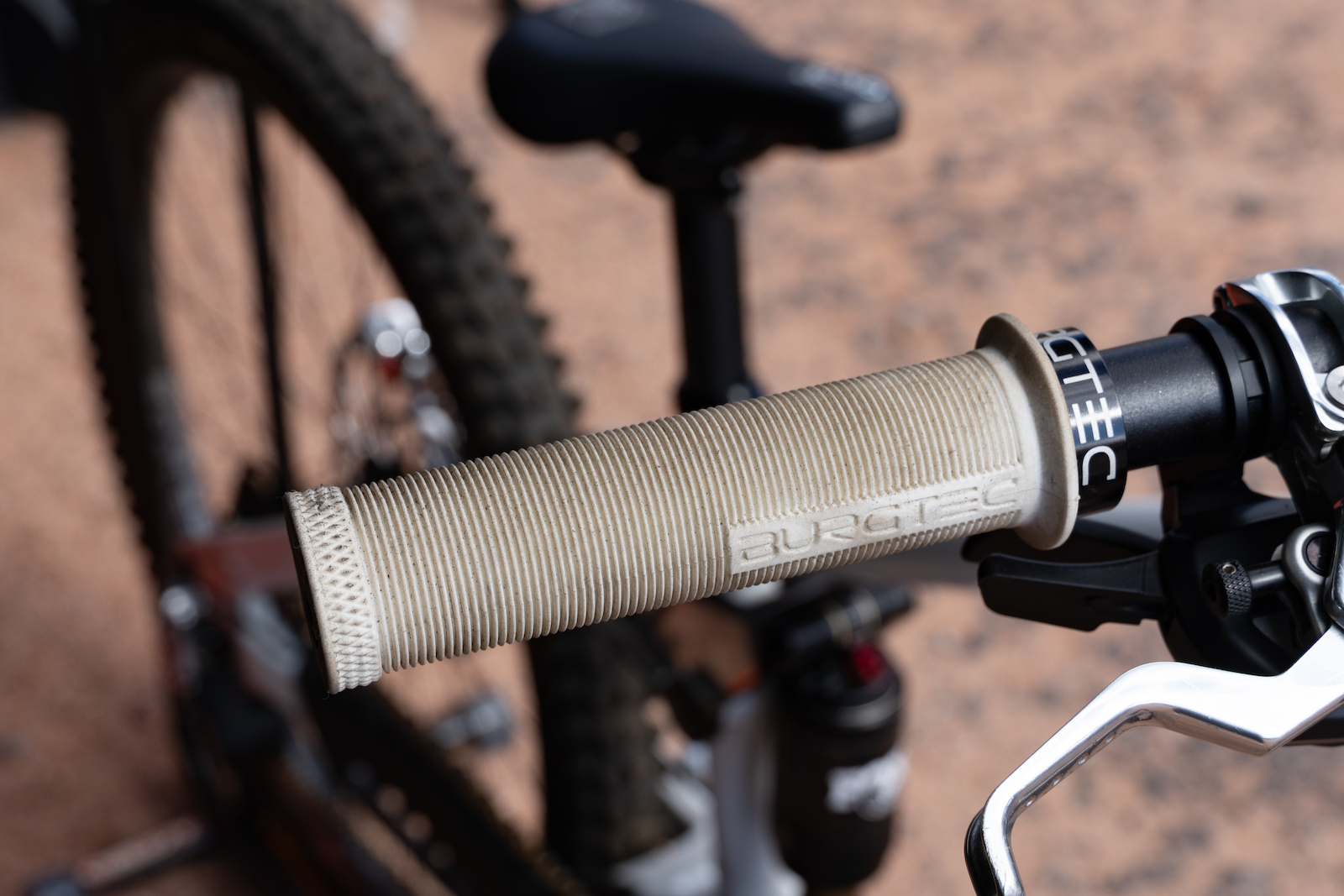
Asa Vermette's upcoming signature grips from Burgtec. They're Longneck-like, but have a slightly raised portion in the center, and a knurled pattern on the outer edge for extra grip.
What matters here is the ratio of wheel diameter vs. rotor diameter.
While the overall kinetic energy converted to heat is about the same, the force you need to make the wheel slow down changes when your lever does.
Say you lock the lever at some position and try to spin the wheel by hand. If you spin it by the tire, it's much easier than spinning it by the rotor. The closer to the center you go, the harder you have to push to rotate the wheel against the braking force applied at rotor.
Since the ground is the one trying to spin your wheel, the bigger the wheel, the bigger the lever you provide for the ground to overcome your clamping force.
Thats why (dry) V-brakes are the best! 👍
Post a reply to: 2026 MTB Tech Rumors and Innovation - Longer and Slacker