Why? What problem are you trying to solve?The beauty of the Rocky System is that you have both your pedaling power and the e-motor power acting...
Why? What problem are you trying to solve?
The beauty of the Rocky System is that you have both your pedaling power and the e-motor power acting on the same chain. It's quite a simple way of getting power to the rear wheel. What you're describing you have a motor acting directly on a chain, and then somehow you have to get your pedal power through to that same chain. Some kind of shaft inside? Something else? What benefit are you achieving by separating these two things? Whatever your solution, it sounds less efficient than what Rocky is doing.
I would be interested to hear from the Rocky motor designers if there would be some benefit to a fully split 2 chain system such as the Pivot 2 chains...which is what I assumed you were talking about...(and what people assume is going on with Speciazlied) but I don't really understand how/why you would try to make it work without a 2nd chain!
It’s purely a thought experiment. It seems like the trend of the last couple years for frame designers is reducing pedal kickback and/or the interaction between pedal forces and suspension movement. The prevalence of high pivots is a result of this. Taken a step further, Pivot and Specialized have done tons of work on their frame designs with 2 chain. I’m just curious if the 2 chain design could be taken even a step further if combined with an e-bike motor.
I wasn’t aware of their motor, I just took a look at it and it’s not exactly what I was trying to describe. It still uses...
I wasn’t aware of their motor, I just took a look at it and it’s not exactly what I was trying to describe. It still uses a traditional chainring and a chain going from the chainring to the cassette. What I’m asking about is basically the Specialized DH bike but with a motor. No chainring on the cranks with a chain connecting to the cassette. The cranks would somehow interface with the motor internally and a chain would connect the cassette to a sprocket which comes off the motor. No direct connection between the BB/cranks and the rear hub/cassette.
Why? What problem are you trying to solve?The beauty of the Rocky System is that you have both your pedaling power and the e-motor power acting...
Why? What problem are you trying to solve?
The beauty of the Rocky System is that you have both your pedaling power and the e-motor power acting on the same chain. It's quite a simple way of getting power to the rear wheel. What you're describing you have a motor acting directly on a chain, and then somehow you have to get your pedal power through to that same chain. Some kind of shaft inside? Something else? What benefit are you achieving by separating these two things? Whatever your solution, it sounds less efficient than what Rocky is doing.
I would be interested to hear from the Rocky motor designers if there would be some benefit to a fully split 2 chain system such as the Pivot 2 chains...which is what I assumed you were talking about...(and what people assume is going on with Speciazlied) but I don't really understand how/why you would try to make it work without a 2nd chain!
The 2nd chain allows you to use larger size sprockets and get better efficiency.
Traditional idler it's a packaging problem to get a large size idler in without going super high on the pivot location.
By using the 2 chains you can run ratios that would allow a mid pivot and avoid a 11/12t sprocket anywhere in the system.
With the Rocky system you could do something similar to the Specalized two chains and not have a visable chain on the cranks...but it would still be there. Rocky achieves a 2 stage gear reduction from the fast spinning motor by using the small drive cog with their main chain driven gear reduction. Off the motor you'd need a planetary/cyclodal/gear reduction that could achieve enough reduction to spin the larger drive ring at the right speeds. Someone would need to run some gear reduction math to see if it fits in the package space.
I guess it's cool that Brembo is probably definitely making the brakes on the spesh rigs but I'm really surprised so see this much hype about it. Like honestly tons of hype around it.
Similar to other brake discussions I really don't understand it. I'm not the gnarliest dude (by a lot) but I have codes on my bike now and have never ever wished I had a burlier brake. If I did I'd just buy saints??? I will always be impressed by the length of discussions people are willing to have regarding brakes, especially since the mavens released.
Any chance someone at the race can get a chainline photo of that spesh proto? It seems like the BB would either have to be super wide to accommodate the set up or its running a narrow rear end and everything's super tight?
Maybe a 142mm spacing with the chainring sitting equal to a 73mm and an 83mm wide BB?
Handling the crank to output ring (or whatever will drive the rear wheel) connection inside the drive unit casing should be fairly easy. Where it gets complicated is where do you out the output ring relative to the cranks? That very much defines the packaging of the complete bike and drives the suspension layout as well (pivot height).
This is something we have seen with gearboxes - Pinion was always concentric, Effigear used to do what you describe (and their layout was somewhat modular as their three shafts need not be in a straight line, so the height could be adjusted) but has recently gone with a concentric output as well.
I guess not everyone wants a high pivot or whoever wants one doesn't mind having an idler in there.
I guess it's cool that Brembo is probably definitely making the brakes on the spesh rigs but I'm really surprised so see this much hype about...
I guess it's cool that Brembo is probably definitely making the brakes on the spesh rigs but I'm really surprised so see this much hype about it. Like honestly tons of hype around it.
Similar to other brake discussions I really don't understand it. I'm not the gnarliest dude (by a lot) but I have codes on my bike now and have never ever wished I had a burlier brake. If I did I'd just buy saints??? I will always be impressed by the length of discussions people are willing to have regarding brakes, especially since the mavens released.
You are probably definitely in the wrong thread if you think everyone should be happy with codes or saints
I guess it's cool that Brembo is probably definitely making the brakes on the spesh rigs but I'm really surprised so see this much hype about...
I guess it's cool that Brembo is probably definitely making the brakes on the spesh rigs but I'm really surprised so see this much hype about it. Like honestly tons of hype around it.
Similar to other brake discussions I really don't understand it. I'm not the gnarliest dude (by a lot) but I have codes on my bike now and have never ever wished I had a burlier brake. If I did I'd just buy saints??? I will always be impressed by the length of discussions people are willing to have regarding brakes, especially since the mavens released.
Hi everyone, Andi Sykes here! I covered the China Cycle Show for Vital last week, and I've finally had time to edit some YouTube videos together...
Hi everyone, Andi Sykes here! I covered the China Cycle Show for Vital last week, and I've finally had time to edit some YouTube videos together of my coverage. Hope everyone is ok with me posting here, and please give me a shout if you have any questions about the bikes seen in China.
Hi all, here's Part 2 of my China Cycle 2025 MTB coverage. If you're enjoying these, please subscribe, as I have more to come.
Morning all :D Last video from the China Cycle Show from me I promise :D some cool-looking components from Lewis in this one. Thanks again for allowing me to share my videos, hoping to do more soon.
I understand you worry, but I also know that Brembo make brakes for everybody in every field.If it is them that is behind these brakes (which...
I understand you worry, but I also know that Brembo make brakes for everybody in every field.
If it is them that is behind these brakes (which is a fair assumption) then it’s fair to assume they know what they’re doing
The thing is, not failing is pretty low goal to strive for isn't it? Because there is absolutely no performance benefit in this orientation whatsoever. Only benefit is free advertising from us talking about most likely soon to be released brake.
I know someone else has mentioned this before but some teams mounting of mass dampers is laughable. If it’s not a good positive connection it’s going to create even more vibration. Zip tied to the frame. Giant running it on the back of a plastic number boards.
I know someone else has mentioned this before but some teams mounting of mass dampers is laughable. If it’s not a good positive connection it’s going...
I know someone else has mentioned this before but some teams mounting of mass dampers is laughable. If it’s not a good positive connection it’s going to create even more vibration. Zip tied to the frame. Giant running it on the back of a plastic number boards.
Flavor of the month.
As long as you are/feel faster, everything is good in racing. Wheter placebo or not. I think in one of Downamics's IG post Steve from Vorsprung mentioned that it be interesting to see a comparison between a regular TMD and the same damper with the weight fixed in place.
I know someone else has mentioned this before but some teams mounting of mass dampers is laughable. If it’s not a good positive connection it’s going...
I know someone else has mentioned this before but some teams mounting of mass dampers is laughable. If it’s not a good positive connection it’s going to create even more vibration. Zip tied to the frame. Giant running it on the back of a plastic number boards.
As long as you are/feel faster, everything is good in racing. Wheter placebo or not. I think in one of Downamics's IG post Steve from Vorsprung...
As long as you are/feel faster, everything is good in racing. Wheter placebo or not. I think in one of Downamics's IG post Steve from Vorsprung mentioned that it be interesting to see a comparison between a regular TMD and the same damper with the weight fixed in place.
Mass dampers are legit, but they need to be finely tuned (weight, spring, damper) for specific oscillations and frequencies. I have my doubts whether any of that is going on in the pits. Normal mountain biking, the terrain is so varied you could never find something to work everywhere. Race track maybe? But when you see the BS mounting methods, it doesn't instill a lot of confidence in the engineering.
I know someone else has mentioned this before but some teams mounting of mass dampers is laughable. If it’s not a good positive connection it’s going...
I know someone else has mentioned this before but some teams mounting of mass dampers is laughable. If it’s not a good positive connection it’s going to create even more vibration. Zip tied to the frame. Giant running it on the back of a plastic number boards.
As long as you are/feel faster, everything is good in racing. Wheter placebo or not. I think in one of Downamics's IG post Steve from Vorsprung...
As long as you are/feel faster, everything is good in racing. Wheter placebo or not. I think in one of Downamics's IG post Steve from Vorsprung mentioned that it be interesting to see a comparison between a regular TMD and the same damper with the weight fixed in place.
I know someone else has mentioned this before but some teams mounting of mass dampers is laughable. If it’s not a good positive connection it’s going...
I know someone else has mentioned this before but some teams mounting of mass dampers is laughable. If it’s not a good positive connection it’s going to create even more vibration. Zip tied to the frame. Giant running it on the back of a plastic number boards.
As long as you are/feel faster, everything is good in racing. Wheter placebo or not. I think in one of Downamics's IG post Steve from Vorsprung...
As long as you are/feel faster, everything is good in racing. Wheter placebo or not. I think in one of Downamics's IG post Steve from Vorsprung mentioned that it be interesting to see a comparison between a regular TMD and the same damper with the weight fixed in place.
Mass dampers are legit, but they need to be finely tuned (weight, spring, damper) for specific oscillations and frequencies. I have my doubts whether any of...
Mass dampers are legit, but they need to be finely tuned (weight, spring, damper) for specific oscillations and frequencies. I have my doubts whether any of that is going on in the pits. Normal mountain biking, the terrain is so varied you could never find something to work everywhere. Race track maybe? But when you see the BS mounting methods, it doesn't instill a lot of confidence in the engineering.
The dude from Rimpact would push back at you a little on the point about finely tuning mass dampers.
He was on the Downtime podcast not long ago and talked about this stuff. I don't remember all the details but this one stuck out because I also thought it had to be tuned more specifically. Apparently, they did a bunch of testing with a bunch of different weights and spring strengths and noticed less benefit to the "tuning" than they were expecting.
It makes sense as an observation, too. A building standing up to high winds or an earthquake doesn't need (and couldn't physically accommodate) a set of 100 different mass dampers to respond to a bunch of different wind speeds and earthquake tremors.
How much of that is true vs trying to sell a product? Hard to say. BUT it makes sense when you think about the different, more practical use cases you find for mass dampers.
As long as you are/feel faster, everything is good in racing. Wheter placebo or not. I think in one of Downamics's IG post Steve from Vorsprung...
As long as you are/feel faster, everything is good in racing. Wheter placebo or not. I think in one of Downamics's IG post Steve from Vorsprung mentioned that it be interesting to see a comparison between a regular TMD and the same damper with the weight fixed in place.
Mass dampers are legit, but they need to be finely tuned (weight, spring, damper) for specific oscillations and frequencies. I have my doubts whether any of...
Mass dampers are legit, but they need to be finely tuned (weight, spring, damper) for specific oscillations and frequencies. I have my doubts whether any of that is going on in the pits. Normal mountain biking, the terrain is so varied you could never find something to work everywhere. Race track maybe? But when you see the BS mounting methods, it doesn't instill a lot of confidence in the engineering.
The dude from Rimpact would push back at you a little on the point about finely tuning mass dampers.He was on the Downtime podcast not long...
The dude from Rimpact would push back at you a little on the point about finely tuning mass dampers.
He was on the Downtime podcast not long ago and talked about this stuff. I don't remember all the details but this one stuck out because I also thought it had to be tuned more specifically. Apparently, they did a bunch of testing with a bunch of different weights and spring strengths and noticed less benefit to the "tuning" than they were expecting.
It makes sense as an observation, too. A building standing up to high winds or an earthquake doesn't need (and couldn't physically accommodate) a set of 100 different mass dampers to respond to a bunch of different wind speeds and earthquake tremors.
How much of that is true vs trying to sell a product? Hard to say. BUT it makes sense when you think about the different, more practical use cases you find for mass dampers.
Building mass dampers are designed to counteract the natural frequency of the structure (a known variable). Let my boy Grady explain: https://www.youtube.com/watch?v=f1U4SAgy60c The bike ones (at least to my knowledge) are design to counteract vibrations from the trail (an unknown variable). Maybe it could be tuned to the suspension telemetry for specific tracks?
Look there is something there. But my point was when the implementation is so poor, it doesn't make you think they have this sorted.
EDIT: sorry spomer, I was writing my dissertation and hit send before I saw you say to take it elsewhere.
have not confirmed, hoping you sleuths can help, but was told two belts broke in poland today. "too cold."
Dumb question… other than the 100k purse, is there a reason these gear box systems need to run a belt? Couldn’t they use a chain instead? Is it due to weight or something?
Dumb question… other than the 100k purse, is there a reason these gear box systems need to run a belt? Couldn’t they use a chain instead...
Dumb question… other than the 100k purse, is there a reason these gear box systems need to run a belt? Couldn’t they use a chain instead? Is it due to weight or something?
A gearbox bike can use a chain or belt, but a belt- driven bike needs a gearbox (unless running single speed…).
So the belt is necessitating the gearbox, not the other way around.
Dumb question… other than the 100k purse, is there a reason these gear box systems need to run a belt? Couldn’t they use a chain instead...
Dumb question… other than the 100k purse, is there a reason these gear box systems need to run a belt? Couldn’t they use a chain instead? Is it due to weight or something?
It's the other way around. You can't run a belt through a derailleur.
The thing is, not failing is pretty low goal to strive for isn't it? Because there is absolutely no performance benefit in this orientation whatsoever. Only...
The thing is, not failing is pretty low goal to strive for isn't it? Because there is absolutely no performance benefit in this orientation whatsoever. Only benefit is free advertising from us talking about most likely soon to be released brake.
This is simple physics and 100% an incorrect way to install a rotor, assuming they intend to use it to stop the bicycle while it's moving forward and brake on the left side.
Imagine the force vectors a brake applies and the constraints of material. It's quite achievable to bend or fold a rotor. It's much more difficult to expand its outer diameter. And that's exactly the directions forces are applied when the rotor is installed incorrectly vs. correctly.
Not sure how that happened at the top level of the sport, but then I have worked at a "top" bike company and can't say it's the most competent industry I've witnessed
Happy to take the physics to a thread if anyone needs convincing.
have not confirmed, hoping you sleuths can help, but was told two belts broke in poland today. "too cold."
Cold cannot be the problem here. Do timing belts in cars break when its cold? I run a pinion/belt equipped fat bike all winter when its 0F and I have never broken a belt...
The times I have broke a belt however, is after a rock strike. While all of the pinions have bashguards to protect the box, several of the bikes dont have anyway of protecting the belt specifically. If a rock kicks up and hits the belt, there's a good chance its damaged and can break.
I have thousands and thousands of miles on gearboxes/belts and design bikes around it.


It’s purely a thought experiment. It seems like the trend of the last couple years for frame designers is reducing pedal kickback and/or the interaction between pedal forces and suspension movement. The prevalence of high pivots is a result of this. Taken a step further, Pivot and Specialized have done tons of work on their frame designs with 2 chain. I’m just curious if the 2 chain design could be taken even a step further if combined with an e-bike motor.
The 2nd chain allows you to use larger size sprockets and get better efficiency.
Traditional idler it's a packaging problem to get a large size idler in without going super high on the pivot location.
By using the 2 chains you can run ratios that would allow a mid pivot and avoid a 11/12t sprocket anywhere in the system.
With the Rocky system you could do something similar to the Specalized two chains and not have a visable chain on the cranks...but it would still be there. Rocky achieves a 2 stage gear reduction from the fast spinning motor by using the small drive cog with their main chain driven gear reduction. Off the motor you'd need a planetary/cyclodal/gear reduction that could achieve enough reduction to spin the larger drive ring at the right speeds. Someone would need to run some gear reduction math to see if it fits in the package space.
Forgot that Starling has basically done this already.
https://bikerumor.com/wp-content/uploads/2022/12/freeflow-ff60-ebike-motor-on-jack-drive-starling-steel-full-suspension-emtb-prototype-jpg.webp
https://www.starlingcycles.com/starlings-prototype-ebike-on-embn/
They used a FreeFlow drive (basically same as TQ) mounted to spin non drive side and ran a jackshaft across to dive side.
I guess it's cool that Brembo is probably definitely making the brakes on the spesh rigs but I'm really surprised so see this much hype about it. Like honestly tons of hype around it.
Similar to other brake discussions I really don't understand it. I'm not the gnarliest dude (by a lot) but I have codes on my bike now and have never ever wished I had a burlier brake. If I did I'd just buy saints??? I will always be impressed by the length of discussions people are willing to have regarding brakes, especially since the mavens released.
Any chance someone at the race can get a chainline photo of that spesh proto? It seems like the BB would either have to be super wide to accommodate the set up or its running a narrow rear end and everything's super tight?
Maybe a 142mm spacing with the chainring sitting equal to a 73mm and an 83mm wide BB?
Handling the crank to output ring (or whatever will drive the rear wheel) connection inside the drive unit casing should be fairly easy. Where it gets complicated is where do you out the output ring relative to the cranks? That very much defines the packaging of the complete bike and drives the suspension layout as well (pivot height).
This is something we have seen with gearboxes - Pinion was always concentric, Effigear used to do what you describe (and their layout was somewhat modular as their three shafts need not be in a straight line, so the height could be adjusted) but has recently gone with a concentric output as well.
I guess not everyone wants a high pivot or whoever wants one doesn't mind having an idler in there.
You are probably definitely in the wrong thread if you think everyone should be happy with codes or saints
If I didn't like Blue I would just buy Red??? Not seeing the need for other "colors."
Morning all :D Last video from the China Cycle Show from me I promise :D some cool-looking components from Lewis in this one. Thanks again for allowing me to share my videos, hoping to do more soon.
This a new fox lid or just sleeping under a rock?
(Its rock i guess haha)
Uses the peak of the new speedframe, parts.of the chinguard look like the full face but definately not a proframe nor a rpc
The thing is, not failing is pretty low goal to strive for isn't it? Because there is absolutely no performance benefit in this orientation whatsoever. Only benefit is free advertising from us talking about most likely soon to be released brake.
I know someone else has mentioned this before but some teams mounting of mass dampers is laughable. If it’s not a good positive connection it’s going to create even more vibration. Zip tied to the frame. Giant running it on the back of a plastic number boards.
Flavor of the month.
Looks very similar to the current moto version.
As long as you are/feel faster, everything is good in racing. Wheter placebo or not. I think in one of Downamics's IG post Steve from Vorsprung mentioned that it be interesting to see a comparison between a regular TMD and the same damper with the weight fixed in place.
Mass dampers are legit, but they need to be finely tuned (weight, spring, damper) for specific oscillations and frequencies. I have my doubts whether any of that is going on in the pits. Normal mountain biking, the terrain is so varied you could never find something to work everywhere. Race track maybe? But when you see the BS mounting methods, it doesn't instill a lot of confidence in the engineering.
I believe it is a horst link. The knolly style 4 bars with 2 bar shock linkages are one of the trends on the DH circuit this season.
https://www.vitalmtb.com/photos/features/sea-otter-2025-day-1-part-1/fo…
PB did exactly that recently.
The dude from Rimpact would push back at you a little on the point about finely tuning mass dampers.
He was on the Downtime podcast not long ago and talked about this stuff. I don't remember all the details but this one stuck out because I also thought it had to be tuned more specifically. Apparently, they did a bunch of testing with a bunch of different weights and spring strengths and noticed less benefit to the "tuning" than they were expecting.
It makes sense as an observation, too. A building standing up to high winds or an earthquake doesn't need (and couldn't physically accommodate) a set of 100 different mass dampers to respond to a bunch of different wind speeds and earthquake tremors.
How much of that is true vs trying to sell a product? Hard to say. BUT it makes sense when you think about the different, more practical use cases you find for mass dampers.
have not confirmed, hoping you sleuths can help, but was told two belts broke in poland today. "too cold."
Tuned mass damper discussion exists here for deeper dives - https://www.vitalmtb.com/forums/hub/tuned-mass-dampers-and-mountain-bik…
Building mass dampers are designed to counteract the natural frequency of the structure (a known variable). Let my boy Grady explain: https://www.youtube.com/watch?v=f1U4SAgy60c The bike ones (at least to my knowledge) are design to counteract vibrations from the trail (an unknown variable). Maybe it could be tuned to the suspension telemetry for specific tracks?
Look there is something there. But my point was when the implementation is so poor, it doesn't make you think they have this sorted.
EDIT: sorry spomer, I was writing my dissertation and hit send before I saw you say to take it elsewhere.
Dumb question… other than the 100k purse, is there a reason these gear box systems need to run a belt? Couldn’t they use a chain instead? Is it due to weight or something?
Jackson Goldstone running new Shimano brakes in the latest DH WC Course preview

A gearbox bike can use a chain or belt, but a belt- driven bike needs a gearbox (unless running single speed…).
So the belt is necessitating the gearbox, not the other way around.
It's the other way around. You can't run a belt through a derailleur.
This is simple physics and 100% an incorrect way to install a rotor, assuming they intend to use it to stop the bicycle while it's moving forward and brake on the left side.
Imagine the force vectors a brake applies and the constraints of material. It's quite achievable to bend or fold a rotor. It's much more difficult to expand its outer diameter. And that's exactly the directions forces are applied when the rotor is installed incorrectly vs. correctly.
Not sure how that happened at the top level of the sport, but then I have worked at a "top" bike company and can't say it's the most competent industry I've witnessed
Happy to take the physics to a thread if anyone needs convincing.
From the other site... Orbea uncovered and no magic found
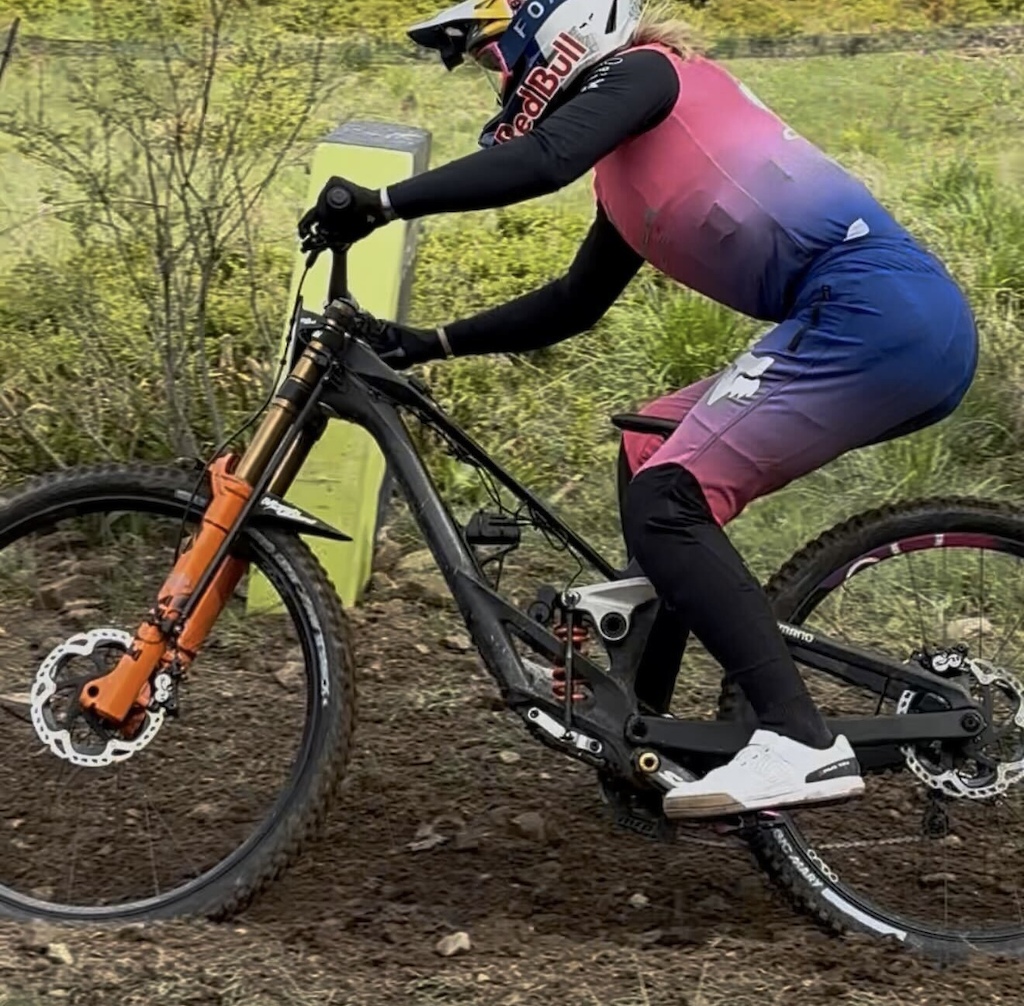
Just another crab link.
Main pivot appears to be low af. Other teams going high AR, Orbea go really low AR.
Cold cannot be the problem here. Do timing belts in cars break when its cold? I run a pinion/belt equipped fat bike all winter when its 0F and I have never broken a belt...
The times I have broke a belt however, is after a rock strike. While all of the pinions have bashguards to protect the box, several of the bikes dont have anyway of protecting the belt specifically. If a rock kicks up and hits the belt, there's a good chance its damaged and can break.
I have thousands and thousands of miles on gearboxes/belts and design bikes around it.
https://www.pinkbike.com/news/bike-check-the-brewser-a-crazy-slack-expe…
They arent perfect systems, but its still a damn good step in the right direction.