



If you haven’t already, check out Vital’s latest PIT BITS for a quick overview of Reece’s particular setup. While there is a lot of interesting tech on Reece’s bike, one defining feature is the prototype raised reversed stem manufactured by Be More Bikes.

Reece combines this stem with high rise bars to create a tall stack with reduced reach. This allows Reece to extend at the hips more, creating a tall, upright riding posture. However, doing this causes his center of mass to shift backward, disrupting the front-to-rear weight balance on the wheels. To counteract this and redistribute weight back onto the front tire, Reece deploys three strategies: (i) he runs long chainstays; (ii) he uses a firmer rear spring rate and softer front spring weight; (iii) he reduces the front tire pressure. This combination of components and setup creates a unique geometry package that allows him to maintain an upright riding posture while maintaining his desired front-to-rear weight balance.
In this YouTube video, Reece discusses the merits of his setup, primarily focusing on the improved steering dynamics that he feels. He only briefly mentions the biomechanical benefits of the more upright riding position his setup affords, where he states (at the 7:50 mark): “This creates a lot more… weight being through your feet. You’re using your quads more, your glutes more, and your back more. Those are much bigger muscles than your arms.”
What Reece touches on here is the redistribution of force from the arms and torso to the lower extremities. This redistribution of forces is important because when riding downhill (and like in most sports), it is optimal to generate the majority of power via muscles involved in the triple extension of the hip, knee, and ankle joint (e.g., glutes, quads, hamstrings, calfs, etc.). As Reece points out, these muscles are (generally) stronger and able to generate and sustain higher forces.
But, what Reece doesn’t touch on are two other biomechanical advantages that an upright body position facilitates. The first is the optimization of the length-tension relationship of muscles, which is a phenomena that describes how much force a muscle can produce depending on how stretched or shortened it is. Typically, a muscle is both weaker at a fully stretched or shortened position, with the most force being produced in the middle length.
When it comes to establishing the optimal length-tension relationship of the muscles involved in the triple extension of the ankle, knee, and hip during downhill mountain biking, data are scarce. But, one place we can look is in the literature on the deadlift (as it loosely resembles riding mechanics). Here we see that the strongest position of these muscles is around the mid-thigh position, with the next strongest position being at lock out (hips fully extended), and the weakest position being at the start (hips fully flexed).
 Mapping the deadlift movement pattern into downhill is non-trivial, as the forces and body position in downhill are dynamic and constantly changing. This means that what may be optimal in a static neutral position may be suboptimal in another (e.g., in a steep chute). Also, due to individual anatomical differences and strengths, what may be favorable for one person may be suboptimal for another. Nonetheless, as a guiding principle from powerlifting research, we can infer that, as a downhill rider, it is generally preferable to bias positions towards more hip extension (i.e., more upright) than towards hip flexion (i.e., more bent over).
A second biomechanical advantage of having a more upright body position is the increased range of motion in the hips and arms to absorb impacts. As the front wheel encounters obstacles, the handlebars are forced upward and backward toward the rider. Having a greater range of motion means the rider can dissipate this force over longer time periods, thus reducing the peak forces they have to manage.
So, should you go out and throw a raised reverse stem on your bike to get in a more upright body position if it comes with all of these advantages? Probably not. Reece’s bike is designed as a complete geometry package, and for it to work, you need all parts of the package to work in unison. So unless you have engineered your setup to work with the stem, putting it on your bike in isolation will likely cause unfavorable riding characteristics.
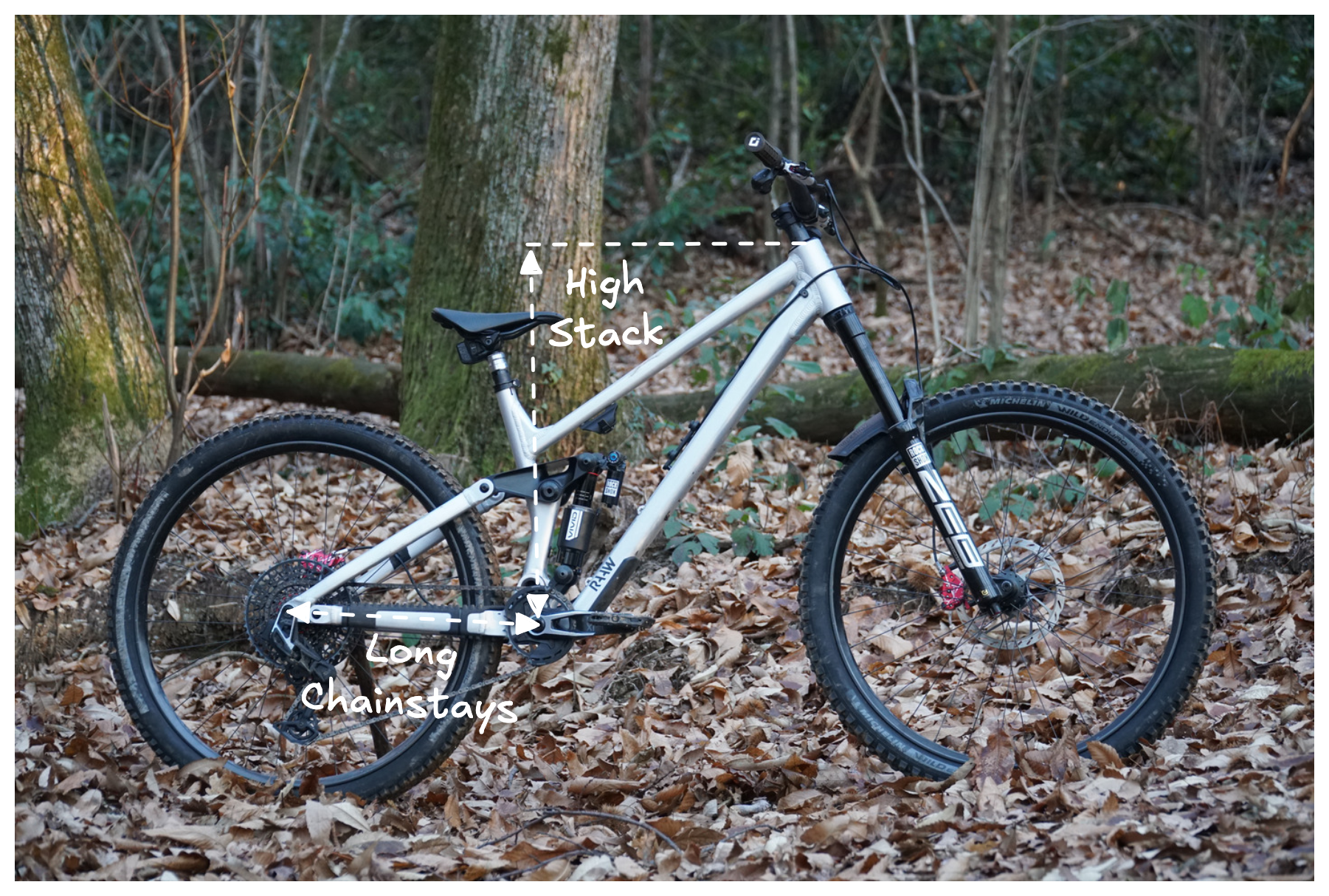
On the less extreme end of this geometry concept, other companies such as Raaw, Forbidden, and Frameworks are also using similar principles of higher stacks and longer chainstays to also place riders in a more upright body position, but using a traditional stem. Other riders such as Jackson Goldstone and Dakotah Norton have also tweaked their more “traditional” geometry by using longer chainstays and very high-rise bars, respectively. In each case, and as with any setup, there are tradeoffs that are rider, condition, and course dependent.

Only time will tell whether Reece’s set of trade-offs is right for him and his team. But, the recent triple win the AON Team took at British National Downhill in Rhyd-Y-Felin, plus Reece’s 20th and Harriet Harnden’s 4th place finishes on this setup at the South Korea DH World Cup are early positive signs. Until we have more data, we can only speculate if the new setup is helping or hindering. For now, at least we can say there is a little bit of (biomechanical) method in the madness.

Find seven differences
Not enough data points yet to determine if this is good setup or not.
Reece's 2025 WC finishes: 6 missed finals and 22nd place average for the 3 finals he made. His best result came from Lake Placid, a new track that all riders had to puzzle over.
What we could infer, is that Reece is a quick learner and can dissect new tracks better than many racers but that, eventually when all the racers catch up and learn the track, his avg race speed is still slower than the top 20.
I'm stoked to see the puzzling on the bike. He's an amazing rider and watching him both ride and test new setups is highly entertaining.
There is merit in it to me. I came from Moto. I would set up my enduro dirtbikes bike with sky high bars and lowered footpegs to give a upright/strong riding position for long days. Coming to mtb I always struggled with the low stack heights.
My current bike has relatively high stack, 40mm bars, 30mm spacers under the stem and a 462mm chainstay. I'm as close to riding a dirtbike as I've ever been. I feel "in" the bike now rather than on top of it. That security of been centered between the wheels is confidence inspiring. You utilize the quads/hamstrings and glutes rather than upper body.
Stack is king, but only when the rest of the bike is suitable for that stack. A long Rear center is paramount.
But my god that stem is ugly.
I think high stack and long rear center is kinda a no brainer for DH but... I thought this post was specifically going to be about 0mm or reversed stems, which is the more confusing narrative that definitely leads to different handling characteristics but... Still can't say if its simply better or not.
Living near Bronson, I got to demo the RR stem for free, but on a normal bike. It did what I expected, but I am the most average rider ever. Lots of leverage, quite good handling, but made my normal bike feel 'too small' and ended up twitchy. It has a short rear center to begin with. I would have loved to try it on a size up with a long chainstay and basically throw it down the hardest trail I can survive.
Yeah, idk why a top 20 is any indicator if this works or not. I tried high rise bars and it just led to me loosing front wheel grip and not having trust in the front wheel not washing out. But I'm just riding very conservative to avoid crashes so it's really hard to say if the new tech with 32 inch wheels and weird bar heights will translate to recreational riding.
I got a Raaw about a year ago and I've come to appreciate the benefits of the higher stack and longer stays. But it took me a bit to adjust to it, and I'm not convinced that making the stack substantially higher along with a shorter reach would be beneficial. There are times when I'm trying to move forward on the bike, but getting forward makes the bars feel too close to my chest. My arms are bent too much, which makes it harder to press through an obstacle. With the Raaw, this is a relatively rare occurrence, and the other benefits of the geometry outweigh this downside. But if the bars were positioned like Reece's, I think that situation would be less rare and a much bigger downside. This is all speculation of course, but I remain skeptical.
I'm also skeptical that Reece's setup would translate well to a bike that needs to be pedaled uphill. If it's a DH only thing, that's fine, but it also means it's perpetually relegated to obscurity. And if it doesn't work well on my pedal bike, I'm not sure I want it on my DH bike; I want my bikes to at least have some thread of commonality, otherwise it's hard to switch back and forth.
I got no idea if I should use this. I really can’t predict at all what it would feel like. I’m certainly in the high stack, long chainstay gang. But I’d have to try it and I’m not sure any of my bikes geo is quite right to make the most of it. Tr11 has fairly short stays and my spire has pretty short reach for my height.
I don't think a top 20 will definively indicate if it works or not. Even a win wouldn't, because there are too many other factors in consideration. But I think the current string of results are at least an early positive sign that the setup, even if not optimal, isn't noticably hindering them.
Are you able to talk a little more about the handling? I didn't mention it in the post as without riding it I don't feel qualified to comment on the steering dynamics.
I'm curious if you felt any vagueness in the front wheel (i.e. it was difficult to precisely place it)? I'm pretty sure Brian Cahal mentions this as one of the downsides in one of his videos where he test rides it.
In all fairness, when considering just stack, Jackson Goldstone's bars are also super high. When he's standing next to his bike they're at his rib-cage. If I wanted to do something similar at 190cm tall my front-end would end up looking like Reece's I think.. There's definitely some merit to it
To answer the title... maybe for DH? No for any bike you gotta pedal up.
Absolutely going to feel that if you're not "buying a bike for it". So for me that was highly exaggerated. For Brian it's a bit more interesting because I believe he ran it on a proper bike (along with trying the custom mule). Along with being a much better rider, I expected him to basically utilize it more but also struggle when trying to push. Which makes sense as a mere mortal, it's not like Brian makes 0 mistakes on a normal bike, as well as I'm not sure how long he's committed a specific time period to the stem.
I think it's generally been discussed and Bronson has made it rather clear that this is a product that is ideally built around a certain bike. I mean the mule itself is a sort of exaggerated testimony of 'yeah, you need to make the bike bigger to make use of it'. I don't recall Bronson being all that tall in person. Maybe average height. That bicycle is MASSIVE.
What I found interesting about the narrative, since I have nothing against high stack and long rear center, is the cornering 'style'. Comfortably loading corners from the feet while trusting the long rear center and being able to be aggressive right after. As opposed to loading the front wheel, being very aggressive and 'on edge' in the corner... And kinda having to 'recover' coming out of the corner and be less prepared for whatever comes just after. Or, to reduce the idea, simply avoiding fatigue in various features on a long, hard track.
I'm not sure how the margin will be noticed for a smaller/lighter rider or on a smoother bike park track (maybe Leogang will help prove this?). But I think it's a kinda no brainer concept for taller / heavier riders on rougher tracks. Doing a lot of moving around and sinking into a lot of shtty holes and just generating fatigue. Not sure I can see a use case for a shorter weaker rider, maybe an average joe. Could help, but could also create a total fitment puzzle since smaller frames tend to have higher stack reach ratios that are actually respectable out the box. Whereas Larges and XLs are notoriously frustrating for stack reach ratio and it's fairly common to see dudes 6 feet and up running StakDak bars on them, and 35mm or shorter stems.
Part of me imagines the product still makes more sense for an Average Joe (unfit, heavier, moderate riding skill) than it does a top 30 pro. BUT... If you build around it more I think it makes sense. To me the problem is... Do you want that exact same bike for every track? Unless they get rid of shorter / smoother tracks... I see it as a liability on the world cup.
I'm bummed Ft Bill is off the cards. In between Reece's experience there and the discomfort of the top half, I think it would maybe be the best track for it. I guess just choose the roughest track of the year and bring out your microscope. VDS? Is the Whistler track like MSA or smoother?
I think the "it needs a special frame" part of the equation is, observationally at least correct. Hattie is the smallest on the team and her setup, to my eye looks proportionally the most correct and is also the first time I've seen the RR stem on a bike, including the various test mules on instagram and thought; "Oh, I see what they're actually trying to achieve here". Both of the male riders look like they're riding a Segway with their hands in their armpits.
Conventional wisdom up until a week ago would have said this setup is unrideable and has no place at a World Cup. The fact that they were even in touch with these bikes demonstrates that there are still lots of places to go and things to explore re: bike geometry/fit
You can get to simmilar riding position with a fairly normal bike too. At least if you have moderately long chainstays. It is basically what Goldstone is doing.
What reverse stem allows you to is running a looong wheelbase, which at least for DH is probably quite benefical, but you need a bike build for it.
As someone who likes to ride very upright, but hates long bikes basically I just picked the bike with the shortest reach I feel comfortable running and longest chainstays I could get and it works fairly well. With short reach you only kinda run into limitation with stack because after certain point it feels like you are going to fall of the back of the bike.
This could probably be resolved with longer stem, but I feel like I already have almost to much front wheel grip, so slightly longer reach may be the way to go, but then you need to lengthen the rear center too and you end up with a looong bike again.
There are probably other ways to get to it, but this one worked for me .
Well, very timely... Entire interview on the other site with Hattie, mostly regarding the bike set up. Needless to say her opinion and experience speaks volumes more than my limited experience with a demo day or even Brian's various experiments with various bikes.
She said she settled on the negative 10. Wording is kinda confusing but seems like the whole team is running the negative 10 and then just changing the overall stack, mostly through bar but also some spacer? Not sure what all their heights are but, seemed like it was mostly describing height even though she brought up how much harder the boys ride and how their set up is valid.
I think the hardest narrative to pin down is the 'off set'. The entire industry has forward offset with the stem. I feel like 0 offset stems make sense from a 'steering axis input' perspective (kinda moto related)... But then you have this wrench in the gears of negative offset. And I've seen various explanations but none have quite hammered down why it would be beneficial to me. It's like quantum mechanics... You can keep explaining it but it rolls off my brain.
Which is why I think it's just easier to discuss stack, reach, chainstay, etc. And i dunno if people wanna touch the actual topic of the thread, reverse offset, bars/hands behind steering axis (fork).
I have a Nicolai G1 with the following geo:
510mm reach
1349mm WB
474mm chainstays
115cm handlebar off the ground
203mm front travel and 211mm rear
I have been using a 20mm stem for years and also have a 10mm one which I have tested on occasion. I have recently put on the 10mm stem on backward and got a set of 90mm risers (previously was on 60mm). If you draw a straight line through the handlebar from the grips then the bars are 35mm behind the steered tube. I thought my 20mm stem and 60mm stem setup was dialed but this new one has changed things for the better. Less weight on my arms so slightly less fatiguing but it's given me way more leverage over the bike making it feel like a dirt jumper almost. Still am able to ride fast and be precise but now I'm able to take lines I couldn't because I have way more control over the bike. Climbing isn't a problem as the steering actually feels calmer. Did back off the low speed compression 6 click off and lowered my fork pressure by 5psi to get my balanced feel again. I haven't felt the need to run lower front tyre pressure but did increase my rear spring rate by 25lbs. Handlebar height with 20mm stem and 60mm riser was 114cm so this new setup is only 10mm taller even though the bars are way higher. I haven't measure the effective stack (aka cockpit) but I'm sure it will definitely be shorter.
Anyways this is all just to say I think Bronson and Aon Racing are definitely onto something.
Combine that setup with the ever-growing front wheel trend and we're slowly but surely getting there
Put the cranks on the rear wheel and ready to rip.
Surely not every bike fits everyone, but I do think people freak out over mere millemeters when the fact is - you can get used to just about anything. Its just fucking bikes.
I've got an XL GT Fury with 515 reach & 70mm bars: best DH bike I've ever had in 20+ years... a 2019 YT capra with 480 reach and 50mm bars: super fun, still going strong. A size L 2023 Marin Alpine with 490 reach and 35mm...no 50mm... no 80mm bars. Super fun. I move around on these bikes, jump them all mercilessly and continue to get faster & faster & faster times (if seeking that) but more so - having fun. Going from bike to bike takes literally zero effort to adjust to.
Sure Reece & crew wanna win WC races on these bikes. The entire team just took British nationals as #1 & 3 in men's, #1 in womes and #1 in juniors: that's fucking good results. They have p-lenty of data (so scratch the idea "there's not enough"). Hattie came in 4th and Reece was 20th in in Korea. Not fucking great.
But for us? Doesn't matter at all - we're not WC riders. The point is not to be opinionated and narrow minded about your bi-cy-cle when we've not experimented with or tried a wide range of things like bars, wheels, tires, suspension, grips etc.- its just bikes. Play around. Over-fork your bike by 20mm - it's prob fine. Ride a freeride seat: prob just fine. Go from 12x to 10x on your trailbike - its fine. Mullet that long chainstay bike you're "not supposed to mullet" - it'll be fine. Get an XC bike. Just kidding, that's lame.
The issue here isn't really the bikes, its narrow imaginations and being opinionated. Doesn't mean ya have to go strap up a banana seat bucket hardtail with 200mm bars & a 210 dual crown fork, wear clips and it's a 32/26 mullet... but if that's what ya wanna try out, fuckin do it. We'll all be dead soon enough - life's for fucking around. Go fuck around and have some fun.
I've recently shrunk stems and raised bars on all my bikes and its been mostly great for everything but technical uphill moves. It's hard to hop up rocks when your bars knock your teeth out. Front wheel flop up step climbs is also real. If I only rode down, I'd try even higher bars and longer stays.
How do you measure handlebar height? At the end of the grips? It seems low as in almost at the same height with a 35 mm bar.
I tried shorter stems and different bar heights but maybe it didn't work for me because my bike has only 440 mm chain stays in S4. I also tried really long chain stays but didn't like it.
I ride mostly ebikes so the weight factor might muddle all of this...
What also comes to mind with this: didn't Fabien Varel and Cesar Rojos forward geometry from like 10 years ago go into a similar direction or am I missing something?
They released very long bikes with a stem that was mounted directly on top of the steerer tube. What was missing was the negative stem and the high rise bars. Maybe also the really long chainstays. Barely rode/promoted it for a while but mondraker got rid of it quickly and I think he also switched back to a more traditional setup for racing.
It was with 26 so very short chainstays and the bikes looked funky af:
https://m.pinkbike.com/news/Mondrakers-New-Forward-Geometry-with-Fabien…
I measure the handlebar height at the end of the grips because that is where my hands are. They aren't super high because my head angle is 62.5º with a steeper head angle the bars would be higher. Forward geometry was the beginning of making bikes longer but not as extreme as the setup of modern Nicolai G1 or even Paul Aston's bikes. Also if you look how bike geo is getting closer and closer to dirt bikes, they are also running super short stems and long chainstays.
I can comment on these setups. I have posted on vital MTB a little before and felt there was a closed mindedness to this kind of a-typical stuff... That seems to be changing in MTB circles. I am not here to change any minds. I have my own opinions, coming from the moto side of things and the trends in MTB just do not feel right in terms of front wheel grip and rider / body position.
I post regularly on VitalMX and have been a motocross racer for most of my life at the amateur / expert level.
June of 2025 I built up a bike on a Banshee frame (a 473mm chainstay length with my own experimental geometry changes).
Last Saturday I raced my first enduro. My bike grabbed a lot of comments all day and I saw this thread while reading a race report with a caption stating I had the rig of the day and some podium beer shenanigans.
I think the BMore raised / reversed stem is too much of a good thing. I believe it is too tall and the bar position is moved to far behind the steering axis.
I also believe the idea of changing the stem length as a way to fit a bike to a rider is suboptimal. I got the steering feel I like with about 455 reach.
I machined a set of bar mounts (direct mount stem in MTB land) that moves the bar position just 20mm in front of the steering axis.
I run the short offset manitou crowns (47mm designed for 27.5 wheels) with my 29 front end.
My bike started at 1308 wheelbase as a Banshee 29 Legend (Large).
The short offset crowns move the axle 5mm closer to the bottom bracket.
A 1° headset moves the axle 10mm closer to the bottom bracket.
My wheelbase ends up around 1293mm and with the 473mm chainstay, I am around 1.733 front/rear center ratio.
I personally prefer to think in terms of the percentage of rear center to wheelbase... About 36.6%
Another modification I have made to this chassis is to off-set grind a shock bushing to give about 1mm increase in shock length.
This bike does not steer like a twitchy dump truck, you lean it into the corners like a motocross bike and ride light on the hands.
I frequently ride with others who get hand or arm pump... The front/rear center ratio allows weighting the front through the legs, saving the arms.
The increased trail and balanced geo allows the bike to be stable when vertical and carve hard when leaned into a turn.
During setup the fork height and rear shock length are crucial parameters in how a bike corners.
Cahal is right with the long chainstay stuff...
Reece and BMore are too far in the right direction...
I met in the middle and the bike is great for my needs as a guy who came from the moto side of life.
These are my opinions...
If you are local and you want to ride, reach out.
https://www.vitalmtb.com/community/Race%20Cascadia/blog/05/12/2026/entry/148131?mc_cid=b987e7fe3c
How tall are you? Is the reach and chainstay length measured with the modifications or the stock frame measurements?
I tried a bike with a similar reach and 465 mm chainstays at 1,80 m/5 10 and it felt weird. Maybe also because it was a heavy full power E-Bike. The old Bosch ebikes often had very long chainstays.
One question when it comes to moto comparisons, how much of a difference does the way you hold the vehicle with your legs make? With bikes, yeah, being light on the hands makes sense even to me, but I've recently been on a path to try to open up my knees (I notoriously squeezed my knees towards the top tube) and it really frees up the riding. But that means that regardless of the position you control the bike with your hands and your feet only. With an mx bike you're grabbing it with your thighs (in corners) or lower legs. You're probably much more connected to it, even if you're light on your hands, than you are with your bike. I'm guessing having some more control on your hands might be a good thing, at least psychologically if nothing else?
Caveat, I just thought about this while reading the thread. It's literally putting my thoughts to text without any deep thought into it.
Interesting to read about your experimenting and see the setup you have landed on.
Do you see a difference in the gradient of the terrain ridden between mtb and moto (I'm not a moto guy at all so have no idea)? Is this something you factored into your setup?
Interestingly, Reece has gone in the opposite direction and has been testing steering the bike more with his knees. Do you remember those huge custom plates he had bolted onto the side of his bike last season?
I do and I did think of them. But trying to open up my knees on the bike has made me a lot more relaxed for some reason...
Unlike moto, I suspect the bike moves more relative the rider in mounain biking due to the lower weight of the bikes plus the dynamic nature of mountain biking. I'm inclined to think that having more space between the knees to move the bike around is favourable because as the bike pings off line or slips into a catch berm, for example, the forces imparted onto the bike can be dissapated more easily if there is more distance (i.e., space) to control them over.
But, I'm thinking out loud here, and not entirely convinced of my own reasoning. I'm sure it is probably more complicated than that.
Post a reply to: Should You Reverse Your Stem? - Reece Wilson Setup Analysis