I’ve married a DB8 caliper to a Shimano XT lever. Seems to be holding oil… But will it work well? Or will I be killed?
It’s only the front that I’ve made this frankenbrake with as the caliper was weeping on the shimanos. Haven’t yet bedded it in but it has a much more mushy feel to it than shimano. For those in the UK you can get a set of db8s for £35 from banana industries.
I’ve married a DB8 caliper to a Shimano XT lever. Seems to be holding oil… But will it work well? Or will I be killed?It’s only...
I’ve married a DB8 caliper to a Shimano XT lever. Seems to be holding oil… But will it work well? Or will I be killed?
It’s only the front that I’ve made this frankenbrake with as the caliper was weeping on the shimanos. Haven’t yet bedded it in but it has a much more mushy feel to it than shimano. For those in the UK you can get a set of db8s for £35 from banana industries.
I'm using same setup just with SLX levers for almost a year. Works like a charm. On another bike I have DB8 callipers and Formula Cura levers, same story. In both cases the system is filled with Maxima fluid.
I’ve married a DB8 caliper to a Shimano XT lever. Seems to be holding oil… But will it work well? Or will I be killed?It’s only...
I’ve married a DB8 caliper to a Shimano XT lever. Seems to be holding oil… But will it work well? Or will I be killed?
It’s only the front that I’ve made this frankenbrake with as the caliper was weeping on the shimanos. Haven’t yet bedded it in but it has a much more mushy feel to it than shimano. For those in the UK you can get a set of db8s for £35 from banana industries.
I'm using same setup just with SLX levers for almost a year. Works like a charm.On another bike I have DB8 callipers and Formula Cura levers...
I'm using same setup just with SLX levers for almost a year. Works like a charm. On another bike I have DB8 callipers and Formula Cura levers, same story. In both cases the system is filled with Maxima fluid.
I've run DB8 calipers with Tektro, shimano and (currently, on one bike) zrace levers.
I’ve married a DB8 caliper to a Shimano XT lever. Seems to be holding oil… But will it work well? Or will I be killed?It’s only...
I’ve married a DB8 caliper to a Shimano XT lever. Seems to be holding oil… But will it work well? Or will I be killed?
It’s only the front that I’ve made this frankenbrake with as the caliper was weeping on the shimanos. Haven’t yet bedded it in but it has a much more mushy feel to it than shimano. For those in the UK you can get a set of db8s for £35 from banana industries.
I'm using same setup just with SLX levers for almost a year. Works like a charm.On another bike I have DB8 callipers and Formula Cura levers...
I'm using same setup just with SLX levers for almost a year. Works like a charm. On another bike I have DB8 callipers and Formula Cura levers, same story. In both cases the system is filled with Maxima fluid.
I've run DB8 calipers with Tektro, shimano and (currently, on one bike) zrace levers.
Not dead yet
Thank you both for the reassurance. I've got a custom blend of stock sram fluid and shimano fluid in mine, for performance reasons and definately not because I haven't bothered to do a full bleed...
New brake combo in the works. TRP / Oak Lever / Maven base 18/18mm caliper. Shimano BH90 lines and maxima mineral oil. I previously tried the 19.5/18mm...
New brake combo in the works. TRP / Oak Lever / Maven base 18/18mm caliper. Shimano BH90 lines and maxima mineral oil.
I previously tried the 19.5/18mm maven caliper with these same levers, and found the lever throw to be a little excessive. I'm hoping the 18/18mm caliper reduces that a bit. The TRP levers don't suffer the pump out effect experienced with maven/shimano levers. No swing link / servowave action, just heaps of mechanical leverage on a 9mm master cylinder.
Yeah omakacycle does all sorts of fun brake experiments on IG. He claims short lever throw on that combo but I don't buy it. I haven't used...
Yeah omakacycle does all sorts of fun brake experiments on IG. He claims short lever throw on that combo but I don't buy it.
I haven't used the radic lever but it should be quite similar to the TRP lever. They are both axial cylinder, 9mm master cylinder, and have long levers for plenty of mechanical leverage.
I believe radic achieves the minimal dead stroke their brakes are known for primarily through caliper piston seals that retract very little. They also use 2.3mm rotors, which IME seem to run more true than thinner rotors, leading to less pad rub and allowing less pad retraction.
I'd love to try the radic levers, but $360 USD for levers is kind of steep.
Just get the whole Radic brake set and don't bother messing about with the Maven bits. They work so well as they are and don't require any piston massaging or other faff... 😜🙃
Raicam is an Italian manufacturer. They originated outside of the cycling industry, can’t remember exactly. It was all very neatly packaged, the bleedkit is supreme, rotors and pads seem very nice. Setting them up was a charm, bleeding was super easy and everything has a nice touch to it. Original Pads have no rattle, pad shape is the same as Shimano, TRP, etc. 4P Brakes, pistons work very evenly, it’s a mineral-oil system…it ticks a lot of boxes for me.
I haven’t put any meters on them yet but this seems to be a very considerable option. This is the Gravity brake which comes in three levels. The one right here sits in the middle of the three. The lever shape feels like a XTR, the pull force is very low similar to Hayes and the little extra squish after pad contact reminds me a lot of Mavens or TRPs. Freestroke and Lever Adjust seems similar to the Hope Idea.
It will take time to give a first comment on how they worked on the trail since I am still injured, but I could share more pictures of the single parts and accessories if you are interested.
Just pulled my bike out of the basement and discovered my Shiguras are leaking oil at the pistons. The donor MT7s were brand new and the brakes were performing perfectly last fall. Standard Shimano mineral oil, not the new lower viscosity stuff. Bummer.
Just pulled my bike out of the basement and discovered my Shiguras are leaking oil at the pistons. The donor MT7s were brand new and the...
Just pulled my bike out of the basement and discovered my Shiguras are leaking oil at the pistons. The donor MT7s were brand new and the brakes were performing perfectly last fall. Standard Shimano mineral oil, not the new lower viscosity stuff. Bummer.
I very much doubt it has anything to do with the mineral oil choice. I have a set of MT5s (with SLX levers) on my wife's bike that is filled with Shimano mineral oil since 2023. And I just checked the callipers - no leaks.
I very much doubt it has anything to do with the mineral oil choice. I have a set of MT5s (with SLX levers) on my wife's...
I very much doubt it has anything to do with the mineral oil choice. I have a set of MT5s (with SLX levers) on my wife's bike that is filled with Shimano mineral oil since 2023. And I just checked the callipers - no leaks.
This is good to know. Pretty disappointing because I loved 'em, except it gives me an excuse to try some Mavens.
Pal had a couple pairs of old XT brakes that were well, well, WELL overdue for some loving. Swapped out the caliper pistons to the Exnavi phenolic units I've used in the past with great results. While cleaning things, I got to thinking. (We can blame that on the 91% iso fumes.) As we've all seen Shimano fluid get horribly dirty, like stupid beyond belief dirty, I started looking a bit more at these cal pistons. Ceramic jobbers, porous. You can see crap built up in the pores (not the best photo work, sorry), but one thing that piqued me was the presence of what looks to be embedded aluminum. This got me thinking that it'd be rad to get a chem analysis of the fluid, to see if some of those suspended solids are in fact aluminum. Working theorem is ceramic piston grinds on piston bore, material is transferred to the fluid, which eventually ends up in the MC, which in turn causes more aluminum grinding and scores the MC bore. I've seen dirty fluid on all levels of their brakes, but it always seemed substantially more on units with the ceramic pistons. That could well be due to a person riding series level brakes tends to ride more and harder of course, exposing the brake to more crap, but I still think getting a spectrograph of the burnt fluid would be interesting. Likely a non-issue for the latest n greatest stoppers since they walked back from ceramic pistons, or at least I would hope so.
I didn't read everything, but I can 100 % assure you that aluminium enters the chat when it comes to dirty fluid. QED, I've bled a lot of Code R and RSC brakes. The difference is that RSC is anodized, which includes the insides of the lever body and the caliper, which means a smooth, hard coated master cylinder bore resistant to wear. On the other hand Code R is painted and is painted only on the outside. Which means the piston rides directly on raw aluminium. The master piston, if you disassemble the R level brake, is a lot dirtier and infused with aluminium than with an RSC brake and the oil, when doing a bleed, is gray while it's hardly dirty when bleeding an old RSC brake.
Pal had a couple pairs of old XT brakes that were well, well, WELL overdue for some loving. Swapped out the caliper pistons to the Exnavi...
Pal had a couple pairs of old XT brakes that were well, well, WELL overdue for some loving. Swapped out the caliper pistons to the Exnavi phenolic units I've used in the past with great results. While cleaning things, I got to thinking. (We can blame that on the 91% iso fumes.) As we've all seen Shimano fluid get horribly dirty, like stupid beyond belief dirty, I started looking a bit more at these cal pistons. Ceramic jobbers, porous. You can see crap built up in the pores (not the best photo work, sorry), but one thing that piqued me was the presence of what looks to be embedded aluminum. This got me thinking that it'd be rad to get a chem analysis of the fluid, to see if some of those suspended solids are in fact aluminum. Working theorem is ceramic piston grinds on piston bore, material is transferred to the fluid, which eventually ends up in the MC, which in turn causes more aluminum grinding and scores the MC bore. I've seen dirty fluid on all levels of their brakes, but it always seemed substantially more on units with the ceramic pistons. That could well be due to a person riding series level brakes tends to ride more and harder of course, exposing the brake to more crap, but I still think getting a spectrograph of the burnt fluid would be interesting. Likely a non-issue for the latest n greatest stoppers since they walked back from ceramic pistons, or at least I would hope so.
Worth pointing out that they are not "porous" but they have a poor surface finish which leads to them accumulating materials that are much softer than them in the surface. It is surprising that they didn't at least coat the sliding surface with an amorphous carbon coating to prevent this. Would have made a huge difference.
Out of curiosity, did you see any wear in the caliper that would suggest the piston removing the ano down the bare aluminum?
Pal had a couple pairs of old XT brakes that were well, well, WELL overdue for some loving. Swapped out the caliper pistons to the Exnavi...
Pal had a couple pairs of old XT brakes that were well, well, WELL overdue for some loving. Swapped out the caliper pistons to the Exnavi phenolic units I've used in the past with great results. While cleaning things, I got to thinking. (We can blame that on the 91% iso fumes.) As we've all seen Shimano fluid get horribly dirty, like stupid beyond belief dirty, I started looking a bit more at these cal pistons. Ceramic jobbers, porous. You can see crap built up in the pores (not the best photo work, sorry), but one thing that piqued me was the presence of what looks to be embedded aluminum. This got me thinking that it'd be rad to get a chem analysis of the fluid, to see if some of those suspended solids are in fact aluminum. Working theorem is ceramic piston grinds on piston bore, material is transferred to the fluid, which eventually ends up in the MC, which in turn causes more aluminum grinding and scores the MC bore. I've seen dirty fluid on all levels of their brakes, but it always seemed substantially more on units with the ceramic pistons. That could well be due to a person riding series level brakes tends to ride more and harder of course, exposing the brake to more crap, but I still think getting a spectrograph of the burnt fluid would be interesting. Likely a non-issue for the latest n greatest stoppers since they walked back from ceramic pistons, or at least I would hope so.
Worth pointing out that they are not "porous" but they have a poor surface finish which leads to them accumulating materials that are much softer than...
Worth pointing out that they are not "porous" but they have a poor surface finish which leads to them accumulating materials that are much softer than them in the surface. It is surprising that they didn't at least coat the sliding surface with an amorphous carbon coating to prevent this. Would have made a huge difference.
Out of curiosity, did you see any wear in the caliper that would suggest the piston removing the ano down the bare aluminum?
Since ceramics have a porous nature that provides them with their high insulation values I think I am still in the right here, but that's splittin' hairs between our respective opines. That it is evident on the running face of the piston does look to be a helluvan oversight, that we can agree on. I will say the caliper bores did look a bit shiny, but without having seen a brand new unit dissected I can't make proper call but I suspect the shiny surfaces to be due to rubbing related surface erosion.
I didn't read everything, but I can 100 % assure you that aluminium enters the chat when it comes to dirty fluid. QED, I've bled a...
I didn't read everything, but I can 100 % assure you that aluminium enters the chat when it comes to dirty fluid. QED, I've bled a lot of Code R and RSC brakes. The difference is that RSC is anodized, which includes the insides of the lever body and the caliper, which means a smooth, hard coated master cylinder bore resistant to wear. On the other hand Code R is painted and is painted only on the outside. Which means the piston rides directly on raw aluminium. The master piston, if you disassemble the R level brake, is a lot dirtier and infused with aluminium than with an RSC brake and the oil, when doing a bleed, is gray while it's hardly dirty when bleeding an old RSC brake.
Yeah, I've seen ya mention that in the past, which gets me wondering what grade of AL and what heat treat (if any) most large scale manufacturers are using for their calipers and MCs. If the same thing is happening to some brands due to phenolics, that would be eye opening/concerning.
I didn't read everything, but I can 100 % assure you that aluminium enters the chat when it comes to dirty fluid. QED, I've bled a...
I didn't read everything, but I can 100 % assure you that aluminium enters the chat when it comes to dirty fluid. QED, I've bled a lot of Code R and RSC brakes. The difference is that RSC is anodized, which includes the insides of the lever body and the caliper, which means a smooth, hard coated master cylinder bore resistant to wear. On the other hand Code R is painted and is painted only on the outside. Which means the piston rides directly on raw aluminium. The master piston, if you disassemble the R level brake, is a lot dirtier and infused with aluminium than with an RSC brake and the oil, when doing a bleed, is gray while it's hardly dirty when bleeding an old RSC brake.
Yeah, I've seen ya mention that in the past, which gets me wondering what grade of AL and what heat treat (if any) most large scale...
Yeah, I've seen ya mention that in the past, which gets me wondering what grade of AL and what heat treat (if any) most large scale manufacturers are using for their calipers and MCs. If the same thing is happening to some brands due to phenolics, that would be eye opening/concerning.
I saw 2014 T6 for one of the older Hope models.
Might be different for forged vs machined brakes though.
Pal had a couple pairs of old XT brakes that were well, well, WELL overdue for some loving. Swapped out the caliper pistons to the Exnavi...
Pal had a couple pairs of old XT brakes that were well, well, WELL overdue for some loving. Swapped out the caliper pistons to the Exnavi phenolic units I've used in the past with great results. While cleaning things, I got to thinking. (We can blame that on the 91% iso fumes.) As we've all seen Shimano fluid get horribly dirty, like stupid beyond belief dirty, I started looking a bit more at these cal pistons. Ceramic jobbers, porous. You can see crap built up in the pores (not the best photo work, sorry), but one thing that piqued me was the presence of what looks to be embedded aluminum. This got me thinking that it'd be rad to get a chem analysis of the fluid, to see if some of those suspended solids are in fact aluminum. Working theorem is ceramic piston grinds on piston bore, material is transferred to the fluid, which eventually ends up in the MC, which in turn causes more aluminum grinding and scores the MC bore. I've seen dirty fluid on all levels of their brakes, but it always seemed substantially more on units with the ceramic pistons. That could well be due to a person riding series level brakes tends to ride more and harder of course, exposing the brake to more crap, but I still think getting a spectrograph of the burnt fluid would be interesting. Likely a non-issue for the latest n greatest stoppers since they walked back from ceramic pistons, or at least I would hope so.
Worth pointing out that they are not "porous" but they have a poor surface finish which leads to them accumulating materials that are much softer than...
Worth pointing out that they are not "porous" but they have a poor surface finish which leads to them accumulating materials that are much softer than them in the surface. It is surprising that they didn't at least coat the sliding surface with an amorphous carbon coating to prevent this. Would have made a huge difference.
Out of curiosity, did you see any wear in the caliper that would suggest the piston removing the ano down the bare aluminum?
Since ceramics have a porous nature that provides them with their high insulation values I think I am still in the right here, but that's splittin'...
Since ceramics have a porous nature that provides them with their high insulation values I think I am still in the right here, but that's splittin' hairs between our respective opines. That it is evident on the running face of the piston does look to be a helluvan oversight, that we can agree on. I will say the caliper bores did look a bit shiny, but without having seen a brand new unit dissected I can't make proper call but I suspect the shiny surfaces to be due to rubbing related surface erosion.
Im just being an annoying ME now but porous ceramics are a thing except they are sintered from larger diameter media, under much less heat and pressure, and make great filtration devices. Porous media has not only gas but at most times liquid permeability of which ceramic pistons that we are discussing do not. These are most likely manufactured via hot press method that results in a non-porous but poor surface finish alumina or yttria ceramic oxide that's commonly called zirconia.
I work with high performance ceramics for both filtration and high strength hard on hard seal applications. But from my experience the lack of quality surface finishes with ceramics results in the need to use DLC type coatings, much more tricky to do with a non-conductive material or to "green machine" the blank prior to firing. All in all it's not the best matierial considering that there are realistic price points to hit with off-the-shelf commercial products.
Its a great find either way and and interesting discussion.
I didn't read everything, but I can 100 % assure you that aluminium enters the chat when it comes to dirty fluid. QED, I've bled a...
I didn't read everything, but I can 100 % assure you that aluminium enters the chat when it comes to dirty fluid. QED, I've bled a lot of Code R and RSC brakes. The difference is that RSC is anodized, which includes the insides of the lever body and the caliper, which means a smooth, hard coated master cylinder bore resistant to wear. On the other hand Code R is painted and is painted only on the outside. Which means the piston rides directly on raw aluminium. The master piston, if you disassemble the R level brake, is a lot dirtier and infused with aluminium than with an RSC brake and the oil, when doing a bleed, is gray while it's hardly dirty when bleeding an old RSC brake.
Yeah, I've seen ya mention that in the past, which gets me wondering what grade of AL and what heat treat (if any) most large scale...
Yeah, I've seen ya mention that in the past, which gets me wondering what grade of AL and what heat treat (if any) most large scale manufacturers are using for their calipers and MCs. If the same thing is happening to some brands due to phenolics, that would be eye opening/concerning.
Might be different for forged vs machined brakes though.
This, I guess it could be 6000 or 7000 series for machined brakes, your Radics, Trickstuffs, Intends, Lewis(?) while something more conducive to forging for mass produced brakes, your Shimanos and Srams and Hayes and the like.
As for bore scoring, I don't really think it's the caliper piston scratching the bore, making particles that then travel to the lever and damage the master bore. It's a bit far fetched, I'd say oil in the caliper is in most cases quite isolated from the oil in the lever.
Furthermore, with the calipers, it's the piston running on the seals in the bore. Damaging the bore is just collateral damage (as long as it doesn't affect the piston sealing against the seal).
With the master the piston sealing and running on the same surface. Besides that, due to the lever and linkage geometry, I'm guessing there is a fair bit of sideloading on the master piston vs the caliper piston (hopefully the pad is supported by the caliper body). So I'm fairly certain most aluminium particle contamination comes from the lever, not the caliper. I'm not saying exclusively from the lever, but I'd be willing to bet it's mostly.
Threading the pistons is neat. It’s on my mind right now as I just revitalized a clutch of seized Sram calipers, threads would have helped (if they didn’t just strip out).
Colour me dubious about the functionality of their twin IFP reservoirs. That looks like a number of potential problems all in the wings waiting to happen. Aside from some old Zrace brakes, I am unaware of any other brake using IFPs in lieu of bladders for their reservoir.
IFPs work nicely when preloaded, but that won't work for a brake... Without a serious preload I suspect it's likely the ifp will bind. Or at least not want to move because of friction...
IFPs work nicely when preloaded, but that won't work for a brake... Without a serious preload I suspect it's likely the ifp will bind. Or at...
IFPs work nicely when preloaded, but that won't work for a brake... Without a serious preload I suspect it's likely the ifp will bind. Or at least not want to move because of friction...
Precisely. Relying on the pressure differences from seal slip and roll and lever actuation to balance the fluid level in the system due to pad wear and fluid expansion/contraction seems to be asking mucho. Having flashback to Elixirs with that MC piston/bore setup too.
Like the fact someone's taking chances, but I am definitely in the wait n see camp here.
We did a spring backed IFP on the DH-R brake adjuster. It works fine so long as you keep the spring preload within reason. The main idea behind the whole brake adjuster was actually to have a base brake line pressure be about 15 psi so that the system would be less sensitive to bubbles. Not much impact on pad retract at that pressure with that brake, but much past it and you'd start to notice decreased pad retract/lever throw. But yeah relying on fluid to pull something as opposed to push something is a trickier thing.
Re brembo: Will be interesting to see how they survive in the real world. Was telling a buddy of mine that WC racing isn’t really a stress test considering that those brakes are bled every run. Based on hydraulic leverage ratios they will be quite powerful… Another player isn’t a bad thing…


I’ve married a DB8 caliper to a Shimano XT lever. Seems to be holding oil… But will it work well? Or will I be killed?
It’s only the front that I’ve made this frankenbrake with as the caliper was weeping on the shimanos. Haven’t yet bedded it in but it has a much more mushy feel to it than shimano.
For those in the UK you can get a set of db8s for £35 from banana industries.
I'm using same setup just with SLX levers for almost a year. Works like a charm.
On another bike I have DB8 callipers and Formula Cura levers, same story.
In both cases the system is filled with Maxima fluid.
I've run DB8 calipers with Tektro, shimano and (currently, on one bike) zrace levers.
Not dead yet
Thank you both for the reassurance. I've got a custom blend of stock sram fluid and shimano fluid in mine, for performance reasons and definately not because I haven't bothered to do a full bleed...
Just get the whole Radic brake set and don't bother messing about with the Maven bits. They work so well as they are and don't require any piston massaging or other faff... 😜🙃
Got myself a pair of those.
Raicam is an Italian manufacturer. They originated outside of the cycling industry, can’t remember exactly.
It was all very neatly packaged, the bleedkit is supreme, rotors and pads seem very nice. Setting them up was a charm, bleeding was super easy and everything has a nice touch to it. Original Pads have no rattle, pad shape is the same as Shimano, TRP, etc. 4P Brakes, pistons work very evenly, it’s a mineral-oil system…it ticks a lot of boxes for me.
I haven’t put any meters on them yet but this seems to be a very considerable option. This is the Gravity brake which comes in three levels. The one right here sits in the middle of the three. The lever shape feels like a XTR, the pull force is very low similar to Hayes and the little extra squish after pad contact reminds me a lot of Mavens or TRPs. Freestroke and Lever Adjust seems similar to the Hope Idea.
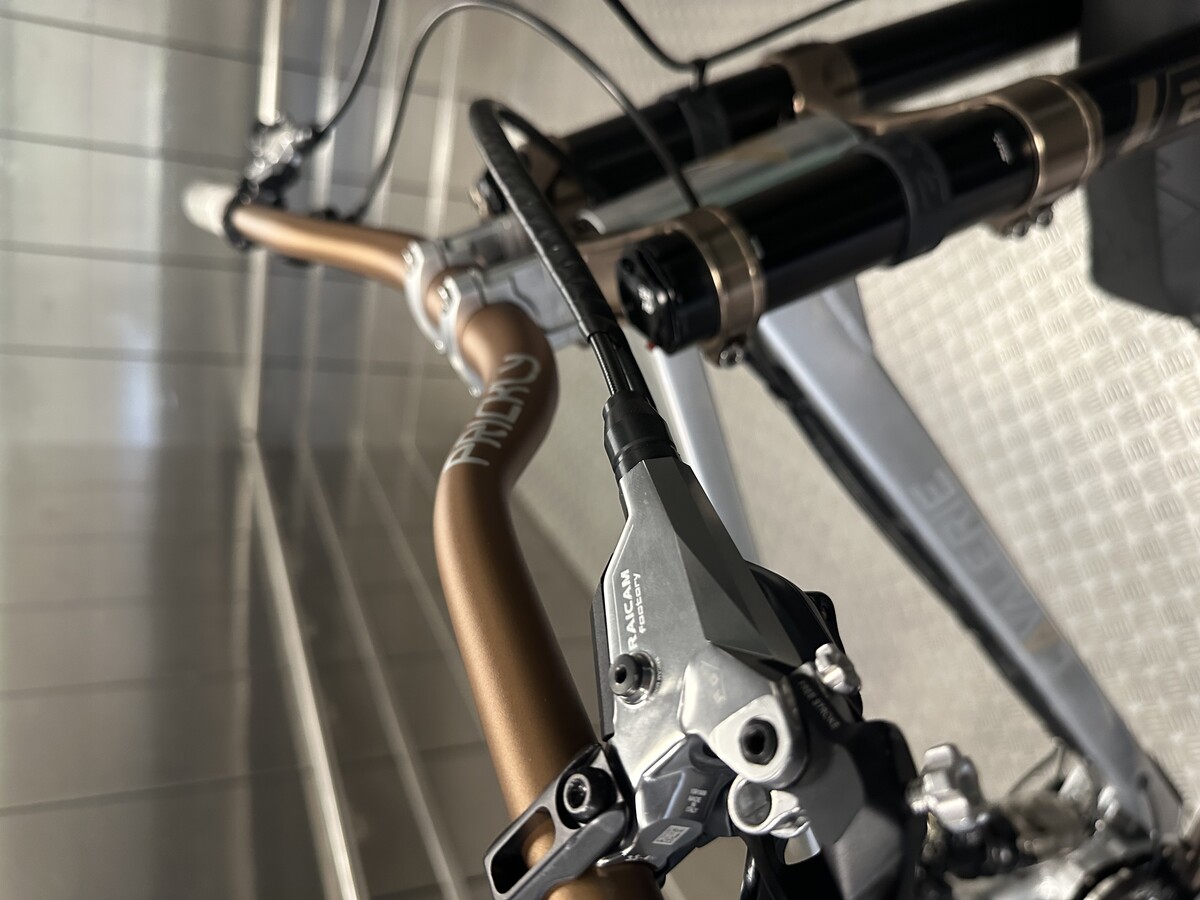
It will take time to give a first comment on how they worked on the trail since I am still injured, but I could share more pictures of the single parts and accessories if you are interested.
Just pulled my bike out of the basement and discovered my Shiguras are leaking oil at the pistons. The donor MT7s were brand new and the brakes were performing perfectly last fall. Standard Shimano mineral oil, not the new lower viscosity stuff. Bummer.
I very much doubt it has anything to do with the mineral oil choice. I have a set of MT5s (with SLX levers) on my wife's bike that is filled with Shimano mineral oil since 2023. And I just checked the callipers - no leaks.
It’s not.
This is good to know. Pretty disappointing because I loved 'em, except it gives me an excuse to try some Mavens.
Pal had a couple pairs of old XT brakes that were well, well, WELL overdue for some loving. Swapped out the caliper pistons to the Exnavi phenolic units I've used in the past with great results. While cleaning things, I got to thinking. (We can blame that on the 91% iso fumes.) As we've all seen Shimano fluid get horribly dirty, like stupid beyond belief dirty, I started looking a bit more at these cal pistons. Ceramic jobbers, porous. You can see crap built up in the pores (not the best photo work, sorry), but one thing that piqued me was the presence of what looks to be embedded aluminum. This got me thinking that it'd be rad to get a chem analysis of the fluid, to see if some of those suspended solids are in fact aluminum. Working theorem is ceramic piston grinds on piston bore, material is transferred to the fluid, which eventually ends up in the MC, which in turn causes more aluminum grinding and scores the MC bore. I've seen dirty fluid on all levels of their brakes, but it always seemed substantially more on units with the ceramic pistons. That could well be due to a person riding series level brakes tends to ride more and harder of course, exposing the brake to more crap, but I still think getting a spectrograph of the burnt fluid would be interesting. Likely a non-issue for the latest n greatest stoppers since they walked back from ceramic pistons, or at least I would hope so.
I didn't read everything, but I can 100 % assure you that aluminium enters the chat when it comes to dirty fluid. QED, I've bled a lot of Code R and RSC brakes. The difference is that RSC is anodized, which includes the insides of the lever body and the caliper, which means a smooth, hard coated master cylinder bore resistant to wear. On the other hand Code R is painted and is painted only on the outside. Which means the piston rides directly on raw aluminium. The master piston, if you disassemble the R level brake, is a lot dirtier and infused with aluminium than with an RSC brake and the oil, when doing a bleed, is gray while it's hardly dirty when bleeding an old RSC brake.
Worth pointing out that they are not "porous" but they have a poor surface finish which leads to them accumulating materials that are much softer than them in the surface. It is surprising that they didn't at least coat the sliding surface with an amorphous carbon coating to prevent this. Would have made a huge difference.
Out of curiosity, did you see any wear in the caliper that would suggest the piston removing the ano down the bare aluminum?
Since ceramics have a porous nature that provides them with their high insulation values I think I am still in the right here, but that's splittin' hairs between our respective opines. That it is evident on the running face of the piston does look to be a helluvan oversight, that we can agree on. I will say the caliper bores did look a bit shiny, but without having seen a brand new unit dissected I can't make proper call but I suspect the shiny surfaces to be due to rubbing related surface erosion.
Yeah, I've seen ya mention that in the past, which gets me wondering what grade of AL and what heat treat (if any) most large scale manufacturers are using for their calipers and MCs. If the same thing is happening to some brands due to phenolics, that would be eye opening/concerning.
I saw 2014 T6 for one of the older Hope models.
Might be different for forged vs machined brakes though.
Im just being an annoying ME now but porous ceramics are a thing except they are sintered from larger diameter media, under much less heat and pressure, and make great filtration devices. Porous media has not only gas but at most times liquid permeability of which ceramic pistons that we are discussing do not. These are most likely manufactured via hot press method that results in a non-porous but poor surface finish alumina or yttria ceramic oxide that's commonly called zirconia.
I work with high performance ceramics for both filtration and high strength hard on hard seal applications. But from my experience the lack of quality surface finishes with ceramics results in the need to use DLC type coatings, much more tricky to do with a non-conductive material or to "green machine" the blank prior to firing. All in all it's not the best matierial considering that there are realistic price points to hit with off-the-shelf commercial products.
Its a great find either way and and interesting discussion.
This, I guess it could be 6000 or 7000 series for machined brakes, your Radics, Trickstuffs, Intends, Lewis(?) while something more conducive to forging for mass produced brakes, your Shimanos and Srams and Hayes and the like.
As for bore scoring, I don't really think it's the caliper piston scratching the bore, making particles that then travel to the lever and damage the master bore. It's a bit far fetched, I'd say oil in the caliper is in most cases quite isolated from the oil in the lever.
Furthermore, with the calipers, it's the piston running on the seals in the bore. Damaging the bore is just collateral damage (as long as it doesn't affect the piston sealing against the seal).
With the master the piston sealing and running on the same surface. Besides that, due to the lever and linkage geometry, I'm guessing there is a fair bit of sideloading on the master piston vs the caliper piston (hopefully the pad is supported by the caliper body). So I'm fairly certain most aluminium particle contamination comes from the lever, not the caliper. I'm not saying exclusively from the lever, but I'd be willing to bet it's mostly.
More from them- plus seems to be released now. I posted elsewhere in Tech but also seems like best place to put it.

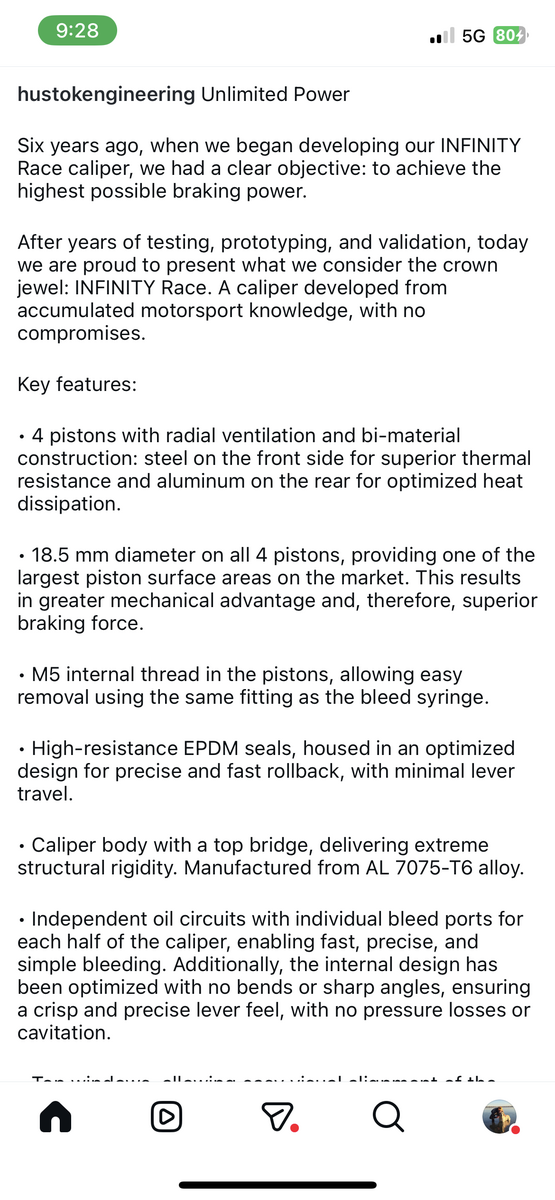
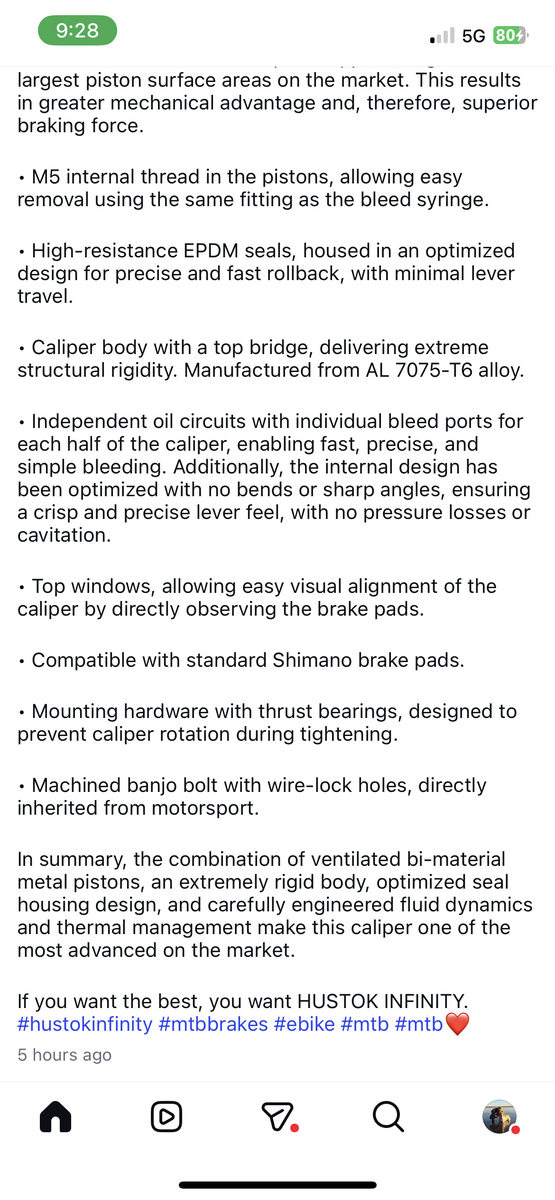
Threading the pistons is neat. It’s on my mind right now as I just revitalized a clutch of seized Sram calipers, threads would have helped (if they didn’t just strip out).
https://www.hustokengineering.com/our-brands
The miniature thrust bearings on the caliper bolts seem a bit OTT just to avoid caliper rotation when tightening.
Colour me dubious about the functionality of their twin IFP reservoirs. That looks like a number of potential problems all in the wings waiting to happen. Aside from some old Zrace brakes, I am unaware of any other brake using IFPs in lieu of bladders for their reservoir.
IFPs work nicely when preloaded, but that won't work for a brake... Without a serious preload I suspect it's likely the ifp will bind. Or at least not want to move because of friction...
Precisely. Relying on the pressure differences from seal slip and roll and lever actuation to balance the fluid level in the system due to pad wear and fluid expansion/contraction seems to be asking mucho. Having flashback to Elixirs with that MC piston/bore setup too.
Like the fact someone's taking chances, but I am definitely in the wait n see camp here.
We did a spring backed IFP on the DH-R brake adjuster. It works fine so long as you keep the spring preload within reason. The main idea behind the whole brake adjuster was actually to have a base brake line pressure be about 15 psi so that the system would be less sensitive to bubbles. Not much impact on pad retract at that pressure with that brake, but much past it and you'd start to notice decreased pad retract/lever throw. But yeah relying on fluid to pull something as opposed to push something is a trickier thing.
Brembo ride test. Price will be somewhere around $1k it seems.
20 years ago they were 1K euro and just two pot so not that bad I guess.
Cant shake the feeling they look a bit cheap this time though…
Re brembo: Will be interesting to see how they survive in the real world. Was telling a buddy of mine that WC racing isn’t really a stress test considering that those brakes are bled every run. Based on hydraulic leverage ratios they will be quite powerful… Another player isn’t a bad thing…
Man, could be the best brake on earth, they look cheap af
Brembo press release here if you want to read a bit more: https://www.vitalmtb.com/news/press-release/brembo-now-makes-brakes-mountain-biking-introducing-gr-pro.
Post a reply to: Nerding out on Brakes shall we? Not another tech deraliment