

Posts
319
Joined
6/30/2023
Location
Kittery, ME, USA
Fantasy

How often do you guys service your fork, both lowers and damper?
I've got a 2021 Lyrik Ultimate that I did a lower service on in 2023, but it's had 150-200 hours on it since then and it 100% needs another lower service, both from time interval, and how sticky it feels. (I know, I've been slacking)
Is it worth it to get a damper service too? It will cost ~$200 for shipping to a trusted tech to do a full service vs the $30 in materials for me to do a lower service myself. I know it's way past the recommended damper service interval but there's no extra noise or oil leaks, and the damper feels normal to me, both in compression in rebound. Does a damper start to feel worse before it blows up or is it more of a binary state?
Poll
Yes.
pre kids - lower service every month, meticulously maintained
post kids - oh cool the fork has air in it still, good enough
How can you tell if a damper needs a service? What do you feel? More friction, less predictable damping?
If the only benefit of a damper service is to prevent catastrophic damage to it, why not just do lower services, and in the very unlikely scenario of blowing out some seals in the damper then buy a new damper. Charger 3.1 are going for less than $300 right now which is only about 1.5x the cost of a damper service.
I generally recommend everyone has a full overhaul once a year - if you ride a ton then also do a lowers service at 6 months, and that covers 99% of people.
You can't tell when a damper NEEDS a service, only when it should have been serviced about 6 months ago. And catastrophic failures always come at the worst time - right before or during a big ride/race/holiday
Damper oil breaks down and starts to wear out parts like the inside of the damper tube - and usually feel fine right up until the point they have done major damage.
o-rings also take set when under pressure or degrade from exposure to oxygen. Which even with little use, they aren't working as good as they were when new and thats why you occasionally can get suspension randomly fail with very little hours on it when they get beyond 2 years old or so. So the key damper and air seals should be replaced every year. Some people can get away with 2 years, but basically if you are reading this forum you probably don't fall in to that category 😊
The other big problem with only doing lowers services is the bath oil slowly gets drawn in to the damper and air spring over time. So if you don't strip those down too, the negative spring of the air chamber fills with oil and the damper gets overfilled (if its a sealed cartridge). Most current self-bleeding cartridges aren't affected by that too much oil but if it doesn't have way of purging that oil then you will eventually have a burst bladder or hydraulic-locked damper.
Every 12 months, if I remember.
If damper fluid breaks down how long can you store it in the bottle?
Damper fluid degrades from use and heat so is less of an issue sitting around - I don't know figures but I'm sure its fine for years sitting in a bottle. As it breaks down there is a negligible change in damping, but its the reduced lubricity or build up of particles from use that are a problem for the damper.
Its the nitrile and polyurethane seals that have a limited shelf life. - Nitrile reacts with oxygen (the dust wipers are most susceptible to that, but there is still oxygen in the air spring and lowers) and they both take set over time. When they are in a compressed state in the housing of the damper or air sealhead, they are squished outwards to create a tight seal. Over time they "relax" and aren't squishing outwards enough to hold to oil or air in any more and can start to leak that way, as well as due to wear. Polyurethane is much more prone to this (was very common in Fox shaft seals but also used in shock wipers) but all elastomers do it to some extent. Thats why you see seals leak when they that aren't under any kind of major sliding situation (like adjusters).
Lowers 2x-3x/year, dampers once a year (although now that I have a Lift I'm going to try doing that one myself)
Dampers on Dh bikes get fluid changes and bleed typically at a minimum of twice a year. Once before winter training starts and then before Nationals. More often if working with athletes doing tuning.
Lowers get serviced before every race, easy way to maintain compliance and air springs get serviced about every three races.
This is the same for my bike as well as the athletes we take care of.
Trail bikes get a twice a year teardown.
The key is consistency. Your suspension is in a steady state of decline in performance as you ride. It is slow but adds up. I have seen many that get frustrated with the way there suspension feels and have a hard time tuning when all it needed was a good service to reestablish some mechanical baseline to work with.
On more than one occasion I have service athletes suspension to find that there rebound speeds are full fast to overcome the amount of drag within the system.
Performance drops off the further you move away from your service intervals. And this effects all riders.
I've needed to order a pike service kit for a least 3 months, but I otherwise try to do it once a year on the big bikes.
Dirt jumper forks get a service when it snows on the sun lol
Question: If I'm not riding a bike, is the suspension decaying?
Essentially, I had 4 months off the bike this last year due to injury. Plus a couple at the beginning of the year because of weather (which I'm back into the weather-induced off-season now).
If there is some deterioration while it hangs out in my garage, is there anything I can do to make sure it comes out the other side of the forced time off in good shape (besides having it serviced...again...after not having ridden it that much)?
Yup I agree with all of this - when setting up suspension that hasn't been serviced you run in to a wall quite quickly where its not possible to have decent comfort/grip as well as support/lively feel. Something freshly serviced has much less compromise
I also made this graphic about how I picture suspension performance over time - I work on forks that I've serviced regularly for over 5 years and pretty much as good as new - its only once the service interval gets dragged out that they start to wear really badly. The effect is probably more noticeable than I made it look here but you get the point, a 2 year old fork will be far from working as its supposed to!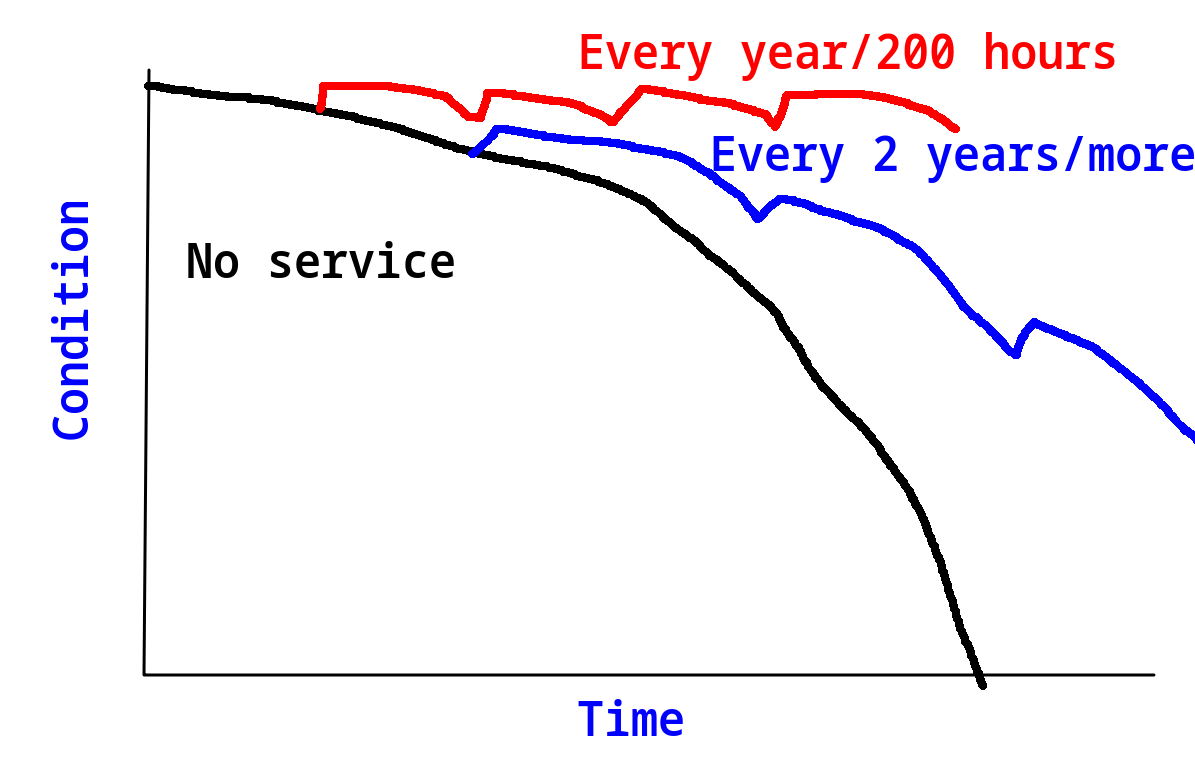
4 months isn't a problem - the seals might stick a little bit the first time you compress them but I wouldn't be too worried. The only thing is if the fork is sitting upright the foam rings will probably dry out and leave you will dry seals/bushings. If you can store it hanging by the front wheel that does go a really long way to keeping it mint, since the oil can run back down to the bushings & keep the foam rings soaked
I was surprised I had to close my rebound a couple clicks after getting my fork rebuilt lol
How are riders following up on those hours?
I've been using Probikegarage for past 2 years but never really like the app.. too complicated.
Then something new came around 12/2025
https://MTB-Tracker.com
Way easier to use and really simple to set up when compared to pbg. Will for sure switch from pbg to this new player for my service and maintenance notifications.
-Toby
Follow-up question how do you guys define "hours" of riding?
If you go to a lift or shuttle assisted bike park all day, does that count as 8h of riding or just the ~1h of descending? I think most would agree the descending only.
But then, if you are doing loops that are mostly road/fireroads up, then a big descent, on a regular bike the ratio is probably 1h climbing for 5 minutes of descending. Ebikes are more like 1h up for 20minutes down, but your suspension is more active on the uphill in virtually all scenarios.
Yes exactly, my riding is just that..on 2h ride.. the descending is about 20min max.. so give or take the suspension does not need to.work that hard when pushing the bike upwards.. so this is something that one can take into consideration and the recommended service intervals does not need to be that exact of what the manufacturers say.
Then again if you ride only parks and downhill then that might even shorten the recommended intervals for service needs.
I don't worry about tracking hours and do lowers twice a year. I do them in the fall and then again in the spring.
I change damper fluid annually to every 18 months.
That's all based on roughly 100-150 miles / month of riding.
Full overhaul/damper service at start of the season then do the lowers every ~2.5ish months of heavy riding. So usually 3ish times per year.
As recommendationa say.
And for notifications of services I use the new Mtb-Tracker tool that helps me with reminders of suspensions, parts and their needed services.
May I suggest adding more voting options.
DH racers might perform services after only a handful runs which might each take less than 4 minutes, so perhaps every 20-60 minutes of riding.
I see your point, but to me that's like saying "How often do you change your tires on your car?" and all the answers are like "winter and summer", "every 30,000 miles" "every 80,000 miles", and "when they wear out". You wouldn't also add "every 30-60 mins" just because that's how often F1 or NASCAR drivers change their tires. I'm sure amateur DH racers service suspension more often than the average rider, but it's only the top level riders on factory teams that are servicing their suspension every few runs.
I prefer your point to my point!
I think racers are a tiny minority of the MTB community, but their stories appear to dominate attention and steer peoples ride fantasies.
I have a Grip 2 damper that I’m going to install in my Fox 40. It’s got about an hour of use on it. Any special procedure I should follow for installation?
Re: "knowing" when a damper needs service -- this might be a totally jank method,but an old-head suspension tuner once showed me how he liked to hand-cycle a damper rod, once it had been pulled out of the fork during a lowers service, and "feel" for any stiction, weird binding points, etc. You can "dyno" (to use the terms very loosely) the damper rod while doing this hand-cycling, too, if you put the external adjusters back on the damper rod, which gives some idea of whether the rebound/compression circuits are actually doing their jobs. (Sometimes I've thought I had a damper issue b/c the rebound range hasn't gotten fast/slow enough, but once I pulled out and hand-cycled the damper, this has turned out to be an air shaft/seal stiction issue that presented as a damper thing.)
Again, I have no idea if this is a viable method for actually assessing a fork for damper service, but it's become the default method for me. I shoot for 2-3 lowers services per season on each fork, especially if it's mounted to an XC bike or a singlespeed hardtail that sees a lot of long miles in the rain/mud, and typically pull the damper during each lowers service to see if it still feels decent. I rarely send forks off for damper service mid-season unless something seems wrong/broken, so that ends up being a once-yearly activity.
Frankly, until the last couple of years I tended to sell most forks every year or so, and so the gradual decline in performance over time didn't seem like an issue. But now I've got a '22 Fox 34 Grip2 that's been absolutely through the ringer, and a '23 Pike Charger 3 (now 3.1 with the heavy stack) that is creeping up on 500 hours, and so Jono's graph is starting to seem MUCH more relevant!
More often than 50hrs. That's for sure.
Do people actually track their hours between services? I feel like I keep better track of my bike than most I know, and I have no idea the hours between services. My routine is 2-3 services for air suspension a year (one or two basic/seals and oil, and one damper service along with lower seals and oil) and one for coil shocks per year.
I rarely use Strava or any kind of ride tracker, but if it helped me track service intervals I'd probably become interested.
I use trailforks built-in tracker, and it's pretty much spot-on on the service intervals at least for the lowers. I mean I can definitely feel the fork doesnt work as good as new when it gets closer to the intervals defined in TF (and it alerts me as well).
Third kid- coil both ends so don’t even need to hold air
Post a reply to: How often do you service your fork?