That new Fox kit is a clever attempt to take advantage of potential loopholes as to how clothing rules are worded in the UCI regulations for...
That new Fox kit is a clever attempt to take advantage of potential loopholes as to how clothing rules are worded in the UCI regulations for mtb (see page 26). My personal opinion is that it violates the original intent as to why the regulation was written but is probably compliant to the verbiage of the rule.
As this is a UCI World Cup event, I expect the PCP and the UCI-appointed TD to provide their opinion on the matter as soon as this particular kit is brought up in a managers' meeting or by another team. As this is a potentially unfair advantage to teams not on Foxhead clothing, I fully expect this topic to have already been brought up to the commissaire panel.
I hope someone at the event in Fort Bill can give this forum a scoop as soon as a communique or ruling is sent out.
What is the actual advantage of the quasi one piece kit vs. jersey and pants? The jersey has to be tucked in anyway, so it's not like there's a huge aero advantage?
That new Fox kit is a clever attempt to take advantage of potential loopholes as to how clothing rules are worded in the UCI regulations for...
That new Fox kit is a clever attempt to take advantage of potential loopholes as to how clothing rules are worded in the UCI regulations for mtb (see page 26). My personal opinion is that it violates the original intent as to why the regulation was written but is probably compliant to the verbiage of the rule.
As this is a UCI World Cup event, I expect the PCP and the UCI-appointed TD to provide their opinion on the matter as soon as this particular kit is brought up in a managers' meeting or by another team. As this is a potentially unfair advantage to teams not on Foxhead clothing, I fully expect this topic to have already been brought up to the commissaire panel.
I hope someone at the event in Fort Bill can give this forum a scoop as soon as a communique or ruling is sent out.
What is the actual advantage of the quasi one piece kit vs. jersey and pants? The jersey has to be tucked in anyway, so it's not...
What is the actual advantage of the quasi one piece kit vs. jersey and pants? The jersey has to be tucked in anyway, so it's not like there's a huge aero advantage?
Hm, I don't know any numbers, but if aero derailleur cages are worth the money, this seems like more likely to make a difference just by the surface area alone. Working on the speed tuck position would most def trump both by quite some margin though.
Is aero derailleur cages being worth their money a proven thing? Larger pulley wheels are sold under the claim that they save power through less chain articulation (which is true, but likely very negligible...).
With all the turbulence behind the rider you could likely have a bolt sticking out the derailleur by a few cm and not notice it drag wise.
I guess biggest advantage is not having a waistline, should make it more comfortable to be in the "attack" position. The moto version has an adjustable strap at the waist, not sure if the DH version does. It is also probably a little bit more comfortable than safety pinning your shirt like people often do for race runs.
Is aero derailleur cages being worth their money a proven thing? Larger pulley wheels are sold under the claim that they save power through less chain...
Is aero derailleur cages being worth their money a proven thing? Larger pulley wheels are sold under the claim that they save power through less chain articulation (which is true, but likely very negligible...).
With all the turbulence behind the rider you could likely have a bolt sticking out the derailleur by a few cm and not notice it drag wise.
Proven? No. But there is a legitimacy to the claim.
Because a road race is 6 hours, any insanely tiny gain of 0.01W CAN be perceived to be significant at the end of race.
If your competitor has to expend 3500 calories and you only 3450 calories to ride the same time that will add up over a tour of even 7 days, let alone 21 days.
In DH though, the bikes are already so draggy, the only aero to be made is the rider, and most if that is from body position anyway.
Might've just figured out the name of the new schwalbe assegai resembling tire. Oops my bad. Albert Gr___? Also looks like new schwalbe branding, not sure...
Might've just figured out the name of the new schwalbe assegai resembling tire. Oops my bad. Albert Gr___? Also looks like new schwalbe branding, not sure how to feel about that
100% The rider must have a feel while using the rear brake they are trying to get. The was a rumor that Danny Hart was looking for something specific while riding this bike.
Valli on the new Tues with high pivot chain guide. I wonder if they will sell that as an add on.
Valli on the new Tues with high pivot chain guide. I wonder if they will sell that as an add on.
they should add it as an accessoire when buying a new tues. kinda ridiculous to launch that „new“ bike and their team riders are already using a different configuration the next day
they should add it as an accessoire when buying a new tues. kinda ridiculous to launch that „new“ bike and their team riders are already using...
they should add it as an accessoire when buying a new tues. kinda ridiculous to launch that „new“ bike and their team riders are already using a different configuration the next day
I think it's a workaround for the relatively high levels of anti-squat on the new model. I was surprised to read the press release and how high the AS is on the new bike, but they also open their copy by talking about how their goal wasn't to make the fastest race bike, but something more versatile. I thought that was odd, but maybe YT made a conscious choice to subordinate their team riders desires for a more pedal-able, "poppy" bike for general population bike park use. YT riders have been using Ochain for a long time, and this idler looks like an attempt to solve the same problem.
I think it's a workaround for the relatively high levels of anti-squat on the new model. I was surprised to read the press release and how...
I think it's a workaround for the relatively high levels of anti-squat on the new model. I was surprised to read the press release and how high the AS is on the new bike, but they also open their copy by talking about how their goal wasn't to make the fastest race bike, but something more versatile. I thought that was odd, but maybe YT made a conscious choice to subordinate their team riders desires for a more pedal-able, "poppy" bike for general population bike park use. YT riders have been using Ochain for a long time, and this idler looks like an attempt to solve the same problem.
could be, but kinda odd to make a „not so racey“ DH-race bike… to me the new tues is a total letdown. first the diaper to suggest something new and different is coming but the end result is basically a mullet version of the old bike with bumpstops added to the frame. geo is mostly the same except flipchip and on the conservative side.
look what others are doing like canyon, pivot, norco, even the new V10 is more different.
Does it looks like like oval chainstay is on Amaury’s frame compared to rectangle? Also an axle mount to chainstay option vs stock is mounted to...
Does it looks like like oval chainstay is on Amaury’s frame compared to rectangle? Also an axle mount to chainstay option vs stock is mounted to seatstay.
Here's another thought on Amaury's steel oval-shaped chainstay. The obvious conclusion is that they're chasing a particular amount of flex that they couldn't get out of aluminum, but here's another idea: What if they already had the level of flex they wanted out of the old bike, but they were breaking aluminum chainstays left and right? It makes sense that the chainstay would be the weak point in a flexy rear end, because it's the direct line from the bottom bracket (aka where most of the rider's mass is transmitted to the rest of the chassis) to the rear axle (the primary load-bearing wheel in violent turns). Steel has a much, much higher fatigue life cycle than aluminum, and would allow the chainstay to flex and flex all day long without breaking, like a leaf spring or torsion bar. Obviously the steel one still has welds, but I'd wager a welded steel leaf spring has a much higher fatigue life cycle than a welded aluminum leaf spring.
This thread is great! Been following since page 100ish and so glad it’s reached 600! Great work, your collected knowledge has given me the edge several times, keep it up!
Does it looks like like oval chainstay is on Amaury’s frame compared to rectangle? Also an axle mount to chainstay option vs stock is mounted to...
Does it looks like like oval chainstay is on Amaury’s frame compared to rectangle? Also an axle mount to chainstay option vs stock is mounted to seatstay.
Here's another thought on Amaury's steel oval-shaped chainstay. The obvious conclusion is that they're chasing a particular amount of flex that they couldn't get out of...
Here's another thought on Amaury's steel oval-shaped chainstay. The obvious conclusion is that they're chasing a particular amount of flex that they couldn't get out of aluminum, but here's another idea: What if they already had the level of flex they wanted out of the old bike, but they were breaking aluminum chainstays left and right? It makes sense that the chainstay would be the weak point in a flexy rear end, because it's the direct line from the bottom bracket (aka where most of the rider's mass is transmitted to the rest of the chassis) to the rear axle (the primary load-bearing wheel in violent turns). Steel has a much, much higher fatigue life cycle than aluminum, and would allow the chainstay to flex and flex all day long without breaking, like a leaf spring or torsion bar. Obviously the steel one still has welds, but I'd wager a welded steel leaf spring has a much higher fatigue life cycle than a welded aluminum leaf spring.
I would agree, except for the fact that the frames are replaced so regularly anyway because of fatigue and cracking everywhere. This isn't a dig at commencal but I'd imagine each rider would go through 4+ frames during a season. I know teams that have used 6+ and Neko admitted to cracking 12 frames in a season.
Now, not all the failures are going to happen on the chainstays, in fact most won't. So great theory, but it doesn't really make sense as they'll swap the whole rest of the bike regularly anyway.
Might've just figured out the name of the new schwalbe assegai resembling tire. Oops my bad. Albert Gr___? Also looks like new schwalbe branding, not sure...
Might've just figured out the name of the new schwalbe assegai resembling tire. Oops my bad. Albert Gr___? Also looks like new schwalbe branding, not sure how to feel about that
I would agree, except for the fact that the frames are replaced so regularly anyway because of fatigue and cracking everywhere. This isn't a dig at...
I would agree, except for the fact that the frames are replaced so regularly anyway because of fatigue and cracking everywhere. This isn't a dig at commencal but I'd imagine each rider would go through 4+ frames during a season. I know teams that have used 6+ and Neko admitted to cracking 12 frames in a season.
Now, not all the failures are going to happen on the chainstays, in fact most won't. So great theory, but it doesn't really make sense as they'll swap the whole rest of the bike regularly anyway.
What I'm suggesting is: what if a disproportionate, predictable, and inconvenient amount of failures are happening at the chainstay? For instance, imagine a rider going through 4 front triangles in a whole season but replacing 4 chainstays in a single weekend. I'm not suggesting that all those failures would be big, catastrophic, run-ending failures, but if there are cracks consistently forming at the welds over and over again throughout a weekend and you have to be swapping chainstays constantly, that's a major PITA for the riders and mechanics. And what if there was a simple way to fix that by switching materials? Carbon would also be good for flex/durability, but would go against the Commencal "all metal, all the time" ethos.
How long before Commencal throws away that ethos in pursuit of ultimate performance? They seem to be investing into the development of the platform (frame) a lot, one of the top 3 on the circuit?
I would agree, except for the fact that the frames are replaced so regularly anyway because of fatigue and cracking everywhere. This isn't a dig at...
I would agree, except for the fact that the frames are replaced so regularly anyway because of fatigue and cracking everywhere. This isn't a dig at commencal but I'd imagine each rider would go through 4+ frames during a season. I know teams that have used 6+ and Neko admitted to cracking 12 frames in a season.
Now, not all the failures are going to happen on the chainstays, in fact most won't. So great theory, but it doesn't really make sense as they'll swap the whole rest of the bike regularly anyway.
What I'm suggesting is: what if a disproportionate, predictable, and inconvenient amount of failures are happening at the chainstay? For instance, imagine a rider going through 4...
What I'm suggesting is: what if a disproportionate, predictable, and inconvenient amount of failures are happening at the chainstay? For instance, imagine a rider going through 4 front triangles in a whole season but replacing 4 chainstays in a single weekend. I'm not suggesting that all those failures would be big, catastrophic, run-ending failures, but if there are cracks consistently forming at the welds over and over again throughout a weekend and you have to be swapping chainstays constantly, that's a major PITA for the riders and mechanics. And what if there was a simple way to fix that by switching materials? Carbon would also be good for flex/durability, but would go against the Commencal "all metal, all the time" ethos.
Sorry I misunderstood before. That's a very valid theory.
I reckon it's still flex based, as they were testing pre steel stays with the adjustable seat stay bridge on the frame.
Someone posted a photo of the pivot moved to the seat stay a couple pages back too, that would totally change the entire suspension package.
The steel/alu/carbon flex characteristics are certainly the next frontier of MTB frames, gone are the days of stiffer is better.
Might've just figured out the name of the new schwalbe assegai resembling tire. Oops my bad. Albert Gr___? Also looks like new schwalbe branding, not sure...
Might've just figured out the name of the new schwalbe assegai resembling tire. Oops my bad. Albert Gr___? Also looks like new schwalbe branding, not sure how to feel about that
it's also curious that they are not running it in the front, it looks like an assegai, weird combinations, i feel that front and tacky chan in the back would be great
going back to helmet rumors, many Alpinestars riders in Fort William are wearing the helmet that looks like the MX one. I guess it is indeed the nex DH version. Also, Canyon Pirelli riders are using what looks like a new helmet from Dainese. Chinguard looks very similar to the old AGV MX helmet.
I was watching Bruni's Gopro footage from Fort William practice, and something caught my eye. From the footage you can actually see when he switches between damping modes from the LEDs on his stem. It happens at least 3 times: 1) blue mode off the start till at least the wood section (I did not check if he switches anything in the upper section); 2) green mode in the wood section until the second turn/shark fin after the road gap; 3) back to blue mode for the new fast section; 4) red mode from the bridge before the motorway to the finish. I think this proves that it's not just a "firm mode" switch. I guess the RS flight attendant does the same thing, but automatically. I wonder how different the damping can be between the modes.


What is the actual advantage of the quasi one piece kit vs. jersey and pants? The jersey has to be tucked in anyway, so it's not like there's a huge aero advantage?
Hm, I don't know any numbers, but if aero derailleur cages are worth the money, this seems like more likely to make a difference just by the surface area alone. Working on the speed tuck position would most def trump both by quite some margin though.
Is aero derailleur cages being worth their money a proven thing? Larger pulley wheels are sold under the claim that they save power through less chain articulation (which is true, but likely very negligible...).
With all the turbulence behind the rider you could likely have a bolt sticking out the derailleur by a few cm and not notice it drag wise.
I guess biggest advantage is not having a waistline, should make it more comfortable to be in the "attack" position. The moto version has an adjustable strap at the waist, not sure if the DH version does. It is also probably a little bit more comfortable than safety pinning your shirt like people often do for race runs.
Proven? No. But there is a legitimacy to the claim.
Because a road race is 6 hours, any insanely tiny gain of 0.01W CAN be perceived to be significant at the end of race.
If your competitor has to expend 3500 calories and you only 3450 calories to ride the same time that will add up over a tour of even 7 days, let alone 21 days.
In DH though, the bikes are already so draggy, the only aero to be made is the rider, and most if that is from body position anyway.
Apparently a Lapierre DH proto. Photo from the PB article where they go more in details on the layout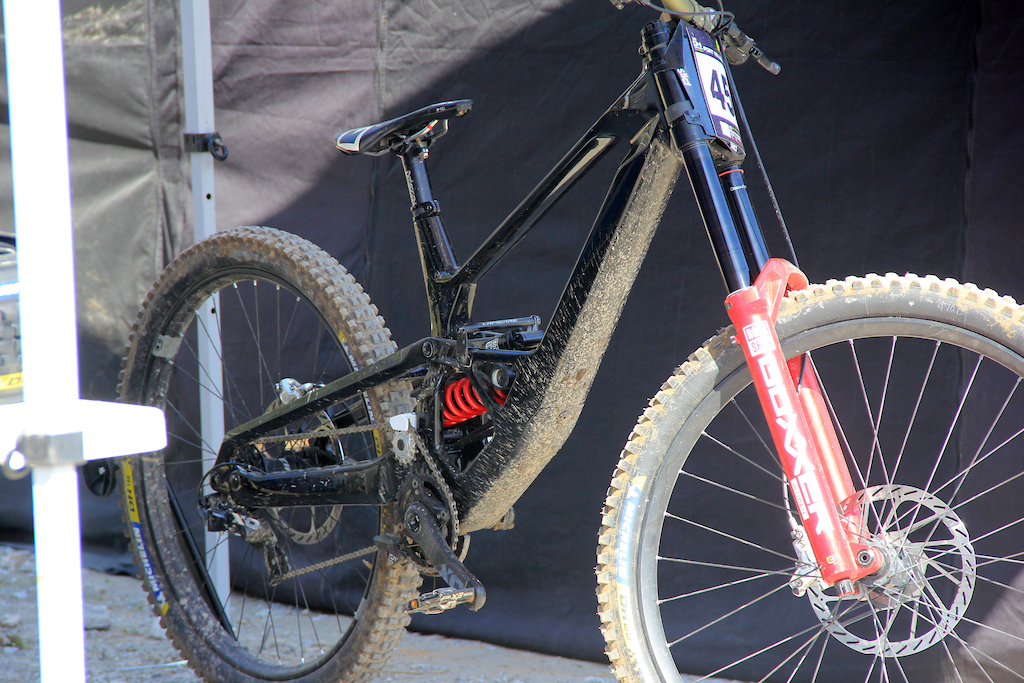
100% The rider must have a feel while using the rear brake they are trying to get. The was a rumor that Danny Hart was looking for something specific while riding this bike.
Looks like the updated Spicy enduro that was supposed to be realased last autumn
they should add it as an accessoire when buying a new tues. kinda ridiculous to launch that „new“ bike and their team riders are already using a different configuration the next day
I think it's a workaround for the relatively high levels of anti-squat on the new model. I was surprised to read the press release and how high the AS is on the new bike, but they also open their copy by talking about how their goal wasn't to make the fastest race bike, but something more versatile. I thought that was odd, but maybe YT made a conscious choice to subordinate their team riders desires for a more pedal-able, "poppy" bike for general population bike park use. YT riders have been using Ochain for a long time, and this idler looks like an attempt to solve the same problem.
could be, but kinda odd to make a „not so racey“ DH-race bike… to me the new tues is a total letdown. first the diaper to suggest something new and different is coming but the end result is basically a mullet version of the old bike with bumpstops added to the frame. geo is mostly the same except flipchip and on the conservative side.
look what others are doing like canyon, pivot, norco, even the new V10 is more different.
Here's another thought on Amaury's steel oval-shaped chainstay. The obvious conclusion is that they're chasing a particular amount of flex that they couldn't get out of aluminum, but here's another idea: What if they already had the level of flex they wanted out of the old bike, but they were breaking aluminum chainstays left and right? It makes sense that the chainstay would be the weak point in a flexy rear end, because it's the direct line from the bottom bracket (aka where most of the rider's mass is transmitted to the rest of the chassis) to the rear axle (the primary load-bearing wheel in violent turns). Steel has a much, much higher fatigue life cycle than aluminum, and would allow the chainstay to flex and flex all day long without breaking, like a leaf spring or torsion bar. Obviously the steel one still has welds, but I'd wager a welded steel leaf spring has a much higher fatigue life cycle than a welded aluminum leaf spring.
^agree... and they could have welded that thing in the breakroom at Commencal HQ.
Not sure if they have in-house Aluminum fab capabilities.
This thread is great! Been following since page 100ish and so glad it’s reached 600! Great work, your collected knowledge has given me the edge several times, keep it up!
I would agree, except for the fact that the frames are replaced so regularly anyway because of fatigue and cracking everywhere. This isn't a dig at commencal but I'd imagine each rider would go through 4+ frames during a season. I know teams that have used 6+ and Neko admitted to cracking 12 frames in a season.
Now, not all the failures are going to happen on the chainstays, in fact most won't. So great theory, but it doesn't really make sense as they'll swap the whole rest of the bike regularly anyway.
Schwalbe bingo? I'd bet Albert Grindstein...
What I'm suggesting is: what if a disproportionate, predictable, and inconvenient amount of failures are happening at the chainstay? For instance, imagine a rider going through 4 front triangles in a whole season but replacing 4 chainstays in a single weekend. I'm not suggesting that all those failures would be big, catastrophic, run-ending failures, but if there are cracks consistently forming at the welds over and over again throughout a weekend and you have to be swapping chainstays constantly, that's a major PITA for the riders and mechanics. And what if there was a simple way to fix that by switching materials? Carbon would also be good for flex/durability, but would go against the Commencal "all metal, all the time" ethos.
How long before Commencal throws away that ethos in pursuit of ultimate performance? They seem to be investing into the development of the platform (frame) a lot, one of the top 3 on the circuit?
Sorry I misunderstood before. That's a very valid theory.
I reckon it's still flex based, as they were testing pre steel stays with the adjustable seat stay bridge on the frame.
Someone posted a photo of the pivot moved to the seat stay a couple pages back too, that would totally change the entire suspension package.
The steel/alu/carbon flex characteristics are certainly the next frontier of MTB frames, gone are the days of stiffer is better.
Difficult to say - they’d blanked the model out…
Maybe Albert Gripstein
it's also curious that they are not running it in the front, it looks like an assegai, weird combinations, i feel that front and tacky chan in the back would be great
any info on the bar/stem Greg is running?

big fan of that markings on the bar and stem, makes setup super easy. why doesn‘t everyone deliver something like this?
Expensive as frig! (has to be quite precise to be of any use...)
going back to helmet rumors, many Alpinestars riders in Fort William are wearing the helmet that looks like the MX one. I guess it is indeed the nex DH version. Also, Canyon Pirelli riders are using what looks like a new helmet from Dainese. Chinguard looks very similar to the old AGV MX helmet.
That new branding in hideous… The „old“ one looks way better on bikes IMHO
I was watching Bruni's Gopro footage from Fort William practice, and something caught my eye. From the footage you can actually see when he switches between damping modes from the LEDs on his stem. It happens at least 3 times: 1) blue mode off the start till at least the wood section (I did not check if he switches anything in the upper section); 2) green mode in the wood section until the second turn/shark fin after the road gap; 3) back to blue mode for the new fast section; 4) red mode from the bridge before the motorway to the finish. I think this proves that it's not just a "firm mode" switch. I guess the RS flight attendant does the same thing, but automatically. I wonder how different the damping can be between the modes.
First switch:
Just after the second switch:
Third switch: