Hey folks, thought I'd share my DIY data acquisition project. It's been about 6 months in the making (so far) and is up and running. My...
Hey folks, thought I'd share my DIY data acquisition project. It's been about 6 months in the making (so far) and is up and running. My intention, once it's cleaned up and a few more of the wrinkles are worked out, is to open-source this.
Hardware-wise, it's based on an ESP32 dev board on a custom PCB that breaks out the connectors and does some simple analog signal processing. It supports 4 analog channels and digital sensors on I2C. It has a small OLED screen and keypad, and optional handlebar-mounted switch for starting and stopping logs and marking events of interest.
Apart from logging data (obviously) the logger runs some simple quality-of-life functions like sensor calibration, turning sensors on and off, and setting the sample rate (I've tested with 2 sensors up to 500Hz and have nice clean signals, at least to my eyes). The logger also supports wifi access for more detailed setup and downloading files. Optionally, you can apply transformations at the source (e.g. shock travel to wheel travel) either as a lookup table or polynomial. The firmware is designed to be extendable to other types of sensors but for now it's limited to analog inputs.
Sampling and recording sensor data is simply (ha!) an engineering problem; deciding what it means is of course the hard part. With this project I'm aiming for somewhere between a black-box “just trust the result” tool and dumping the raw data on the user: the goal isn’t to provide instant answers for everyone but rather to build an extendable set of tools that are useful straight away and provide a platform for "power users" to take further.
To that end, I've built a data pre-processing pipeline and some general-purpose widgets for browsing and analyzing the outputs. These are Python-based and run on Jupyter Lab, a free and open source interactive computing environment.
One aspect of the analysis pipeline I'm particularly pleased with is 'event detection from schema'. Users can specify in a configuration file particular things they are looking for in the data - deep compressions, say - and what they want to know about them from the available data series. This is a work in progress but is already quite flexible and powerful.
I've been running the system on my Stumpjumper Evo with a couple of AliExpress linear potentiometers and 3d printed mountings:
I'm conscious I'm jumping into the middle of a thread that is 12 pages deep, so if you think this belongs somewhere else, feel free to let me know. Otherwise, any thoughts, feedback or questions would be appreciated. I'm also on the hunt for people who would like to have a go at building one. It's not a beginner project as such, but none of it is actually rocket science either.
If you've made it this far, thanks for reading :-)
A fellow engineer I see! 😃 Looks very good! I'm also developing my own system (from page 9 onward there are a few photos of it).
I also plan to release it as OpenSource but first I need to make a few adjustments and create easier to build electronics. I currently use a SmartBee Datalogger Board (Which is also based on an ESP32) but it is not readily available unfortunately. So I plan to do a custom PCB which will connect a standard ESP32 to multiple needed boards).
My system currently logs at 800Hz and the timestamps look fine. So maybe you can also go even faster if needed :-)
I'm super excited to see another DIY project here. Let me know if you want to share knowledge, code or anything 😎
BTW there's a discord running regarding @synBike data logger where I think the plan is also to open source it. Maybe all you diyers might have valuable input there as well?
Hey folks, thought I'd share my DIY data acquisition project. It's been about 6 months in the making (so far) and is up and running. My...
Hey folks, thought I'd share my DIY data acquisition project. It's been about 6 months in the making (so far) and is up and running. My intention, once it's cleaned up and a few more of the wrinkles are worked out, is to open-source this.
Hardware-wise, it's based on an ESP32 dev board on a custom PCB that breaks out the connectors and does some simple analog signal processing. It supports 4 analog channels and digital sensors on I2C. It has a small OLED screen and keypad, and optional handlebar-mounted switch for starting and stopping logs and marking events of interest.
Apart from logging data (obviously) the logger runs some simple quality-of-life functions like sensor calibration, turning sensors on and off, and setting the sample rate (I've tested with 2 sensors up to 500Hz and have nice clean signals, at least to my eyes). The logger also supports wifi access for more detailed setup and downloading files. Optionally, you can apply transformations at the source (e.g. shock travel to wheel travel) either as a lookup table or polynomial. The firmware is designed to be extendable to other types of sensors but for now it's limited to analog inputs.
Sampling and recording sensor data is simply (ha!) an engineering problem; deciding what it means is of course the hard part. With this project I'm aiming for somewhere between a black-box “just trust the result” tool and dumping the raw data on the user: the goal isn’t to provide instant answers for everyone but rather to build an extendable set of tools that are useful straight away and provide a platform for "power users" to take further.
To that end, I've built a data pre-processing pipeline and some general-purpose widgets for browsing and analyzing the outputs. These are Python-based and run on Jupyter Lab, a free and open source interactive computing environment.
One aspect of the analysis pipeline I'm particularly pleased with is 'event detection from schema'. Users can specify in a configuration file particular things they are looking for in the data - deep compressions, say - and what they want to know about them from the available data series. This is a work in progress but is already quite flexible and powerful.
I've been running the system on my Stumpjumper Evo with a couple of AliExpress linear potentiometers and 3d printed mountings:
I'm conscious I'm jumping into the middle of a thread that is 12 pages deep, so if you think this belongs somewhere else, feel free to let me know. Otherwise, any thoughts, feedback or questions would be appreciated. I'm also on the hunt for people who would like to have a go at building one. It's not a beginner project as such, but none of it is actually rocket science either.
If you've made it this far, thanks for reading :-)
I think this is the correct place for this. What's the sampling rate you can go to? Does it stop at 500 Hz?
I haven't tested to find the limits (as yet). Based on how the sample queue behaves (samples are buffered and only written to the SD card periodically) I'd say it could go faster. The analog inputs have low-pass filtering that starts to attenuate above 500Hz but that could easily be made higher with different values for the resistors and capacitors.
BTW there's a discord running regarding @synBike data logger where I think the plan is also to open source it. Maybe all you diyers might have...
BTW there's a discord running regarding @synBike data logger where I think the plan is also to open source it. Maybe all you diyers might have valuable input there as well?
A fellow engineer I see! 😃 Looks very good! I'm also developing my own system (from page 9 onward there are a few photos of it).I...
A fellow engineer I see! 😃 Looks very good! I'm also developing my own system (from page 9 onward there are a few photos of it).
I also plan to release it as OpenSource but first I need to make a few adjustments and create easier to build electronics. I currently use a SmartBee Datalogger Board (Which is also based on an ESP32) but it is not readily available unfortunately. So I plan to do a custom PCB which will connect a standard ESP32 to multiple needed boards).
My system currently logs at 800Hz and the timestamps look fine. So maybe you can also go even faster if needed :-)
I'm super excited to see another DIY project here. Let me know if you want to share knowledge, code or anything 😎
Which potentiometers are you using?
Thanks! Yours is sweet also - especially the software. Very easy on the eye. By total coincidence I also started with the intention to use a Smart Bee, but in the time it took to arrive (it was unaccountably detained by customs) I got impatient and decided that having an external real-time clock wasn't a deal breaker. So I arrived at using a Sparkfun ESP32 Thing Plus S3. There are cheaper dev boards, but this one has an integrated SD card slot and is available worldwide so seemed like a good choice for an open source project.
I'm definitely up for sharing. I'm just embarassed about the state of my repo, or I'd send you a link just now :-)
The pots I'm using came off AliExpress. I'll post some pics (and links) a bit later. So far, they have been fine and they're a fair bit cheaper than the branded alternatives. I have a little side project to build DIY string pot - see the pic. That's on the shelf at the moment due to other priorities but I think it should be possible to DIY one for under $10. You can get string pots on Ali too, but they're all a bit chunky for my liking.
Cool to see all the open source stuff, anyone got a link to the synbike discord? When i've got some time i'll give a few of these builds a go and see if i can contribute back!
A fellow engineer I see! 😃 Looks very good! I'm also developing my own system (from page 9 onward there are a few photos of it).I...
A fellow engineer I see! 😃 Looks very good! I'm also developing my own system (from page 9 onward there are a few photos of it).
I also plan to release it as OpenSource but first I need to make a few adjustments and create easier to build electronics. I currently use a SmartBee Datalogger Board (Which is also based on an ESP32) but it is not readily available unfortunately. So I plan to do a custom PCB which will connect a standard ESP32 to multiple needed boards).
My system currently logs at 800Hz and the timestamps look fine. So maybe you can also go even faster if needed :-)
I'm super excited to see another DIY project here. Let me know if you want to share knowledge, code or anything 😎
Thanks! Yours is sweet also - especially the software. Very easy on the eye. By total coincidence I also started with the intention to use a...
Thanks! Yours is sweet also - especially the software. Very easy on the eye. By total coincidence I also started with the intention to use a Smart Bee, but in the time it took to arrive (it was unaccountably detained by customs) I got impatient and decided that having an external real-time clock wasn't a deal breaker. So I arrived at using a Sparkfun ESP32 Thing Plus S3. There are cheaper dev boards, but this one has an integrated SD card slot and is available worldwide so seemed like a good choice for an open source project.
I'm definitely up for sharing. I'm just embarassed about the state of my repo, or I'd send you a link just now :-)
The pots I'm using came off AliExpress. I'll post some pics (and links) a bit later. So far, they have been fine and they're a fair bit cheaper than the branded alternatives. I have a little side project to build DIY string pot - see the pic. That's on the shelf at the moment due to other priorities but I think it should be possible to DIY one for under $10. You can get string pots on Ali too, but they're all a bit chunky for my liking.
There's a lot of coincidences here...😄 By also total coincidence I'm also working on a string pot using an AS5600 encoder and also with the same kind of spring 😅 The plan is to (maybe) replace my fork sensor with this but due to the fact that my rear sensor is also an AS5600 I cannot use two of them on one I2C bus. So it's currently on the shelf too. Thanks for putting the sparkfun board in the mix, I'll definitely look at that one and maybe build the OpenSource version around this board :-)
@Primoz:
Thanks for pointing that out! I'll definitely search that one and join if allowed :-)
A fellow engineer I see! 😃 Looks very good! I'm also developing my own system (from page 9 onward there are a few photos of it).I...
A fellow engineer I see! 😃 Looks very good! I'm also developing my own system (from page 9 onward there are a few photos of it).
I also plan to release it as OpenSource but first I need to make a few adjustments and create easier to build electronics. I currently use a SmartBee Datalogger Board (Which is also based on an ESP32) but it is not readily available unfortunately. So I plan to do a custom PCB which will connect a standard ESP32 to multiple needed boards).
My system currently logs at 800Hz and the timestamps look fine. So maybe you can also go even faster if needed :-)
I'm super excited to see another DIY project here. Let me know if you want to share knowledge, code or anything 😎
Thanks! Yours is sweet also - especially the software. Very easy on the eye. By total coincidence I also started with the intention to use a...
Thanks! Yours is sweet also - especially the software. Very easy on the eye. By total coincidence I also started with the intention to use a Smart Bee, but in the time it took to arrive (it was unaccountably detained by customs) I got impatient and decided that having an external real-time clock wasn't a deal breaker. So I arrived at using a Sparkfun ESP32 Thing Plus S3. There are cheaper dev boards, but this one has an integrated SD card slot and is available worldwide so seemed like a good choice for an open source project.
I'm definitely up for sharing. I'm just embarassed about the state of my repo, or I'd send you a link just now :-)
The pots I'm using came off AliExpress. I'll post some pics (and links) a bit later. So far, they have been fine and they're a fair bit cheaper than the branded alternatives. I have a little side project to build DIY string pot - see the pic. That's on the shelf at the moment due to other priorities but I think it should be possible to DIY one for under $10. You can get string pots on Ali too, but they're all a bit chunky for my liking.
Nice work on the logger set up! looks very clean and cool to see the ali express sensors working well - I've often looked at them and figured they probably work well enough! That string pot is spookily similar to the one I was making a few pages back - I was planning on making it more as a sag measurement tool but its on hold for now as a few other projects have jumped the queue
I have been playing with an analog rotary potentiometer that might get on a bike soon - it definitely loses some resolution depending on the pivot its mounted too, as in it only uses 10% of the sensors range but it should be OK for most uses and should be miles tidier than a linear sensor
These folders contain files for 3d-printed linear potentiometer mounts. They were principally developed for my bike - a 2022 Stumpjumper Evo with a Vorsprung Telum shock and Fox 38s - and the particular linear pots I am using (12.7mm / 1/2" dia), but may be adaptable for others.
Included are both the mesh (STL) files, which all 3d printer slicer software should be able to cope with, and the Fusion design files (.f3d) in case you want to modify them. (Warning: the timelines for these are pretty messed up. Some time in the future I may re-master them but no promises ;-)
I recommend printing these in something strong, tough and resilient, like PA-CF, at 100% infill. In particular, note: - the lower fork mounts need to be stretched around the fork so anything too brittle will snap - the fork upper mounts are a bit bendy if printed hollow (you will likely end up with some <0 travel readings).
There are fork mounts to suit Fox 36 and Fox 38 forks (2 variations - one for 38s where the ID of the steerer is oval at the bottom, the other for where it is round). These can probably be used on Rockshox forks too but I haven't measured any.
The shock mounts are a bit more specific. The upper mount is made to clamp to the barrel of a Vorsprung Telum, just above the spring collar. It may work for other coil shocks but is probably too small to fit an air shock. The spherical bearing can be used to set the static alignment of the pot to point at the rear mount, but does not rotate in use: this design is not really kinematically robust and relies on some flex in the mounting to accomodate small misalignments.
These run to about $200 AU for the pair. They seem to work just fine (and look a lot like the ones in the picture on the syn.bike website, just sayin'). The long one in the pic has been crashed pretty solidly but still seems to work.
If you're after a mount that is a minor variation on any of these, then hit me up by DM. If I can I'll produce a modified design.
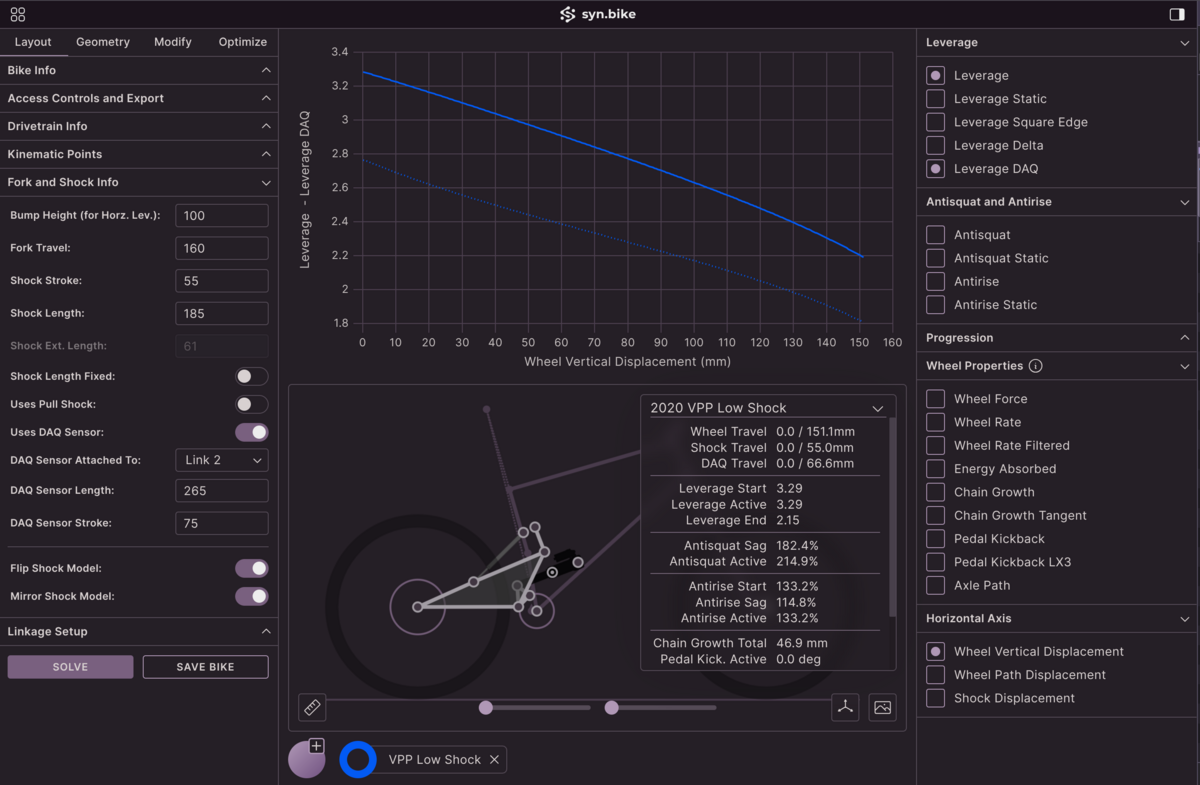
I have been seeing the request for leverage curves for offset-mounted linear sensors come up quite a bit more in the last 12 months. If you don't want to calculate this manually I finally got around to actually surfacing this functionality in the UI. The basic process is:
- measure your sensor eye to eye length at full extension (or what you want full extension to be, recommended to have a little buffer) - enter the stroke (only required for the visualization) - drag or enter the position points. For convenience the length is fixed and you can just move along the arc - view the DAQ curve or go to Layout -> Access Controls and Export -> Download Kinematic Results
The sensor travel is not restricted in any way (because it's not part of the core linkage). Double check in the summary panel that your configuration does not exceed your maximum sensor travel.
Hopefully this helps for the crazier sensor mountings out there.
@synBike That looks like super nice functionality! Making it easier to mount away from the shock is a big help for sure
I've nearly got a working analog rotary sensor - should be fairly easy to plug it in to any BYB system, and the potentiometer uses a universal mount that plugs in to a custom bracket for each frame. I moulded the 6mm hex with knead-it (I think JB weld plastic weld is the closest thing) around the potentiometer shaft. If it works I'll try and tidy it up, maybe find a better potentiometer for the job too.
Just need to map the angle values/% of the potentiometer range to the wheel travel so will test that out on monday, then hopefully get its first outing at Crankworx!
I was curious where some of you land on for shock velocities. I know different systems will record different velocities but I was reading the motion instruments user guide and saw this -
"Next focus on high speed compression. If you are riding really tough downhills, your max speed range will be in the 3000 mm/s range. Enduro pros are in the 4000 - 5500 mm/s range. Downhill can achieve speeds > 7000 mm/s. You want your wheel up and out of the way, if your fork is over damped on compression, something has to give, and it ends up being the whole bike. Your handlebars will move up into your hands. So if your max speeds are in the 2000 mm/s range on compression, then assume your bike is overdamped on compression"
I am hitting mid 4000 in my fork fairly normally and 5500-6k in the rear almost every test. My averages F/R are in the 300 and 95ths in the 1300. I understand that a lot of the velocities are going to be subjective to what feels good to the rider but I was curious if you guys had an approximate bracket you shoot for, for DH vs enduro? I would like to try a different tune on my shock to see if I can still get my peak speeds down but I don't know if its possible with my skills.
This looks already well-balanced (according to my amateurish eyes and acquisitions I've done so far). I try to get my rear in the 5000m/s range just to match my fork (and ease my ocd) -- but if that makes any sense -- I have no idea. It "feels" better, but I guess you put way more force through your feet, so faster hsc velocities kinda make sense on the rear of the bike. Not sure how much of a thing a balanced bike (regarding front/rear measurements) is for the pros? I feel like I gained the most from data aqu. just by achieving around ~30% dynamic sag on the rear wheel, which is quite a lot stiffer that I'd usually run my rear shock when relying on static sag measurements on shock stroke. Then sped up the fork to about as fast as I could handle it on rough terrain and adjusted the rear accordingly.
I was curious where some of you land on for shock velocities. I know different systems will record different velocities but I was reading the motion...
I was curious where some of you land on for shock velocities. I know different systems will record different velocities but I was reading the motion instruments user guide and saw this -
"Next focus on high speed compression. If you are riding really tough downhills, your max speed range will be in the 3000 mm/s range. Enduro pros are in the 4000 - 5500 mm/s range. Downhill can achieve speeds > 7000 mm/s. You want your wheel up and out of the way, if your fork is over damped on compression, something has to give, and it ends up being the whole bike. Your handlebars will move up into your hands. So if your max speeds are in the 2000 mm/s range on compression, then assume your bike is overdamped on compression"
I am hitting mid 4000 in my fork fairly normally and 5500-6k in the rear almost every test. My averages F/R are in the 300 and 95ths in the 1300. I understand that a lot of the velocities are going to be subjective to what feels good to the rider but I was curious if you guys had an approximate bracket you shoot for, for DH vs enduro? I would like to try a different tune on my shock to see if I can still get my peak speeds down but I don't know if its possible with my skills.
Could I please request that people add a quick reminder note of their bike & suspension with these posts? eg
Bike: 2023 Levo
Fork: FOX 38 170mm
Shock: Vivid Coil 550lb/in spring
I lose track of what people are on, and I think its important to not forget the context of what the data relates to. So also include what you feel it could be better or is doing well in terms of is it bottoming, harsh on big bumps, wallowing on rolling terrain and so on. Just looking at a set of numbers, there can be multiple things causing values to trend one way or another so the context is the thing that should be asking the question and you use the data to help guide you to the answer.
IF you are finding that the bike is blowing through travel a lot or gets "overwhelmed", i would probably try a stiffer compression tune, but there will be trial and error with this stuff. Looking at the histogram it does look like the rebound is pinched up towards the centre alittle more than the fork which means it is spending more time rebounding than compressing, which is another sign of potentially needed more compression damping. For a 150mm trail bike I would normally see rear compression speeds around 4-5m/s, 6 isn't unheard of but definitely getting quite high - it does depend on the trails if you have a lot of drops or square edge bumps then high speeds will be expected
I was curious where some of you land on for shock velocities. I know different systems will record different velocities but I was reading the motion...
I was curious where some of you land on for shock velocities. I know different systems will record different velocities but I was reading the motion instruments user guide and saw this -
"Next focus on high speed compression. If you are riding really tough downhills, your max speed range will be in the 3000 mm/s range. Enduro pros are in the 4000 - 5500 mm/s range. Downhill can achieve speeds > 7000 mm/s. You want your wheel up and out of the way, if your fork is over damped on compression, something has to give, and it ends up being the whole bike. Your handlebars will move up into your hands. So if your max speeds are in the 2000 mm/s range on compression, then assume your bike is overdamped on compression"
I am hitting mid 4000 in my fork fairly normally and 5500-6k in the rear almost every test. My averages F/R are in the 300 and 95ths in the 1300. I understand that a lot of the velocities are going to be subjective to what feels good to the rider but I was curious if you guys had an approximate bracket you shoot for, for DH vs enduro? I would like to try a different tune on my shock to see if I can still get my peak speeds down but I don't know if its possible with my skills.
Could I please request that people add a quick reminder note of their bike & suspension with these posts? eg Bike: 2023 LevoFork: FOX 38 170mmShock: Vivid...
Could I please request that people add a quick reminder note of their bike & suspension with these posts? eg
Bike: 2023 Levo
Fork: FOX 38 170mm
Shock: Vivid Coil 550lb/in spring
I lose track of what people are on, and I think its important to not forget the context of what the data relates to. So also include what you feel it could be better or is doing well in terms of is it bottoming, harsh on big bumps, wallowing on rolling terrain and so on. Just looking at a set of numbers, there can be multiple things causing values to trend one way or another so the context is the thing that should be asking the question and you use the data to help guide you to the answer.
IF you are finding that the bike is blowing through travel a lot or gets "overwhelmed", i would probably try a stiffer compression tune, but there will be trial and error with this stuff. Looking at the histogram it does look like the rebound is pinched up towards the centre alittle more than the fork which means it is spending more time rebounding than compressing, which is another sign of potentially needed more compression damping. For a 150mm trail bike I would normally see rear compression speeds around 4-5m/s, 6 isn't unheard of but definitely getting quite high - it does depend on the trails if you have a lot of drops or square edge bumps then high speeds will be expected
Sorry thats a good point.
25 Specialized Lardo 4 with a cascade link long chainstay position
Fox 38 170mm grip x2 110psi 3 tokens
Fox DHX 400# spring Fluid focus bumper "custom tune" I am waiting on an adapter so I can bleed and build another stack.
When I looked at the histogram I thought the rear was rebounding more than the fork but looking at the summary my average, max and 95th were all less so speeding it up would be what I think would be needed. They're a bit conflicting on what the say. I still have a preloaded ring shim stack that I was thinking about trying to change out. Would this be part of my issue?
Would the use of a really high starting LR link (like Cascade) cause that graph to "pinch"? Or would it more likely be from a very low anti-rise that Specialized tends to favor?
I was curious where some of you land on for shock velocities. I know different systems will record different velocities but I was reading the motion...
I was curious where some of you land on for shock velocities. I know different systems will record different velocities but I was reading the motion instruments user guide and saw this -
"Next focus on high speed compression. If you are riding really tough downhills, your max speed range will be in the 3000 mm/s range. Enduro pros are in the 4000 - 5500 mm/s range. Downhill can achieve speeds > 7000 mm/s. You want your wheel up and out of the way, if your fork is over damped on compression, something has to give, and it ends up being the whole bike. Your handlebars will move up into your hands. So if your max speeds are in the 2000 mm/s range on compression, then assume your bike is overdamped on compression"
I am hitting mid 4000 in my fork fairly normally and 5500-6k in the rear almost every test. My averages F/R are in the 300 and 95ths in the 1300. I understand that a lot of the velocities are going to be subjective to what feels good to the rider but I was curious if you guys had an approximate bracket you shoot for, for DH vs enduro? I would like to try a different tune on my shock to see if I can still get my peak speeds down but I don't know if its possible with my skills.
Try opening up low speed rebound 1-2 clicks on the rear
I cannot believe I actually found a picture (I knew there was a reason I did that...) but this is what I did. Now that I think about it, I did snap a sensor or 2 mounting them this way - don't remember if this was one of them though
Has anyone had success in mounting a shock sensor to a coil equipped Specialized Enduro?
Try mounting it without the ball joint swivels and using the 3d printed mount on the front and zip tying directly to the coil adapter on the rear. I had to do it this way on a V10 recently.
Work continues on the analysis pipeline for my data logging project. While I have ambitions beyond these kind of basic descriptive statistics, it seemed worthwhile to replicate some of the charts and metrics that seem to be widely used in analysis of suspension data.
These, like all my data analysis tools, are built in Jupyter Lab. I have separate notebooks for pre-processing the raw logger data (detecting inactive periods, calculating velocity and acceleration, calculating normalised displacement, low-pass filtering and event detection, assigning semantic roles to data series and stashing it all in a library) and for other general-purpose visualisations that are exploratory at this stage. My focus just now is on expanding pre-processing and library management to include bike setup data and to merge GPS data from another device such as a bike computer.
I'm also endeavouring to document the API surfaces of these tools so others can use them too.
I also was able to jump on the bike today before the rain comes back tomorrow. Here is a video of a short test ride on my hometrail with the new rear sensor (link arm driven rotary encoder, measuring rear wheel travel directly over the rear triangle). I strugle a bit to get my rear shock matching up with the fork. No matter what I do, the rear rebound is always a touch faster than the front (even completely closed up...). It also seems like the LSC is not doing enough, even almost fully closed at 4/5 clicks. The max travel was reached during a G-Out. Never finished I guess 😉 Anyways, here is the video, some screenshots of the data and the current setup of the video. Feedback and ideas for setup changes are welcome.😊
Bike: Santa Cruz Heckler SL
Fork: DVO Diamond D1 OTT
125 PSI
11 Rotations OTT
-17 LSR
2 LSC
0 HSC
> This leads to 20% static SAG
Shock: Rockshox Vivid Air Ultimate
245PSI
2 Tokens
-10 LSR
LSC 4/5
HSC 3/5
HBO 3/5
> This leads to 30% static SAG (29-31% recommended by Santa Cruz)
Very tidy! the graphs look nice - that can be tough to plot them just right to make the data clear
The Diamond damper does have very slow rebound (small ports in the piston etc) so the peak speeds will always be quite low with those forks. Bit strange on the Vivid though - their rebound valving can normally be slowed right down in the recent generation dampers.


A fellow engineer I see! 😃 Looks very good! I'm also developing my own system (from page 9 onward there are a few photos of it).
I also plan to release it as OpenSource but first I need to make a few adjustments and create easier to build electronics. I currently use a SmartBee Datalogger Board (Which is also based on an ESP32) but it is not readily available unfortunately. So I plan to do a custom PCB which will connect a standard ESP32 to multiple needed boards).
My system currently logs at 800Hz and the timestamps look fine. So maybe you can also go even faster if needed :-)
I'm super excited to see another DIY project here. Let me know if you want to share knowledge, code or anything 😎
Which potentiometers are you using?
BTW there's a discord running regarding @synBike data logger where I think the plan is also to open source it. Maybe all you diyers might have valuable input there as well?
I haven't tested to find the limits (as yet). Based on how the sample queue behaves (samples are buffered and only written to the SD card periodically) I'd say it could go faster. The analog inputs have low-pass filtering that starts to attenuate above 500Hz but that could easily be made higher with different values for the resistors and capacitors.
Thanks - was not aware. I'll hunt it out.
Thanks! Yours is sweet also - especially the software. Very easy on the eye. By total coincidence I also started with the intention to use a Smart Bee, but in the time it took to arrive (it was unaccountably detained by customs) I got impatient and decided that having an external real-time clock wasn't a deal breaker. So I arrived at using a Sparkfun ESP32 Thing Plus S3. There are cheaper dev boards, but this one has an integrated SD card slot and is available worldwide so seemed like a good choice for an open source project.
I'm definitely up for sharing. I'm just embarassed about the state of my repo, or I'd send you a link just now :-)
The pots I'm using came off AliExpress. I'll post some pics (and links) a bit later. So far, they have been fine and they're a fair bit cheaper than the branded alternatives. I have a little side project to build DIY string pot - see the pic. That's on the shelf at the moment due to other priorities but I think it should be possible to DIY one for under $10. You can get string pots on Ali too, but they're all a bit chunky for my liking.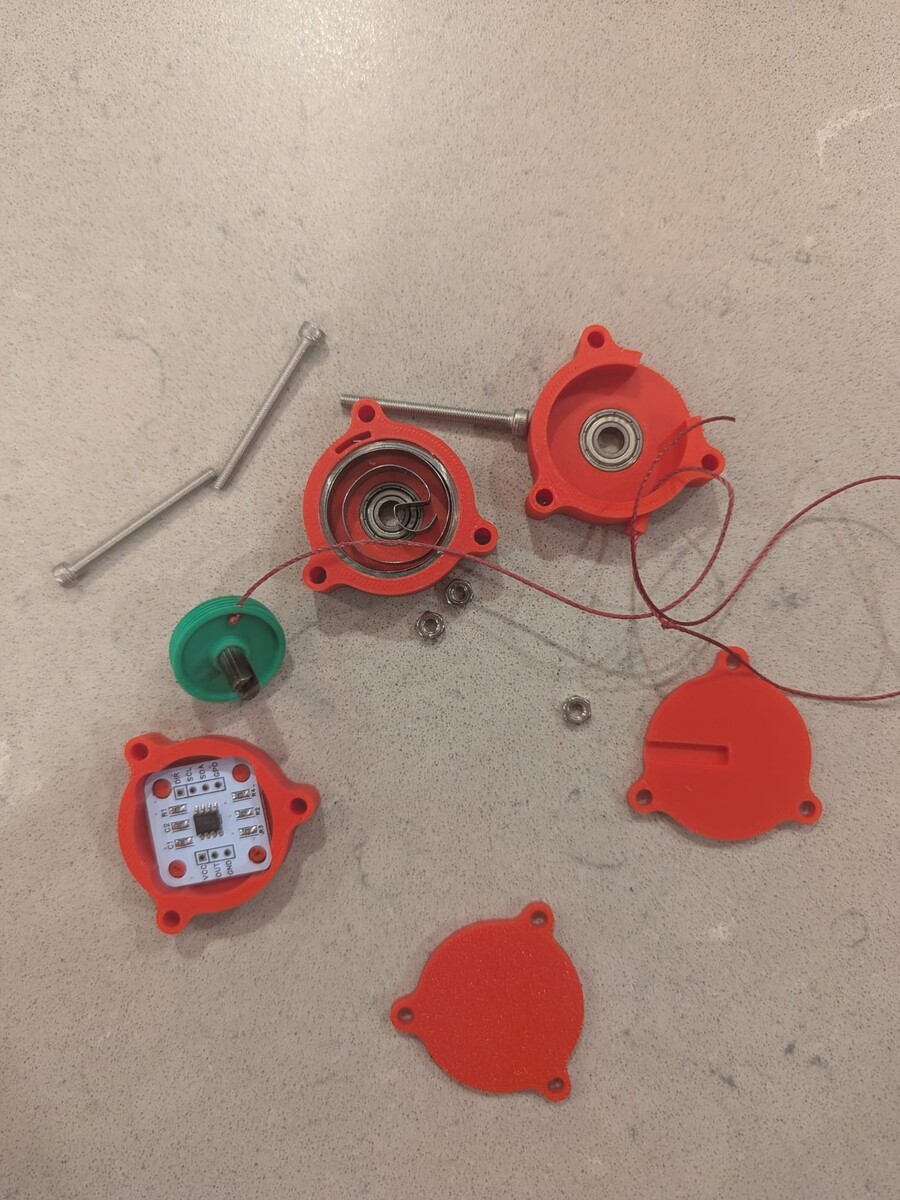
That was me, and a lot of fiddling it was too. But it's been bombproof. Happy to share the files if there's interest.
Cool to see all the open source stuff, anyone got a link to the synbike discord? When i've got some time i'll give a few of these builds a go and see if i can contribute back!
Please, I'll send a DM.
There's a lot of coincidences here...😄 By also total coincidence I'm also working on a string pot using an AS5600 encoder and also with the same kind of spring 😅 The plan is to (maybe) replace my fork sensor with this but due to the fact that my rear sensor is also an AS5600 I cannot use two of them on one I2C bus. So it's currently on the shelf too. Thanks for putting the sparkfun board in the mix, I'll definitely look at that one and maybe build the OpenSource version around this board :-)
@Primoz:
Thanks for pointing that out! I'll definitely search that one and join if allowed :-)
Some photos from BYB of clean mounting setups!
Nice work on the logger set up! looks very clean and cool to see the ali express sensors working well - I've often looked at them and figured they probably work well enough! That string pot is spookily similar to the one I was making a few pages back - I was planning on making it more as a sag measurement tool but its on hold for now as a few other projects have jumped the queue
I have been playing with an analog rotary potentiometer that might get on a bike soon - it definitely loses some resolution depending on the pivot its mounted too, as in it only uses 10% of the sensors range but it should be OK for most uses and should be miles tidier than a linear sensor
I hope @synBike doesn't mind... https://discord.gg/WPjcxPhg
Per a DM request, I've put my sensor mount designs in a Google Drive folder, here:
https://drive.google.com/drive/folders/1rIsdjYRYZxvGNPqRv1Ob1g5by7T4zd1j?usp=sharing
These folders contain files for 3d-printed linear potentiometer mounts. They were principally developed for my bike - a 2022 Stumpjumper Evo with a Vorsprung Telum shock and Fox 38s - and the particular linear pots I am using (12.7mm / 1/2" dia), but may be adaptable for others.
Included are both the mesh (STL) files, which all 3d printer slicer software should be able to cope with, and the Fusion design files (.f3d) in case you want to modify them. (Warning: the timelines for these are pretty messed up. Some time in the future I may re-master them but no promises ;-)
I recommend printing these in something strong, tough and resilient, like PA-CF, at 100% infill. In particular, note:
- the lower fork mounts need to be stretched around the fork so anything too brittle will snap
- the fork upper mounts are a bit bendy if printed hollow (you will likely end up with some <0 travel readings).
There are fork mounts to suit Fox 36 and Fox 38 forks (2 variations - one for 38s where the ID of the steerer is oval at the bottom, the other for where it is round). These can probably be used on Rockshox forks too but I haven't measured any.
The shock mounts are a bit more specific. The upper mount is made to clamp to the barrel of a Vorsprung Telum, just above the spring collar. It may work for other coil shocks but is probably too small to fit an air shock. The spherical bearing can be used to set the static alignment of the pot to point at the rear mount, but does not rotate in use: this design is not really kinematically robust and relies on some flex in the mounting to accomodate small misalignments.
The linear pots I use can be found here:

https://www.aliexpress.com/item/1005008810289538.html
These run to about $200 AU for the pair. They seem to work just fine (and look a lot like the ones in the picture on the syn.bike website, just sayin'). The long one in the pic has been crashed pretty solidly but still seems to work.
If you're after a mount that is a minor variation on any of these, then hit me up by DM. If I can I'll produce a modified design.
Also, I have an Instagram account for the project: Instagram.com/bodaqs.
I have been seeing the request for leverage curves for offset-mounted linear sensors come up quite a bit more in the last 12 months. If you don't want to calculate this manually I finally got around to actually surfacing this functionality in the UI. The basic process is:
- measure your sensor eye to eye length at full extension (or what you want full extension to be, recommended to have a little buffer)
- enter the stroke (only required for the visualization)
- drag or enter the position points. For convenience the length is fixed and you can just move along the arc
- view the DAQ curve or go to Layout -> Access Controls and Export -> Download Kinematic Results
The sensor travel is not restricted in any way (because it's not part of the core linkage). Double check in the summary panel that your configuration does not exceed your maximum sensor travel.
Hopefully this helps for the crazier sensor mountings out there.
@synBike That looks like super nice functionality! Making it easier to mount away from the shock is a big help for sure
I've nearly got a working analog rotary sensor - should be fairly easy to plug it in to any BYB system, and the potentiometer uses a universal mount that plugs in to a custom bracket for each frame. I moulded the 6mm hex with knead-it (I think JB weld plastic weld is the closest thing) around the potentiometer shaft. If it works I'll try and tidy it up, maybe find a better potentiometer for the job too.
Just need to map the angle values/% of the potentiometer range to the wheel travel so will test that out on monday, then hopefully get its first outing at Crankworx!
I was curious where some of you land on for shock velocities. I know different systems will record different velocities but I was reading the motion instruments user guide and saw this -
"Next focus on high speed compression. If you are riding really tough downhills, your max speed
range will be in the 3000 mm/s range. Enduro pros are in the 4000 - 5500 mm/s range. Downhill
can achieve speeds > 7000 mm/s. You want your wheel up and out of the way, if your fork is
over damped on compression, something has to give, and it ends up being the whole bike. Your
handlebars will move up into your hands. So if your max speeds are in the 2000 mm/s range on
compression, then assume your bike is overdamped on compression"
I am hitting mid 4000 in my fork fairly normally and 5500-6k in the rear almost every test. My averages F/R are in the 300 and 95ths in the 1300. I understand that a lot of the velocities are going to be subjective to what feels good to the rider but I was curious if you guys had an approximate bracket you shoot for, for DH vs enduro? I would like to try a different tune on my shock to see if I can still get my peak speeds down but I don't know if its possible with my skills.
This looks already well-balanced (according to my amateurish eyes and acquisitions I've done so far). I try to get my rear in the 5000m/s range just to match my fork (and ease my ocd) -- but if that makes any sense -- I have no idea. It "feels" better, but I guess you put way more force through your feet, so faster hsc velocities kinda make sense on the rear of the bike. Not sure how much of a thing a balanced bike (regarding front/rear measurements) is for the pros? I feel like I gained the most from data aqu. just by achieving around ~30% dynamic sag on the rear wheel, which is quite a lot stiffer that I'd usually run my rear shock when relying on static sag measurements on shock stroke. Then sped up the fork to about as fast as I could handle it on rough terrain and adjusted the rear accordingly.
Could I please request that people add a quick reminder note of their bike & suspension with these posts? eg
Bike: 2023 Levo
Fork: FOX 38 170mm
Shock: Vivid Coil 550lb/in spring
I lose track of what people are on, and I think its important to not forget the context of what the data relates to. So also include what you feel it could be better or is doing well in terms of is it bottoming, harsh on big bumps, wallowing on rolling terrain and so on. Just looking at a set of numbers, there can be multiple things causing values to trend one way or another so the context is the thing that should be asking the question and you use the data to help guide you to the answer.
IF you are finding that the bike is blowing through travel a lot or gets "overwhelmed", i would probably try a stiffer compression tune, but there will be trial and error with this stuff. Looking at the histogram it does look like the rebound is pinched up towards the centre alittle more than the fork which means it is spending more time rebounding than compressing, which is another sign of potentially needed more compression damping. For a 150mm trail bike I would normally see rear compression speeds around 4-5m/s, 6 isn't unheard of but definitely getting quite high - it does depend on the trails if you have a lot of drops or square edge bumps then high speeds will be expected
Sorry thats a good point.
25 Specialized Lardo 4 with a cascade link long chainstay position
Fox 38 170mm grip x2 110psi 3 tokens
Fox DHX 400# spring Fluid focus bumper "custom tune" I am waiting on an adapter so I can bleed and build another stack.
When I looked at the histogram I thought the rear was rebounding more than the fork but looking at the summary my average, max and 95th were all less so speeding it up would be what I think would be needed. They're a bit conflicting on what the say. I still have a preloaded ring shim stack that I was thinking about trying to change out. Would this be part of my issue?
Would the use of a really high starting LR link (like Cascade) cause that graph to "pinch"? Or would it more likely be from a very low anti-rise that Specialized tends to favor?
Try opening up low speed rebound 1-2 clicks on the rear
Has anyone had success in mounting a shock sensor to a coil equipped Specialized Enduro?
would need to check the archives but I think I've done it using a mount on the top tube and swingram
I cannot believe I actually found a picture (I knew there was a reason I did that...) but this is what I did. Now that I think about it, I did snap a sensor or 2 mounting them this way - don't remember if this was one of them though
Is there not enough room to mount to the ring and the reservoir?
Try mounting it without the ball joint swivels and using the 3d printed mount on the front and zip tying directly to the coil adapter on the rear. I had to do it this way on a V10 recently.
Work continues on the analysis pipeline for my data logging project. While I have ambitions beyond these kind of basic descriptive statistics, it seemed worthwhile to replicate some of the charts and metrics that seem to be widely used in analysis of suspension data.
These, like all my data analysis tools, are built in Jupyter Lab. I have separate notebooks for pre-processing the raw logger data (detecting inactive periods, calculating velocity and acceleration, calculating normalised displacement, low-pass filtering and event detection, assigning semantic roles to data series and stashing it all in a library) and for other general-purpose visualisations that are exploratory at this stage. My focus just now is on expanding pre-processing and library management to include bike setup data and to merge GPS data from another device such as a bike computer.
I'm also endeavouring to document the API surfaces of these tools so others can use them too.
I also was able to jump on the bike today before the rain comes back tomorrow. Here is a video of a short test ride on my hometrail with the new rear sensor (link arm driven rotary encoder, measuring rear wheel travel directly over the rear triangle). I strugle a bit to get my rear shock matching up with the fork. No matter what I do, the rear rebound is always a touch faster than the front (even completely closed up...).
It also seems like the LSC is not doing enough, even almost fully closed at 4/5 clicks. The max travel was reached during a G-Out. Never finished I guess 😉
Anyways, here is the video, some screenshots of the data and the current setup of the video.
Feedback and ideas for setup changes are welcome.😊
Bike: Santa Cruz Heckler SL
Fork: DVO Diamond D1 OTT
125 PSI
11 Rotations OTT
-17 LSR
2 LSC
0 HSC
> This leads to 20% static SAG
Shock: Rockshox Vivid Air Ultimate
245PSI
2 Tokens
-10 LSR
LSC 4/5
HSC 3/5
HBO 3/5
> This leads to 30% static SAG (29-31% recommended by Santa Cruz)
Very tidy! the graphs look nice - that can be tough to plot them just right to make the data clear
The Diamond damper does have very slow rebound (small ports in the piston etc) so the peak speeds will always be quite low with those forks. Bit strange on the Vivid though - their rebound valving can normally be slowed right down in the recent generation dampers.
Post a reply to: Suspension Data Acquisition