The bike industry as a whole could have sold more than they did in 2020 and most likely throughout the whole 2021. However, the supply chains simply were not able to cope with the demand. And I completely understand that, for some companies (those that essentially everyone needed parts from) it was impossible to give exact lead times. Their systerm could not scale for that demand and that's why you suddenly heard about lead times of 700-800 days. In reality it could have been 300 or 1000. Simply because no one could accurately scale it up just like that, because everybody else at the same time needed to scale up, too. At some point it was not only even about parts anymore, but about raw materials. There was not enough aluminum. So you simply could not know accurate lead times. That was a big mess, but unavoidable. So many things came together at once, and these things adding up, disrupted an industry that had grown and developed networks, lead times, habits consistently over the years more or less steadily.
So, if you want to know if we could have sold those posts AT SOME POINT IN TIME, my answer is: It depends on how you mean it.
If you refer simply to the sheer quantity and time is the variable, then MAYBE in 2020 and 2021. IF that particular customer had miraculously managed to spawn the rest of the needed parts to complete all these bikes out of nowhere and had them all available at once at peak Covid demand. Then, maybe we could have successfuly sold them.
But if you refer to these specific posts, which were meant for 2022 and 2023, the answer is simply: NO WAY. If we had produced them or ordered raw material for all these forecasted posts, we wouldn't have sold them. The demand was simply gone by then. I would need to pull the detailed numbers, but we delivered only a fraction of that.
And then you are asking: Could we have sold them? You are not asking if we could have sold them healthily. There are ways that you could set up contracts that say that orders are obiliged to be taken (forecasts are not orders by the way, the formal order comes later). So the problem is not neccessarily that we could have sold them to our OE partner. Even if we had nailed down our partners to take them off our hands and pay them, because they have to, then it only solves the problem on the short run. These posts then need to be sold again to the end consumer. And as long as that remains in a complete bike, I do not care. But if these posts are being sold aftermarket, for prices that our own dealers can't compete with, because they do not buy bulk OE products, then we have a problem. And that is why we always tried to make sure that we only produce what was really needed in the market at that time and if OE customers told us to postpone or cancel orders (even if ready to ship), we cancelled them without hesitation, without penalty. We even purchase back a six-figure-value of posts from another OE customer after they had found out too late that they had overstepped in taking orders. They already had received several shipments becond their needs. When I asked them why they hadn't reached out to me earlier, they said, that they were black and blue from discussing with other vendors who insisted on payment and who would not let them out of theior contracts. For us it was simple: We purchased back ALL posts for the same price they paid to us. And why? Simply because we were in a position to do so and because OE customers are not only customers to us. To us they are partners and they can trust that we got their back, as long as we can.
I've always wondered since covid if at any point someone at one of the major player ever questioned if people were willing to wait 18 months for a bike? I know at the shop level, when that wait got past 8 months, people were way less willing to commit. I even bypassed my boss's normal policy of full down payments for special orders because I figured a small deposit was easier for the shop to return...
I believe it's hard to put the blame on anyone specific. It's also not always fair to wonder, "what they were thinking". There are no hard feelings or criticism from our side towards anyone of our partners who might have forecasted too high, because it is our call to interprete these forecasts for ourselves. We have outstanding and strong relationships with all of our partners. Many of these relationships go way back. What I was trying to say with my post was that this was an extremely unreal situation everyone suddenly found themselves in. And it was naturally going to be impossible to get right. I would not have wanted to be in the shoes of anyone else, let alone one of the big players. They found themselves in a situation that was orders of magnitudes more difficult than ours. Yes, bike brands tried to get parts from any vendor possible. That's what they had to to to get bikes for sale. That's their job. So in the example of droppers, they might have placed the orders or forecasts to us, but at the same time to multiple other suppliers as well, just to maximize the chance to get any at all. They placed them just to have the foot in the door. But it's not like they pulled these numbers out of thin air. What applies to the supplier-brand level, also applies at the level of shops to customer level: Customers ran into the shops and ordered bikes, and if not available immediately, they preordered their bike at their dealer. The shop then placed their order(s) to the brand. The brand placed their orders to their vendors based on the orders they received themselves from dealers (or customers in case of DTC) Customer Z, because everything was out of stock, did not only order a bike from brand A from dealer F. Customer Z also ordered a brand B from dealer G and possibly a brand C from dealer H and maybe even a brand D from dealer I. In the end, the customer Z settled with the bike B from dealer G, because that's what they got first and then cancelled the other orders. So dealers F, H, I were left with the bike that now they do not have a customer for. And if the dealers were not left with the bikes (because they were still with the b rand), then the brands A, C, D were left with the bike. All in all, it was probably an unavoidable scenario that no one can truly be blamed for. No one knew how to handle this kind of extreme and sudden, but timely limited demand.
I'd particularly love to know what's involved in actual bike industry forecasting. What the heck are people doing?
There is mostly 2 type of forecasting for most retail business. High Level financial forecasting mostly done by management team with helps from in-house financial analyst or external consultant. Then there is demand planning forecast based on those financials forecast that will translate sales target numbers in dollars from the management team into actual product/parts of bill of material units sold monthly/weekly and spread for size/color/etc.
Forecasting in any industry is a mixture of science and voodoo (I'm a forecaster in a completely different industry).
At its best it's an educated guess, at it's worst it's a random dart on the board.
There's often so many moving parts that the human mind truely struggles to comprehend the range of outcomes and so tends to default to bias and hubris.
The seminal books on this are things like "Thinking fast and slow"
Maybe I need to look back to find screenshots, but I remember everyone screaming in the comments and forums that this is insanity and unsustainable (myself included). It's just like cash for clunkers- demand didn't actually go up much, it is just that stimmy checks pull future demand into the present, plus adds inflation
I'd particularly love to know what's involved in actual bike industry forecasting. What the heck are people doing?
If you want to know the defnition of what a forecast is, I cna try to explain in my own words (that is how we work with forecasts and does not need to apply for others):
For starters, we are an OEM (Original Equipment Manufacturer) for many brands. That means that companies buy our products to put them on their complete bikes. Usually, before the beginning of a new year or model year, our customers will provide us with an estimate of their complete demand for a certain period of time. This estimate is called a forecast. This forecast can typically span over a whole year or half a year, or quarter of a year. This forecast is not an official order. It is an estimate (i.e. educated guess, as someone said) of the demand they are expecting for said period. We need this forecast to plan and distribute our production and assembly capacities and also order raw materials. Forecasts are also often further broken down into months. Example: Customer X provides a forecast of 1,454 REVIVE 230/31.6 posts for 2026 and they provide a monthly break down as following:
Jan '26: 68 posts Feb '26: 76 posts Mar '26: 115 posts Apr '26: 123 posts May '26: 175 posts Jun '26: 183 posts Jul '26: 193 posts Aug: '26: 153 posts Sep '26: 122 posts Oct '26: 109 posts Nov '26: 83 posts Dec '26: 54 posts
At the same time, Lead Times are communicated. Lead Time is the time span we need to prepare the goods of a placed order. Let's assume we have a Lead Time of 45 days, then customer X places his order and then needs to wait 45 days until we can ship it. Lead Times have established over time by experience. We know our monthly output capacity and we know the demand for each of the coming months from all our customers that gave a forecast. We also know past years, and usually there is not a big shift. We do also try to keep capacity reserves for urgent and unscheduled demands. Smaller OE customers or distributors for example do not need to provide a forecast (at least that is the case for us), but we still want to be able to deliver their "unannounced orders" in a timely manner. Based on all the information we are fed with and based on what we typically can expect on unannounced orders on top, we provide and communicate Lead Times. Lead Times "develop" historically and usually do not shift or change too much. Problems with a supplier or a bad batch of tubes or bolts, ... can bring you into troubles and cause delays, but usually you plan your material stock not for Just In Time manufacturing,. There is the opccasional hiccup, though, of course.
Anyway, in order to receive their posts for January in time, customer X from above knows that they will need to place/lock the final order by middle of November 2025. The February order needs to be placed/locked by middle of December, and so on. Naturally, customers will lock their order as close to the deadline as possible because those numbers will reflect their most accurate actual demand and everyone wants to keep chash flow in check, for boviuous reasons. So, when the final order is placed, best case scenario is that the order is close or identical to the forecasted numbers. Small changes often happes and are usually no issue. That's why it's a forecast. You also don't know tomorrow's weather, but you usually have a very good idea. Should there be an unexpected and overly big urgent demand, Lead Times might need to be temporarily adjusted and communicated, or we can try to work harder that one month to keep the planned or scheduled deliveries for the following months unaffected. That works as long as you have enough manpower and machines and enough material on hand.
Needless to say that you can not scale up to a multiple of your capacity out of nothing and permanently. Neither do you have enough skilled workers, nor machines, nor materials. That is exactly what happened in 2020 and 2021. Demand increased from basically 1 to 3. And that happened not only at your company, but basically in the whole industry. So, a system that had developed slowly over time, actually decades, suddenly changed dramatically. Previously discussed forecasts you had been planning with became completey useless, your Lead Times suddenly had to be guesstimated because everything had turned into an unprecedentet event with no former data to draw from. You did not understand what was going, where to get all that stuff from on and you were generally simply completely overwhelmed.
Sorry, my English is not the best, but I hope it was somwehat understandable what forecasts are and what they are for.
Completely O/T but a big shout-out to @Sacki - your posts changed my dropper experience from a random gamble to a reliable, dependable, don't-have-to-think-about-it-anymore boring matter. Boring is good.
@Sacki care to share where you manufacture your posts? Is it a Taiwanese partner? Is it in Europe? When you say manpower and capacity, is it actually your inhouse capability or the partner's?
When I refer to "manpower" I am talking about our in-house capacity. We manufacture/assemble our posts in Taiwan in our own facilities with our own team of now 13 people. That means every single post is assembled by ourselves, not, as it is otherwise often the case, by a "partner"/factory/assembler who is contracted to do all the sourcing, manufacturing, assembly to get the product ready in the box to sell. We draw every single part, source the suppliers, have them made, get them to us and then put everything together in our own facilities with our own machines. No post goes out without assembly and QC by our very own team in our own halls. So, in the end, we know that it is ourselves, who are responsible for the quality of every single post leaving our doors. And since BikeYoke is the only thing that pays our living, we all know that we need to do the best we can to sustain in this market. We have to care for every piston we assemble and every o-ring we install. And that is, in my opinion, crucial for the quality we intend to deliver and one of the reasons for the standing we have gained over the years.
What is also still unusual for a bike factory in Taiwan, is that most of our guys are avid mountainbikers themselves. So they understand, how a product must function and feel. That is one big asset. Here are a few impressions of our team: https://photos.app.goo.gl/M26ZxJtAB2EUHKao9 Once per year, we try to get the Taiwan team to Germany and organize a few days of riding, preferably to Finale Ligure. At the same time, when we we go to Taiwan, we reserve a few days for riding there. I could not be prouder to be part of the team we put together. It's just the best team I could imagine.
So how I/we ended up in Taiwan? I might want to go back in time a little more: During my time as engineer at Bionicon, I have lived in Taiwan/Taichung for two years to learn all about our suppliers and how everything plays together. For your understanding, at Bionicon, we designed not only our own frames, but also made our own forks, a fully pnematic geometry adjust system, a proprietary stem and headset system (still the best headset concept on the market in combinatio with ridiculously light dual crown forks), ... Parts were made by factories and small workshops in Taiwan. Some suppliers specialize in turning, some in milling, others in forging, others in coating/anodizing, ... We then received the parts in Germany and all forks and the geo-system were hand assembled in Germany. So you do not just have a frame supplier to take care of. You also have dozens of suppliers only for the parts of a fork alone that you need to handle. It was such an exciting time visiting probably close to 100 different factories. Back then, seeing that a Fox shock body came from the same workshop as our stanchions, or a Pike's adjuster knobs and our handlebar switch shared same suppliers was a big deal to me. It was like a big candy shop, really. Seeing the inside of huge factories of the likes of Apro or Suntour, talking with their owners, to later even become friends with some, was a honour. I was just overwhelmed and fascinated by impressions. All this experience turned into knowledge and the connections helped to build up our own facilities in Taiwan, after I decided to make BikeYoke a full time business, while it was a side hustle at first. BikeYoke had not been possible, if it was not for me living there and learning to love this country and its people.
We're still a very lean/small team. We are three people in Germany: A friend of mine, my girlfriend and myself. And 13 people in Taiwan taking care of production/assembly. Two of the guys also already help me with drawings and design. I am not a designer. I am a mechnical engineer. I can maybe make things work quite OK, but I can need some assistance in making it look good. My girlfriend is taking care of shipping orders to customers and accounting. My friend is taking care of dealers and service requests and creating content and is helping with all the stuff that I do not find the time to do- And I am designing/drawings things, answering service e-mails, taking phone calls from customers (it is also my personal phone number on our website), taking care of the OE customers, distributors, helping with shipping when needed, creating content, and basically everything else that needs to be done. I still have so many ideas. Forks and shocks have been on my mind for a long time, brakes would be a great thing to have, too. I just lack the time. A day has only 24 hours and we have a lot to do. We're essentially three people running the "front side" of BikeYoke (basically all that you can see of it, which includes website, website content, product pictures, drawings, manuals, service instruction, press releases, ) and 13 people making sure you can actually get the things. I also wished we had more capacities to create cool content and do more marketing. That's where we could really do better. But we're runninng Bikeyoke as lean and efficient as possible and hope/trust that our products can speak for themselves. And every time I see comments like the ones from @ballz (thank you so much) it always makes my day and tells me that we're not doing a terrible job overall.
I guess that is more than you originally wanted to know, when you asked where these products are made. But I felt, it might make sense to not only simply state where we produce but also how we do and why and how it came all about.
Completely O/T but a big shout-out to @Sacki - your posts changed my dropper experience from a random gamble to a reliable, dependable, don't-have-to-think-about-it-anymore boring matter...
Completely O/T but a big shout-out to @Sacki - your posts changed my dropper experience from a random gamble to a reliable, dependable, don't-have-to-think-about-it-anymore boring matter. Boring is good.
Yuuup! Currently have 3 Revives on 3 different bikes and they're all great. I'm especially happy that they are all 1. user serviceable and 2. can be easily upgraded (by the user no less). I'm sure it would be easier not to make the upgrades backward compatible so I very much appreciate the extra time/effort/expense that goes into that aspect.
When I refer to "manpower" I am talking about our in-house capacity.We manufacture/assemble our posts in Taiwan in our own facilities with our own team of...
When I refer to "manpower" I am talking about our in-house capacity. We manufacture/assemble our posts in Taiwan in our own facilities with our own team of now 13 people. That means every single post is assembled by ourselves, not, as it is otherwise often the case, by a "partner"/factory/assembler who is contracted to do all the sourcing, manufacturing, assembly to get the product ready in the box to sell. We draw every single part, source the suppliers, have them made, get them to us and then put everything together in our own facilities with our own machines. No post goes out without assembly and QC by our very own team in our own halls. So, in the end, we know that it is ourselves, who are responsible for the quality of every single post leaving our doors. And since BikeYoke is the only thing that pays our living, we all know that we need to do the best we can to sustain in this market. We have to care for every piston we assemble and every o-ring we install. And that is, in my opinion, crucial for the quality we intend to deliver and one of the reasons for the standing we have gained over the years.
What is also still unusual for a bike factory in Taiwan, is that most of our guys are avid mountainbikers themselves. So they understand, how a product must function and feel. That is one big asset. Here are a few impressions of our team: https://photos.app.goo.gl/M26ZxJtAB2EUHKao9 Once per year, we try to get the Taiwan team to Germany and organize a few days of riding, preferably to Finale Ligure. At the same time, when we we go to Taiwan, we reserve a few days for riding there. I could not be prouder to be part of the team we put together. It's just the best team I could imagine.
So how I/we ended up in Taiwan? I might want to go back in time a little more: During my time as engineer at Bionicon, I have lived in Taiwan/Taichung for two years to learn all about our suppliers and how everything plays together. For your understanding, at Bionicon, we designed not only our own frames, but also made our own forks, a fully pnematic geometry adjust system, a proprietary stem and headset system (still the best headset concept on the market in combinatio with ridiculously light dual crown forks), ... Parts were made by factories and small workshops in Taiwan. Some suppliers specialize in turning, some in milling, others in forging, others in coating/anodizing, ... We then received the parts in Germany and all forks and the geo-system were hand assembled in Germany. So you do not just have a frame supplier to take care of. You also have dozens of suppliers only for the parts of a fork alone that you need to handle. It was such an exciting time visiting probably close to 100 different factories. Back then, seeing that a Fox shock body came from the same workshop as our stanchions, or a Pike's adjuster knobs and our handlebar switch shared same suppliers was a big deal to me. It was like a big candy shop, really. Seeing the inside of huge factories of the likes of Apro or Suntour, talking with their owners, to later even become friends with some, was a honour. I was just overwhelmed and fascinated by impressions. All this experience turned into knowledge and the connections helped to build up our own facilities in Taiwan, after I decided to make BikeYoke a full time business, while it was a side hustle at first. BikeYoke had not been possible, if it was not for me living there and learning to love this country and its people.
We're still a very lean/small team. We are three people in Germany: A friend of mine, my girlfriend and myself. And 13 people in Taiwan taking care of production/assembly. Two of the guys also already help me with drawings and design. I am not a designer. I am a mechnical engineer. I can maybe make things work quite OK, but I can need some assistance in making it look good. My girlfriend is taking care of shipping orders to customers and accounting. My friend is taking care of dealers and service requests and creating content and is helping with all the stuff that I do not find the time to do- And I am designing/drawings things, answering service e-mails, taking phone calls from customers (it is also my personal phone number on our website), taking care of the OE customers, distributors, helping with shipping when needed, creating content, and basically everything else that needs to be done. I still have so many ideas. Forks and shocks have been on my mind for a long time, brakes would be a great thing to have, too. I just lack the time. A day has only 24 hours and we have a lot to do. We're essentially three people running the "front side" of BikeYoke (basically all that you can see of it, which includes website, website content, product pictures, drawings, manuals, service instruction, press releases, ) and 13 people making sure you can actually get the things. I also wished we had more capacities to create cool content and do more marketing. That's where we could really do better. But we're runninng Bikeyoke as lean and efficient as possible and hope/trust that our products can speak for themselves. And every time I see comments like the ones from @ballz (thank you so much) it always makes my day and tells me that we're not doing a terrible job overall.
I guess that is more than you originally wanted to know, when you asked where these products are made. But I felt, it might make sense to not only simply state where we produce but also how we do and why and how it came all about.
Wow, just wow. The amount of insight we get in here is absolutely fantastic, and this week specifically has been tremendous.
To Sacki, big thank you for sharing the passion, the stories and the pictures! Seems your posts here are as good as the ones you build :D
When I refer to "manpower" I am talking about our in-house capacity.We manufacture/assemble our posts in Taiwan in our own facilities with our own team of...
When I refer to "manpower" I am talking about our in-house capacity. We manufacture/assemble our posts in Taiwan in our own facilities with our own team of now 13 people. That means every single post is assembled by ourselves, not, as it is otherwise often the case, by a "partner"/factory/assembler who is contracted to do all the sourcing, manufacturing, assembly to get the product ready in the box to sell. We draw every single part, source the suppliers, have them made, get them to us and then put everything together in our own facilities with our own machines. No post goes out without assembly and QC by our very own team in our own halls. So, in the end, we know that it is ourselves, who are responsible for the quality of every single post leaving our doors. And since BikeYoke is the only thing that pays our living, we all know that we need to do the best we can to sustain in this market. We have to care for every piston we assemble and every o-ring we install. And that is, in my opinion, crucial for the quality we intend to deliver and one of the reasons for the standing we have gained over the years.
What is also still unusual for a bike factory in Taiwan, is that most of our guys are avid mountainbikers themselves. So they understand, how a product must function and feel. That is one big asset. Here are a few impressions of our team: https://photos.app.goo.gl/M26ZxJtAB2EUHKao9 Once per year, we try to get the Taiwan team to Germany and organize a few days of riding, preferably to Finale Ligure. At the same time, when we we go to Taiwan, we reserve a few days for riding there. I could not be prouder to be part of the team we put together. It's just the best team I could imagine.
So how I/we ended up in Taiwan? I might want to go back in time a little more: During my time as engineer at Bionicon, I have lived in Taiwan/Taichung for two years to learn all about our suppliers and how everything plays together. For your understanding, at Bionicon, we designed not only our own frames, but also made our own forks, a fully pnematic geometry adjust system, a proprietary stem and headset system (still the best headset concept on the market in combinatio with ridiculously light dual crown forks), ... Parts were made by factories and small workshops in Taiwan. Some suppliers specialize in turning, some in milling, others in forging, others in coating/anodizing, ... We then received the parts in Germany and all forks and the geo-system were hand assembled in Germany. So you do not just have a frame supplier to take care of. You also have dozens of suppliers only for the parts of a fork alone that you need to handle. It was such an exciting time visiting probably close to 100 different factories. Back then, seeing that a Fox shock body came from the same workshop as our stanchions, or a Pike's adjuster knobs and our handlebar switch shared same suppliers was a big deal to me. It was like a big candy shop, really. Seeing the inside of huge factories of the likes of Apro or Suntour, talking with their owners, to later even become friends with some, was a honour. I was just overwhelmed and fascinated by impressions. All this experience turned into knowledge and the connections helped to build up our own facilities in Taiwan, after I decided to make BikeYoke a full time business, while it was a side hustle at first. BikeYoke had not been possible, if it was not for me living there and learning to love this country and its people.
We're still a very lean/small team. We are three people in Germany: A friend of mine, my girlfriend and myself. And 13 people in Taiwan taking care of production/assembly. Two of the guys also already help me with drawings and design. I am not a designer. I am a mechnical engineer. I can maybe make things work quite OK, but I can need some assistance in making it look good. My girlfriend is taking care of shipping orders to customers and accounting. My friend is taking care of dealers and service requests and creating content and is helping with all the stuff that I do not find the time to do- And I am designing/drawings things, answering service e-mails, taking phone calls from customers (it is also my personal phone number on our website), taking care of the OE customers, distributors, helping with shipping when needed, creating content, and basically everything else that needs to be done. I still have so many ideas. Forks and shocks have been on my mind for a long time, brakes would be a great thing to have, too. I just lack the time. A day has only 24 hours and we have a lot to do. We're essentially three people running the "front side" of BikeYoke (basically all that you can see of it, which includes website, website content, product pictures, drawings, manuals, service instruction, press releases, ) and 13 people making sure you can actually get the things. I also wished we had more capacities to create cool content and do more marketing. That's where we could really do better. But we're runninng Bikeyoke as lean and efficient as possible and hope/trust that our products can speak for themselves. And every time I see comments like the ones from @ballz (thank you so much) it always makes my day and tells me that we're not doing a terrible job overall.
I guess that is more than you originally wanted to know, when you asked where these products are made. But I felt, it might make sense to not only simply state where we produce but also how we do and why and how it came all about.
really refreshing to see such honest and open communication plus a look behind the curtain.
@rodrigomorais Haha, good one! No, truly, these words mean a lot to us. That's also what we're doing this for! It's great to know that people are appreciating the effort we put into trying to make our products sustainable and user friendly instead of cranking out one iteration after the other just to create that fear of missing out. Of course we do want to sell new posts (and we need to), but it's so much more rewarding, hearing people tell us that their BikeYoke dropper (particularly the Revive) is that one thing they take from bike to bike. I mean, it's a design that is now almost ten years old and it's still holding its ground against brand new launched products. Whenever I see a new dropper launch, somewhere in the comment section I will see our name mentioned (most of the time in a positive light) and that feeling is so good. Thanks to everyone supporting our small brand and passionate and independent brand! Also a big thank you to all the brands that trust in our products by speccing our posts and/or other parts! It was much easier a few years ago to get a spec than it is now, so we can't be grateful enough for sticking with us! OE business is important for us. We try to pay it back with exceptional products that truly bring value for the brand and the customer. And also thank you to all the distributors, dealers and service centers who continuously keep promoting and supporting our products. They are just part of the team as everyone else. It's just a good feeling when you know they really stand behind the brand, not because of the best or flashiest marketing or biggest money to make, but because of the products themselves and our honest philosophy of working as partners, not as simple suppliers and customers.
a new bikes: unaffiliated just went up and we have troydon from crestline on. at about 20 mins in, he goes into some really interesting details about how he got started and dealt with overseas manufacturing etc. the episode is "about ebikes" (the 2nd hour is) but we got derailed for a while b/c his production info was so insightful.
If you want to know the defnition of what a forecast is, I cna try to explain in my own words (that is how we work...
If you want to know the defnition of what a forecast is, I cna try to explain in my own words (that is how we work with forecasts and does not need to apply for others):
For starters, we are an OEM (Original Equipment Manufacturer) for many brands. That means that companies buy our products to put them on their complete bikes. Usually, before the beginning of a new year or model year, our customers will provide us with an estimate of their complete demand for a certain period of time. This estimate is called a forecast. This forecast can typically span over a whole year or half a year, or quarter of a year. This forecast is not an official order. It is an estimate (i.e. educated guess, as someone said) of the demand they are expecting for said period. We need this forecast to plan and distribute our production and assembly capacities and also order raw materials. Forecasts are also often further broken down into months. Example: Customer X provides a forecast of 1,454 REVIVE 230/31.6 posts for 2026 and they provide a monthly break down as following:
Jan '26: 68 posts Feb '26: 76 posts Mar '26: 115 posts Apr '26: 123 posts May '26: 175 posts Jun '26: 183 posts Jul '26: 193 posts Aug: '26: 153 posts Sep '26: 122 posts Oct '26: 109 posts Nov '26: 83 posts Dec '26: 54 posts
At the same time, Lead Times are communicated. Lead Time is the time span we need to prepare the goods of a placed order. Let's assume we have a Lead Time of 45 days, then customer X places his order and then needs to wait 45 days until we can ship it. Lead Times have established over time by experience. We know our monthly output capacity and we know the demand for each of the coming months from all our customers that gave a forecast. We also know past years, and usually there is not a big shift. We do also try to keep capacity reserves for urgent and unscheduled demands. Smaller OE customers or distributors for example do not need to provide a forecast (at least that is the case for us), but we still want to be able to deliver their "unannounced orders" in a timely manner. Based on all the information we are fed with and based on what we typically can expect on unannounced orders on top, we provide and communicate Lead Times. Lead Times "develop" historically and usually do not shift or change too much. Problems with a supplier or a bad batch of tubes or bolts, ... can bring you into troubles and cause delays, but usually you plan your material stock not for Just In Time manufacturing,. There is the opccasional hiccup, though, of course.
Anyway, in order to receive their posts for January in time, customer X from above knows that they will need to place/lock the final order by middle of November 2025. The February order needs to be placed/locked by middle of December, and so on. Naturally, customers will lock their order as close to the deadline as possible because those numbers will reflect their most accurate actual demand and everyone wants to keep chash flow in check, for boviuous reasons. So, when the final order is placed, best case scenario is that the order is close or identical to the forecasted numbers. Small changes often happes and are usually no issue. That's why it's a forecast. You also don't know tomorrow's weather, but you usually have a very good idea. Should there be an unexpected and overly big urgent demand, Lead Times might need to be temporarily adjusted and communicated, or we can try to work harder that one month to keep the planned or scheduled deliveries for the following months unaffected. That works as long as you have enough manpower and machines and enough material on hand.
Needless to say that you can not scale up to a multiple of your capacity out of nothing and permanently. Neither do you have enough skilled workers, nor machines, nor materials. That is exactly what happened in 2020 and 2021. Demand increased from basically 1 to 3. And that happened not only at your company, but basically in the whole industry. So, a system that had developed slowly over time, actually decades, suddenly changed dramatically. Previously discussed forecasts you had been planning with became completey useless, your Lead Times suddenly had to be guesstimated because everything had turned into an unprecedentet event with no former data to draw from. You did not understand what was going, where to get all that stuff from on and you were generally simply completely overwhelmed.
Sorry, my English is not the best, but I hope it was somwehat understandable what forecasts are and what they are for.
Thanks for these incredible insights! Manufacturing is such a complicated process its awesome for people to get a look at how it actually works
@Sacki, I'm going to mirror a number of others' accolades. Rarely is it that a business owner throws their can in the fires of forums and come out looking just as good if not better than when they went in. You manage that pretty much every time I see you comment anywhere. I tip my hat to you. I'll also say how I've had nary any issue with the first post I got (used from a swap) from your company, and the same goes for the new one that came on my Ibis. Keep up the excellent work and make sure your team know they're appreciated by 'the market'.
I think it's mostly those of us in small enough businesses that we don't have a marketing person to tell us what we can or can't say who frequent the forums. Darren from Push is quite regular here, I post here pretty often, David Turner of Turner bikes is active all the time on MTBR, Steve from Vorsprung has made great discussion leading content, etc...
I'm sure we all would love to have organizations large enough to afford a marketing person. As @Sacki said, it would be wonderful to create cool content - but much as marketing leaders tell us that marketing is most important thing and I don't entirely disagree, if you can't ship parts to pay the rent there would be no business to create content of, so shipping products takes priority.
Just to pile onto the @Sacki praise (I've really enjoyed the insight in this form about a whole host of topics) - Sacki was phenomenal to work with from a customer perspective too. I worked as a purchasing/product manager at a small OE for a while before moving to another industry purchasing job, and I can back up what he has said about his OE relationships.
Our orders were small beans (especially coming off of the COVID spike when we were trying to keep things lean since we weren't super overstocked compared to many other companies), and he really did make it easy for us to order in a couple cases with next to no lead time when we needed them. I think we also modified and/or pushed back orders at one point or another too, and he indeed was as gracious as he claims to be in this thread, along with being quick to respond and very pleasant to work with. I had plenty of great OE supplier relationships, but the average person would be surprised at just how hard it is to get useful service and effective, timely communication out of some reps.
a new bikes: unaffiliated just went up and we have troydon from crestline on. at about 20 mins in, he goes into some really interesting details...
a new bikes: unaffiliated just went up and we have troydon from crestline on. at about 20 mins in, he goes into some really interesting details about how he got started and dealt with overseas manufacturing etc. the episode is "about ebikes" (the 2nd hour is) but we got derailed for a while b/c his production info was so insightful.
Really enjoying these unaffiliated podcasts. And tbh listening to this one while going for a ride this morning. The conversation was making me was to listen more and was distracting me from riding bikes haha. Good job guys
When I refer to "manpower" I am talking about our in-house capacity.We manufacture/assemble our posts in Taiwan in our own facilities with our own team of...
When I refer to "manpower" I am talking about our in-house capacity. We manufacture/assemble our posts in Taiwan in our own facilities with our own team of now 13 people. That means every single post is assembled by ourselves, not, as it is otherwise often the case, by a "partner"/factory/assembler who is contracted to do all the sourcing, manufacturing, assembly to get the product ready in the box to sell. We draw every single part, source the suppliers, have them made, get them to us and then put everything together in our own facilities with our own machines. No post goes out without assembly and QC by our very own team in our own halls. So, in the end, we know that it is ourselves, who are responsible for the quality of every single post leaving our doors. And since BikeYoke is the only thing that pays our living, we all know that we need to do the best we can to sustain in this market. We have to care for every piston we assemble and every o-ring we install. And that is, in my opinion, crucial for the quality we intend to deliver and one of the reasons for the standing we have gained over the years.
What is also still unusual for a bike factory in Taiwan, is that most of our guys are avid mountainbikers themselves. So they understand, how a product must function and feel. That is one big asset. Here are a few impressions of our team: https://photos.app.goo.gl/M26ZxJtAB2EUHKao9 Once per year, we try to get the Taiwan team to Germany and organize a few days of riding, preferably to Finale Ligure. At the same time, when we we go to Taiwan, we reserve a few days for riding there. I could not be prouder to be part of the team we put together. It's just the best team I could imagine.
So how I/we ended up in Taiwan? I might want to go back in time a little more: During my time as engineer at Bionicon, I have lived in Taiwan/Taichung for two years to learn all about our suppliers and how everything plays together. For your understanding, at Bionicon, we designed not only our own frames, but also made our own forks, a fully pnematic geometry adjust system, a proprietary stem and headset system (still the best headset concept on the market in combinatio with ridiculously light dual crown forks), ... Parts were made by factories and small workshops in Taiwan. Some suppliers specialize in turning, some in milling, others in forging, others in coating/anodizing, ... We then received the parts in Germany and all forks and the geo-system were hand assembled in Germany. So you do not just have a frame supplier to take care of. You also have dozens of suppliers only for the parts of a fork alone that you need to handle. It was such an exciting time visiting probably close to 100 different factories. Back then, seeing that a Fox shock body came from the same workshop as our stanchions, or a Pike's adjuster knobs and our handlebar switch shared same suppliers was a big deal to me. It was like a big candy shop, really. Seeing the inside of huge factories of the likes of Apro or Suntour, talking with their owners, to later even become friends with some, was a honour. I was just overwhelmed and fascinated by impressions. All this experience turned into knowledge and the connections helped to build up our own facilities in Taiwan, after I decided to make BikeYoke a full time business, while it was a side hustle at first. BikeYoke had not been possible, if it was not for me living there and learning to love this country and its people.
We're still a very lean/small team. We are three people in Germany: A friend of mine, my girlfriend and myself. And 13 people in Taiwan taking care of production/assembly. Two of the guys also already help me with drawings and design. I am not a designer. I am a mechnical engineer. I can maybe make things work quite OK, but I can need some assistance in making it look good. My girlfriend is taking care of shipping orders to customers and accounting. My friend is taking care of dealers and service requests and creating content and is helping with all the stuff that I do not find the time to do- And I am designing/drawings things, answering service e-mails, taking phone calls from customers (it is also my personal phone number on our website), taking care of the OE customers, distributors, helping with shipping when needed, creating content, and basically everything else that needs to be done. I still have so many ideas. Forks and shocks have been on my mind for a long time, brakes would be a great thing to have, too. I just lack the time. A day has only 24 hours and we have a lot to do. We're essentially three people running the "front side" of BikeYoke (basically all that you can see of it, which includes website, website content, product pictures, drawings, manuals, service instruction, press releases, ) and 13 people making sure you can actually get the things. I also wished we had more capacities to create cool content and do more marketing. That's where we could really do better. But we're runninng Bikeyoke as lean and efficient as possible and hope/trust that our products can speak for themselves. And every time I see comments like the ones from @ballz (thank you so much) it always makes my day and tells me that we're not doing a terrible job overall.
I guess that is more than you originally wanted to know, when you asked where these products are made. But I felt, it might make sense to not only simply state where we produce but also how we do and why and how it came all about.
I know you say you want to be doing more marketing, but ironically your comments in this thread convinced me to buy a bikeyoke last week (a used one off PB buy/sell) but in the future you'll be top of mind when I'm in the market for a new one.
Just to pile onto the @Sacki praise (I've really enjoyed the insight in this form about a whole host of topics) - Sacki was phenomenal to...
Just to pile onto the @Sacki praise (I've really enjoyed the insight in this form about a whole host of topics) - Sacki was phenomenal to work with from a customer perspective too. I worked as a purchasing/product manager at a small OE for a while before moving to another industry purchasing job, and I can back up what he has said about his OE relationships.
Our orders were small beans (especially coming off of the COVID spike when we were trying to keep things lean since we weren't super overstocked compared to many other companies), and he really did make it easy for us to order in a couple cases with next to no lead time when we needed them. I think we also modified and/or pushed back orders at one point or another too, and he indeed was as gracious as he claims to be in this thread, along with being quick to respond and very pleasant to work with. I had plenty of great OE supplier relationships, but the average person would be surprised at just how hard it is to get useful service and effective, timely communication out of some reps.
That's nice to hear @dantecusolito ! It's nice to hear that this kind of engagement can also have an impact on customers. But pretty pictures and videos certainly are the better sales drivers. Great to hear you were able to pick up a second hand post. I am sure it will serve you well!
@Mitch7MTB Thank you for the kind words. We are always happy to give smaller, genuine brands the same attention as the bigger ones. If we can help them we try to make it happen. I also hear what you are saying about how hard it sometimes can be to get effective and timely communication. I have to admit, I do also have the occasional e-mail sitting on my table for days, before I give a reply, but this is certainly not the norm. If you listened to Sam's interview, I had a good laugh at how he was describing the process of ordering in the bike industry. Because that is really the way it is - in most cases. PDFs or excel sheets being sent back and forth. But I, for the most part, do not see this "manual" way of placing orders as a particularly dramatic issue or something that needs to be fixed. I understand that an ERP system can help and assist. But not every ERP-System is universally compatible and as I said before, there are dozens of potentially very small suppliers (truly family run CNC shops) who do not have an ERP system and/or can not afford it, let alone have the ability to use it, properly. Bike industry spans several cultural and language hurdles. So at some point, you will have to accept that you have to manually communicate things between human beings. And I enjoy that. And one big advantage of a human being is that a human being is able to see and interpret happenings in the world that are potentially affecting our business in the near future. That could be, for instance: Covid, the war in Ukraine, tariff wars, ... An ERP system can not intepret these things. It's being fed with hard data/information and that's what it's working with. ERP system also can help generate forecasts and I would bet that we'd not see the issues to the same extent we're seeing it now, if all the forecasts we're all critically reviewed by competent people. No doubt that a crash was unavoidable. But I truly believe that automated processes have played at least some role in the extent of the mess we're finding ourselves in. Then he is mentioning that people might add an extra zero or a dezimal point in the wrong place in the excel spreadsheet or forget something, or whatever, ... Right, but people could also just make those same mistakes when feeding the ERP system. So the human component in this whole equation is critical, regardless. What I find an issue with ERP systems is that the numbers and ERP system generates can lead to people getting overly "comfortable" and not excercise their mental capacities, to adress it politely. An ERP system will, for instance, not ask the question, whether you purposely ordered 386 posts but only 286 remotes. And, unless noticed by a human being, this may/will lead to a mismatch in quantities. However, if you have a team of humans checking orders, checking stock, checking supply chain, who excel in their jobs, they will ask their customer: "Hey, are you sure about those numbers?" Ask me how I know... I understand this may be an old fashioned view. I understand that ERP system are inevitable and crucial for some companies and to some extent, automatized processed can be helpful and reasonable and are required. But - and I can only speak for myself - I'd rather allow one additional person make a living by working for BikeYoke than speding the same amount on an ERP system. Eventually, how I see it this way: How effective and efficient your business is, all comes down to how good your team is and how serious or passionate they are about their job. If you have employees not replying to e-mails for a month (Sam's words), then the problem is not really the lack of an ERP system. I do not want to come across as a "die-hard" from the yesterdays, but I see the human component much more crucial than the automatized, especially in today's world. But then, I also really don't like where all this AI shit is going, so maybe I am just an old-fashioned, outdated analog guy...
Oh, and just to back up my assertion of the importance of the human component, here is a screenshot of what I have ordered from Amazon. I never ordered from Amazon any bike components, but I saw this deal and wanted to give it a try. Price was 394€ by the way (including 19% VAT) for a full XX1 Eagle groupset, shipped from Europe:
First time I ordered, I received a RS rear shock (OE product). Seller told me to send it back and order again. Guess what I received. The same thing went on to happen for 4 orders in total, spanning almost one month. They were not able to get their shit right it in 4 (!!!) weeks, let alone at least take it off of Amazon marketplace. The seller was not Amazon, but a very big online dealer through Amazon.
A few weeks later I saw a similar item offered by Amazon directly, but much cheaper. So I gave it another try. Well, I got a bleed kit for SRAM brakes. I opened a ticket and asked for replacement. Two days later I received the package. What was in it? The same effin' bleed kit. To be honest, I did not expect to get a SRAM XX1 groupset anyway, but I did it just for the fun of it and to confirm my suspicion. That was three weeks ago.
And just because it's too funny/sad/ridiculous, look at what is still available for purchase, today, December 20, 2025, more than three weeks after my first purchase of this item:
Ironic, that such a company can't get thigns right, desopite it's efficiency, isn't it?
Another story, but not Bike stuff related. Two years ago or so, I ordered a Philips electronic toothbrush through Amazon. What I received was a completely different model and on top of that it was a used (!!!) one. Just the (opened) original box was from the model I had ordered. I do not need to explain to you, how that probably happened. You have all heard these stories about what is going on with fraud in return shipments. I guarantee you that, in a team full of people who feel and live the importance of their part of the company, none of this would have happened.
Our world is changing so fast, human relations are becoming less and less important and I find it a shame. It's astonishing, how often I get phone calls only to have customers be surprised when you actually pick up.
Just to pile onto the @Sacki praise (I've really enjoyed the insight in this form about a whole host of topics) - Sacki was phenomenal to...
Just to pile onto the @Sacki praise (I've really enjoyed the insight in this form about a whole host of topics) - Sacki was phenomenal to work with from a customer perspective too. I worked as a purchasing/product manager at a small OE for a while before moving to another industry purchasing job, and I can back up what he has said about his OE relationships.
Our orders were small beans (especially coming off of the COVID spike when we were trying to keep things lean since we weren't super overstocked compared to many other companies), and he really did make it easy for us to order in a couple cases with next to no lead time when we needed them. I think we also modified and/or pushed back orders at one point or another too, and he indeed was as gracious as he claims to be in this thread, along with being quick to respond and very pleasant to work with. I had plenty of great OE supplier relationships, but the average person would be surprised at just how hard it is to get useful service and effective, timely communication out of some reps.
That's nice to hear @dantecusolito ! It's nice to hear that this kind of engagement can also have an impact on customers. But pretty pictures and...
That's nice to hear @dantecusolito ! It's nice to hear that this kind of engagement can also have an impact on customers. But pretty pictures and videos certainly are the better sales drivers. Great to hear you were able to pick up a second hand post. I am sure it will serve you well!
@Mitch7MTB Thank you for the kind words. We are always happy to give smaller, genuine brands the same attention as the bigger ones. If we can help them we try to make it happen. I also hear what you are saying about how hard it sometimes can be to get effective and timely communication. I have to admit, I do also have the occasional e-mail sitting on my table for days, before I give a reply, but this is certainly not the norm. If you listened to Sam's interview, I had a good laugh at how he was describing the process of ordering in the bike industry. Because that is really the way it is - in most cases. PDFs or excel sheets being sent back and forth. But I, for the most part, do not see this "manual" way of placing orders as a particularly dramatic issue or something that needs to be fixed. I understand that an ERP system can help and assist. But not every ERP-System is universally compatible and as I said before, there are dozens of potentially very small suppliers (truly family run CNC shops) who do not have an ERP system and/or can not afford it, let alone have the ability to use it, properly. Bike industry spans several cultural and language hurdles. So at some point, you will have to accept that you have to manually communicate things between human beings. And I enjoy that. And one big advantage of a human being is that a human being is able to see and interpret happenings in the world that are potentially affecting our business in the near future. That could be, for instance: Covid, the war in Ukraine, tariff wars, ... An ERP system can not intepret these things. It's being fed with hard data/information and that's what it's working with. ERP system also can help generate forecasts and I would bet that we'd not see the issues to the same extent we're seeing it now, if all the forecasts we're all critically reviewed by competent people. No doubt that a crash was unavoidable. But I truly believe that automated processes have played at least some role in the extent of the mess we're finding ourselves in. Then he is mentioning that people might add an extra zero or a dezimal point in the wrong place in the excel spreadsheet or forget something, or whatever, ... Right, but people could also just make those same mistakes when feeding the ERP system. So the human component in this whole equation is critical, regardless. What I find an issue with ERP systems is that the numbers and ERP system generates can lead to people getting overly "comfortable" and not excercise their mental capacities, to adress it politely. An ERP system will, for instance, not ask the question, whether you purposely ordered 386 posts but only 286 remotes. And, unless noticed by a human being, this may/will lead to a mismatch in quantities. However, if you have a team of humans checking orders, checking stock, checking supply chain, who excel in their jobs, they will ask their customer: "Hey, are you sure about those numbers?" Ask me how I know... I understand this may be an old fashioned view. I understand that ERP system are inevitable and crucial for some companies and to some extent, automatized processed can be helpful and reasonable and are required. But - and I can only speak for myself - I'd rather allow one additional person make a living by working for BikeYoke than speding the same amount on an ERP system. Eventually, how I see it this way: How effective and efficient your business is, all comes down to how good your team is and how serious or passionate they are about their job. If you have employees not replying to e-mails for a month (Sam's words), then the problem is not really the lack of an ERP system. I do not want to come across as a "die-hard" from the yesterdays, but I see the human component much more crucial than the automatized, especially in today's world. But then, I also really don't like where all this AI shit is going, so maybe I am just an old-fashioned, outdated analog guy...
I’ll happily pay more to a business with a rep. In an ideal world I never have to talk to him/her for pretty decent periods. But even when you are ordering thru a website the ones with reps are always a million times better to use. And when an issue arises or you could use a favor you have a person who knows you as a person and your business to get things done quickly. And in my hyperlocalized business reps/drivers can also turn into customers versus a screen, fed ex, and a couple guys in a warehouse who knows where. I imagine in the bike world it’s very much the same. Ultimately a community but by interest instead of location (though there is some of the latter too for sure and some brands make the most of it)
I’d be buying my produce from someone else but a rep for a huge company lives like 2 blocks away. Only asked one favor so far but it saved me from going to work on my first day off in two weeks for something pretty dang menial. All for technology to make both our lives easier but the human element is hard to replace.
I have now experienced both Microsoft AX and SAP ERP system and I can understand how small business in the bike industry would not be well served by such massively scalable ERP system in terms of financial cost, database maintenance, programming requirement and other factor required to run properly such system. Ordering by coverage and leadtime instead of min/target/max parameters can be complex but doable still in excel but bills of material are much easier to deal in a ERP system.
What Sam Nichols is probably right is that the bike industry in general could benefit from a common EDI/API system for communications purpose instead of sending back and forth excel/pdf.
Just to pile onto the @Sacki praise (I've really enjoyed the insight in this form about a whole host of topics) - Sacki was phenomenal to...
Just to pile onto the @Sacki praise (I've really enjoyed the insight in this form about a whole host of topics) - Sacki was phenomenal to work with from a customer perspective too. I worked as a purchasing/product manager at a small OE for a while before moving to another industry purchasing job, and I can back up what he has said about his OE relationships.
Our orders were small beans (especially coming off of the COVID spike when we were trying to keep things lean since we weren't super overstocked compared to many other companies), and he really did make it easy for us to order in a couple cases with next to no lead time when we needed them. I think we also modified and/or pushed back orders at one point or another too, and he indeed was as gracious as he claims to be in this thread, along with being quick to respond and very pleasant to work with. I had plenty of great OE supplier relationships, but the average person would be surprised at just how hard it is to get useful service and effective, timely communication out of some reps.
That's nice to hear @dantecusolito ! It's nice to hear that this kind of engagement can also have an impact on customers. But pretty pictures and...
That's nice to hear @dantecusolito ! It's nice to hear that this kind of engagement can also have an impact on customers. But pretty pictures and videos certainly are the better sales drivers. Great to hear you were able to pick up a second hand post. I am sure it will serve you well!
@Mitch7MTB Thank you for the kind words. We are always happy to give smaller, genuine brands the same attention as the bigger ones. If we can help them we try to make it happen. I also hear what you are saying about how hard it sometimes can be to get effective and timely communication. I have to admit, I do also have the occasional e-mail sitting on my table for days, before I give a reply, but this is certainly not the norm. If you listened to Sam's interview, I had a good laugh at how he was describing the process of ordering in the bike industry. Because that is really the way it is - in most cases. PDFs or excel sheets being sent back and forth. But I, for the most part, do not see this "manual" way of placing orders as a particularly dramatic issue or something that needs to be fixed. I understand that an ERP system can help and assist. But not every ERP-System is universally compatible and as I said before, there are dozens of potentially very small suppliers (truly family run CNC shops) who do not have an ERP system and/or can not afford it, let alone have the ability to use it, properly. Bike industry spans several cultural and language hurdles. So at some point, you will have to accept that you have to manually communicate things between human beings. And I enjoy that. And one big advantage of a human being is that a human being is able to see and interpret happenings in the world that are potentially affecting our business in the near future. That could be, for instance: Covid, the war in Ukraine, tariff wars, ... An ERP system can not intepret these things. It's being fed with hard data/information and that's what it's working with. ERP system also can help generate forecasts and I would bet that we'd not see the issues to the same extent we're seeing it now, if all the forecasts we're all critically reviewed by competent people. No doubt that a crash was unavoidable. But I truly believe that automated processes have played at least some role in the extent of the mess we're finding ourselves in. Then he is mentioning that people might add an extra zero or a dezimal point in the wrong place in the excel spreadsheet or forget something, or whatever, ... Right, but people could also just make those same mistakes when feeding the ERP system. So the human component in this whole equation is critical, regardless. What I find an issue with ERP systems is that the numbers and ERP system generates can lead to people getting overly "comfortable" and not excercise their mental capacities, to adress it politely. An ERP system will, for instance, not ask the question, whether you purposely ordered 386 posts but only 286 remotes. And, unless noticed by a human being, this may/will lead to a mismatch in quantities. However, if you have a team of humans checking orders, checking stock, checking supply chain, who excel in their jobs, they will ask their customer: "Hey, are you sure about those numbers?" Ask me how I know... I understand this may be an old fashioned view. I understand that ERP system are inevitable and crucial for some companies and to some extent, automatized processed can be helpful and reasonable and are required. But - and I can only speak for myself - I'd rather allow one additional person make a living by working for BikeYoke than speding the same amount on an ERP system. Eventually, how I see it this way: How effective and efficient your business is, all comes down to how good your team is and how serious or passionate they are about their job. If you have employees not replying to e-mails for a month (Sam's words), then the problem is not really the lack of an ERP system. I do not want to come across as a "die-hard" from the yesterdays, but I see the human component much more crucial than the automatized, especially in today's world. But then, I also really don't like where all this AI shit is going, so maybe I am just an old-fashioned, outdated analog guy...
I haven't had a chance to listen to the pod yet, but it's on my list. Both of the small industry companies I've worked for have used different ERP systems, but I find that I use them in a more basic/manual vs. automated form. (It's worth noting, neither company needs a full blown ERP in the first place) Thankfully, I have enough time in my day to not have to rely on automation, whereas I recognize some people rely on some automation to do the work that two people should probably be doing. I fully agree that there's a human element that can play a big part in catching issues or making better decisions, especially when that person has been around a company for a while and has developed a good "gut feel" - of course, decisions rely on numbers and calculations too, but good employees can (and should) bridge the gap between numbers and smart/effective decisions and actions.
At the prior OE I worked for, when I left, a very smart colleague of mine said he was tasked with getting some automated demand and purchasing aspects up and running in our ERP. He later told me that he initially thought the more manual way I was doing things in spreadsheets was a bit crazy, but after getting the automations set up, apparently it became really clear why I did things my way.
At my current job, we receive auto generated demand forecasts from a distributor of ours that get sent out on a monthly basis as a rolling 12 month "order forecast". It only took me a few months of comparing them to actual orders to realize there was no consistency with actual orders placed, and thank goodness I never factored it into my ordering or demand planning.
TLDR; I agree wholeheartedly with your analysis. While I believe automation and AI aren't necessarily inherently bad, I'm quite skeptical of placing any degree of full faith in them. I trust the work I do based on best current information, and it doesn't take long (in my opinion) to figure out who, be it customers or suppliers, will also be thorough in their interactions with us. When we all look out for each others mistakes in the name of accuracy and mutual benefit, we find greater success as a whole.
When I refer to "manpower" I am talking about our in-house capacity.We manufacture/assemble our posts in Taiwan in our own facilities with our own team of...
When I refer to "manpower" I am talking about our in-house capacity. We manufacture/assemble our posts in Taiwan in our own facilities with our own team of now 13 people. That means every single post is assembled by ourselves, not, as it is otherwise often the case, by a "partner"/factory/assembler who is contracted to do all the sourcing, manufacturing, assembly to get the product ready in the box to sell. We draw every single part, source the suppliers, have them made, get them to us and then put everything together in our own facilities with our own machines. No post goes out without assembly and QC by our very own team in our own halls. So, in the end, we know that it is ourselves, who are responsible for the quality of every single post leaving our doors. And since BikeYoke is the only thing that pays our living, we all know that we need to do the best we can to sustain in this market. We have to care for every piston we assemble and every o-ring we install. And that is, in my opinion, crucial for the quality we intend to deliver and one of the reasons for the standing we have gained over the years.
What is also still unusual for a bike factory in Taiwan, is that most of our guys are avid mountainbikers themselves. So they understand, how a product must function and feel. That is one big asset. Here are a few impressions of our team: https://photos.app.goo.gl/M26ZxJtAB2EUHKao9 Once per year, we try to get the Taiwan team to Germany and organize a few days of riding, preferably to Finale Ligure. At the same time, when we we go to Taiwan, we reserve a few days for riding there. I could not be prouder to be part of the team we put together. It's just the best team I could imagine.
So how I/we ended up in Taiwan? I might want to go back in time a little more: During my time as engineer at Bionicon, I have lived in Taiwan/Taichung for two years to learn all about our suppliers and how everything plays together. For your understanding, at Bionicon, we designed not only our own frames, but also made our own forks, a fully pnematic geometry adjust system, a proprietary stem and headset system (still the best headset concept on the market in combinatio with ridiculously light dual crown forks), ... Parts were made by factories and small workshops in Taiwan. Some suppliers specialize in turning, some in milling, others in forging, others in coating/anodizing, ... We then received the parts in Germany and all forks and the geo-system were hand assembled in Germany. So you do not just have a frame supplier to take care of. You also have dozens of suppliers only for the parts of a fork alone that you need to handle. It was such an exciting time visiting probably close to 100 different factories. Back then, seeing that a Fox shock body came from the same workshop as our stanchions, or a Pike's adjuster knobs and our handlebar switch shared same suppliers was a big deal to me. It was like a big candy shop, really. Seeing the inside of huge factories of the likes of Apro or Suntour, talking with their owners, to later even become friends with some, was a honour. I was just overwhelmed and fascinated by impressions. All this experience turned into knowledge and the connections helped to build up our own facilities in Taiwan, after I decided to make BikeYoke a full time business, while it was a side hustle at first. BikeYoke had not been possible, if it was not for me living there and learning to love this country and its people.
We're still a very lean/small team. We are three people in Germany: A friend of mine, my girlfriend and myself. And 13 people in Taiwan taking care of production/assembly. Two of the guys also already help me with drawings and design. I am not a designer. I am a mechnical engineer. I can maybe make things work quite OK, but I can need some assistance in making it look good. My girlfriend is taking care of shipping orders to customers and accounting. My friend is taking care of dealers and service requests and creating content and is helping with all the stuff that I do not find the time to do- And I am designing/drawings things, answering service e-mails, taking phone calls from customers (it is also my personal phone number on our website), taking care of the OE customers, distributors, helping with shipping when needed, creating content, and basically everything else that needs to be done. I still have so many ideas. Forks and shocks have been on my mind for a long time, brakes would be a great thing to have, too. I just lack the time. A day has only 24 hours and we have a lot to do. We're essentially three people running the "front side" of BikeYoke (basically all that you can see of it, which includes website, website content, product pictures, drawings, manuals, service instruction, press releases, ) and 13 people making sure you can actually get the things. I also wished we had more capacities to create cool content and do more marketing. That's where we could really do better. But we're runninng Bikeyoke as lean and efficient as possible and hope/trust that our products can speak for themselves. And every time I see comments like the ones from @ballz (thank you so much) it always makes my day and tells me that we're not doing a terrible job overall.
I guess that is more than you originally wanted to know, when you asked where these products are made. But I felt, it might make sense to not only simply state where we produce but also how we do and why and how it came all about.
As others noted, thanks for this in depth insight along with other comments.
One more question. Podcast with Jeff when? 🙂
EDIT: actually a genuine question. Considering you have your own operation in Taiwan, how do you handle handlebars and stems? Is it also covered in house?
Obviously I'm grateful for everything shared so far, but I am obviously interested in even more 🙂
@Sacki Incredible insight! we all appreciate the transparency and a glimpse into the manufacturing process and management approach. You have earned my business, I'll be seeking out BikeYoke posts over the winter for my rigs.
I don't remember exactly, but if I recall correctly there was a lot of talk about Covid already and also a bit about how all started for me in the bike industry. For those who don't speak German, Youtube auto transcript might work quite well nowadays.
About the stems and handlebars, I am not exactly sure, how to understand the question. If you want to know, if we do the actual manufacturing in house (e.g. forging, milling, tapering, bending, heat treatment, ...), then the answer is no. I wished we had this all of this heavy machinery, but we don't. We have a lathe and a milling machine, and some other small machinery, but nothing worthy for series production.
Our equipment are mainly assembly machines, custom designed and made in cooperation with local machine makers. Some of them you can see on our Instagram, some we can not show for obvious reasons.
As mentioned in one of my previous comments, we have close-by suppliers who make the actual parts for us. We design or engineer (I find the word designing a bit strange, because "to design" in German merely means "to give something a shape") all of our products ourselves (actually there is exactly one very small product, that was originally not ours, but which we sourced and then redesigned to for better fit). That means, for every single part (unless it is a standard bolt or o-ring or circlip) we start with a 3D drawing, then make our 2D drawing for each part. Below you can see an example of one page (of a two page) 2D drawing of our lower tubes After we finish these drawings, we go to our suppliers and discuss them. If needed, corrections are made (e.g. tolerances are too tight or tools are unable to reach a certain area, ...). That is where it becomes very important that you a) either are or b) have a local with you who speaks their "language" and also understands the actual manufacturing process, so he needs to have experience in machining or forging or whatever. And by "language" I do not mean only the spoken words, but also how to deal with people culture-wise. After our drawings are confirmed, the supplier will often make their own manufacturing drawings - because that tube does not use a single manufacturing process. It might be forged first, then go on the lathe, then CNC'ed, then anodized, heat treated, lasered, .... you get it. Each step needs it's own drawing, and those drawings have little to do with the finished part drawing. So, these drawigns are then double checked from our side. Then we get pricing per part and cost for tooling (e.g. we buy and then own the forging toolings for our parts) These steps are done for every single part. Then we have the supplier sample the parts (very small quantities), we build and test the first prototypes, make modifications in correspondence with the suppliers, if needed. Once everything looks good, we order series production runs for every part, receive them in our factory and build the first batch of finished products. I might have forgotten or simplified some steps, but you get the idea. You could also have it a lot easier. You could also go to one of the few big dropper factory and tell them you want this or that dropper from their ODM catalogue, but with your logo on. And then there are also many options in between, where, for instance, you choose one of those "catalog posts" and modify/redesign some parts (e.g clamps or actuator or change the cartridge to another one) either by yourself or tell them to do it for you.
Long story short, we do "assemble" the stems in house. We do not produce the stem parts.
And for handlebars there's luckily not really much to assemble.


The bike industry as a whole could have sold more than they did in 2020 and most likely throughout the whole 2021.
However, the supply chains simply were not able to cope with the demand. And I completely understand that, for some companies (those that essentially everyone needed parts from) it was impossible to give exact lead times. Their systerm could not scale for that demand and that's why you suddenly heard about lead times of 700-800 days. In reality it could have been 300 or 1000. Simply because no one could accurately scale it up just like that, because everybody else at the same time needed to scale up, too. At some point it was not only even about parts anymore, but about raw materials. There was not enough aluminum. So you simply could not know accurate lead times. That was a big mess, but unavoidable.
So many things came together at once, and these things adding up, disrupted an industry that had grown and developed networks, lead times, habits consistently over the years more or less steadily.
So, if you want to know if we could have sold those posts AT SOME POINT IN TIME, my answer is: It depends on how you mean it.
If you refer simply to the sheer quantity and time is the variable, then MAYBE in 2020 and 2021. IF that particular customer had miraculously managed to spawn the rest of the needed parts to complete all these bikes out of nowhere and had them all available at once at peak Covid demand. Then, maybe we could have successfuly sold them.
But if you refer to these specific posts, which were meant for 2022 and 2023, the answer is simply: NO WAY. If we had produced them or ordered raw material for all these forecasted posts, we wouldn't have sold them. The demand was simply gone by then.
I would need to pull the detailed numbers, but we delivered only a fraction of that.
And then you are asking: Could we have sold them? You are not asking if we could have sold them healthily.
There are ways that you could set up contracts that say that orders are obiliged to be taken (forecasts are not orders by the way, the formal order comes later). So the problem is not neccessarily that we could have sold them to our OE partner. Even if we had nailed down our partners to take them off our hands and pay them, because they have to, then it only solves the problem on the short run. These posts then need to be sold again to the end consumer. And as long as that remains in a complete bike, I do not care. But if these posts are being sold aftermarket, for prices that our own dealers can't compete with, because they do not buy bulk OE products, then we have a problem.
And that is why we always tried to make sure that we only produce what was really needed in the market at that time and if OE customers told us to postpone or cancel orders (even if ready to ship), we cancelled them without hesitation, without penalty.
We even purchase back a six-figure-value of posts from another OE customer after they had found out too late that they had overstepped in taking orders. They already had received several shipments becond their needs. When I asked them why they hadn't reached out to me earlier, they said, that they were black and blue from discussing with other vendors who insisted on payment and who would not let them out of theior contracts.
For us it was simple: We purchased back ALL posts for the same price they paid to us.
And why? Simply because we were in a position to do so and because OE customers are not only customers to us. To us they are partners and they can trust that we got their back, as long as we can.
I've always wondered since covid if at any point someone at one of the major player ever questioned if people were willing to wait 18 months for a bike? I know at the shop level, when that wait got past 8 months, people were way less willing to commit. I even bypassed my boss's normal policy of full down payments for special orders because I figured a small deposit was easier for the shop to return...
I believe it's hard to put the blame on anyone specific. It's also not always fair to wonder, "what they were thinking".
There are no hard feelings or criticism from our side towards anyone of our partners who might have forecasted too high, because it is our call to interprete these forecasts for ourselves.
We have outstanding and strong relationships with all of our partners. Many of these relationships go way back.
What I was trying to say with my post was that this was an extremely unreal situation everyone suddenly found themselves in. And it was naturally going to be impossible to get right.
I would not have wanted to be in the shoes of anyone else, let alone one of the big players.
They found themselves in a situation that was orders of magnitudes more difficult than ours.
Yes, bike brands tried to get parts from any vendor possible. That's what they had to to to get bikes for sale. That's their job.
So in the example of droppers, they might have placed the orders or forecasts to us, but at the same time to multiple other suppliers as well, just to maximize the chance to get any at all. They placed them just to have the foot in the door.
But it's not like they pulled these numbers out of thin air. What applies to the supplier-brand level, also applies at the level of shops to customer level: Customers ran into the shops and ordered bikes, and if not available immediately, they preordered their bike at their dealer. The shop then placed their order(s) to the brand. The brand placed their orders to their vendors based on the orders they received themselves from dealers (or customers in case of DTC)
Customer Z, because everything was out of stock, did not only order a bike from brand A from dealer F. Customer Z also ordered a brand B from dealer G and possibly a brand C from dealer H and maybe even a brand D from dealer I. In the end, the customer Z settled with the bike B from dealer G, because that's what they got first and then cancelled the other orders.
So dealers F, H, I were left with the bike that now they do not have a customer for.
And if the dealers were not left with the bikes (because they were still with the b rand), then the brands A, C, D were left with the bike.
All in all, it was probably an unavoidable scenario that no one can truly be blamed for.
No one knew how to handle this kind of extreme and sudden, but timely limited demand.
Sacki podcast when?
I'd particularly love to know what's involved in actual bike industry forecasting. What the heck are people doing?
There is mostly 2 type of forecasting for most retail business. High Level financial forecasting mostly done by management team with helps from in-house financial analyst or external consultant. Then there is demand planning forecast based on those financials forecast that will translate sales target numbers in dollars from the management team into actual product/parts of bill of material units sold monthly/weekly and spread for size/color/etc.
Forecasting in any industry is a mixture of science and voodoo (I'm a forecaster in a completely different industry).
At its best it's an educated guess, at it's worst it's a random dart on the board.
There's often so many moving parts that the human mind truely struggles to comprehend the range of outcomes and so tends to default to bias and hubris.
The seminal books on this are things like "Thinking fast and slow"
Maybe I need to look back to find screenshots, but I remember everyone screaming in the comments and forums that this is insanity and unsustainable (myself included). It's just like cash for clunkers- demand didn't actually go up much, it is just that stimmy checks pull future demand into the present, plus adds inflation
If you want to know the defnition of what a forecast is, I cna try to explain in my own words (that is how we work with forecasts and does not need to apply for others):
For starters, we are an OEM (Original Equipment Manufacturer) for many brands. That means that companies buy our products to put them on their complete bikes.
Usually, before the beginning of a new year or model year, our customers will provide us with an estimate of their complete demand for a certain period of time.
This estimate is called a forecast.
This forecast can typically span over a whole year or half a year, or quarter of a year.
This forecast is not an official order. It is an estimate (i.e. educated guess, as someone said) of the demand they are expecting for said period.
We need this forecast to plan and distribute our production and assembly capacities and also order raw materials.
Forecasts are also often further broken down into months.
Example: Customer X provides a forecast of 1,454 REVIVE 230/31.6 posts for 2026 and they provide a monthly break down as following:
Jan '26: 68 posts
Feb '26: 76 posts
Mar '26: 115 posts
Apr '26: 123 posts
May '26: 175 posts
Jun '26: 183 posts
Jul '26: 193 posts
Aug: '26: 153 posts
Sep '26: 122 posts
Oct '26: 109 posts
Nov '26: 83 posts
Dec '26: 54 posts
At the same time, Lead Times are communicated. Lead Time is the time span we need to prepare the goods of a placed order.
Let's assume we have a Lead Time of 45 days, then customer X places his order and then needs to wait 45 days until we can ship it.
Lead Times have established over time by experience. We know our monthly output capacity and we know the demand for each of the coming months from all our customers that gave a forecast. We also know past years, and usually there is not a big shift.
We do also try to keep capacity reserves for urgent and unscheduled demands. Smaller OE customers or distributors for example do not need to provide a forecast (at least that is the case for us), but we still want to be able to deliver their "unannounced orders" in a timely manner.
Based on all the information we are fed with and based on what we typically can expect on unannounced orders on top, we provide and communicate Lead Times.
Lead Times "develop" historically and usually do not shift or change too much. Problems with a supplier or a bad batch of tubes or bolts, ... can bring you into troubles and cause delays, but usually you plan your material stock not for Just In Time manufacturing,. There is the opccasional hiccup, though, of course.
Anyway, in order to receive their posts for January in time, customer X from above knows that they will need to place/lock the final order by middle of November 2025.
The February order needs to be placed/locked by middle of December, and so on.
Naturally, customers will lock their order as close to the deadline as possible because those numbers will reflect their most accurate actual demand and everyone wants to keep chash flow in check, for boviuous reasons.
So, when the final order is placed, best case scenario is that the order is close or identical to the forecasted numbers. Small changes often happes and are usually no issue. That's why it's a forecast. You also don't know tomorrow's weather, but you usually have a very good idea.
Should there be an unexpected and overly big urgent demand, Lead Times might need to be temporarily adjusted and communicated, or we can try to work harder that one month to keep the planned or scheduled deliveries for the following months unaffected.
That works as long as you have enough manpower and machines and enough material on hand.
Needless to say that you can not scale up to a multiple of your capacity out of nothing and permanently. Neither do you have enough skilled workers, nor machines, nor materials.
That is exactly what happened in 2020 and 2021. Demand increased from basically 1 to 3. And that happened not only at your company, but basically in the whole industry.
So, a system that had developed slowly over time, actually decades, suddenly changed dramatically.
Previously discussed forecasts you had been planning with became completey useless, your Lead Times suddenly had to be guesstimated because everything had turned into an unprecedentet event with no former data to draw from. You did not understand what was going, where to get all that stuff from on and you were generally simply completely overwhelmed.
Sorry, my English is not the best, but I hope it was somwehat understandable what forecasts are and what they are for.
Completely O/T but a big shout-out to @Sacki - your posts changed my dropper experience from a random gamble to a reliable, dependable, don't-have-to-think-about-it-anymore boring matter. Boring is good.
@Sacki care to share where you manufacture your posts? Is it a Taiwanese partner? Is it in Europe? When you say manpower and capacity, is it actually your inhouse capability or the partner's?
When I refer to "manpower" I am talking about our in-house capacity.
We manufacture/assemble our posts in Taiwan in our own facilities with our own team of now 13 people.
That means every single post is assembled by ourselves, not, as it is otherwise often the case, by a "partner"/factory/assembler who is contracted to do all the sourcing, manufacturing, assembly to get the product ready in the box to sell.
We draw every single part, source the suppliers, have them made, get them to us and then put everything together in our own facilities with our own machines.
No post goes out without assembly and QC by our very own team in our own halls. So, in the end, we know that it is ourselves, who are responsible for the quality of every single post leaving our doors. And since BikeYoke is the only thing that pays our living, we all know that we need to do the best we can to sustain in this market. We have to care for every piston we assemble and every o-ring we install.
And that is, in my opinion, crucial for the quality we intend to deliver and one of the reasons for the standing we have gained over the years.
What is also still unusual for a bike factory in Taiwan, is that most of our guys are avid mountainbikers themselves. So they understand, how a product must function and feel. That is one big asset.
Here are a few impressions of our team:
https://photos.app.goo.gl/M26ZxJtAB2EUHKao9
Once per year, we try to get the Taiwan team to Germany and organize a few days of riding, preferably to Finale Ligure.
At the same time, when we we go to Taiwan, we reserve a few days for riding there.
I could not be prouder to be part of the team we put together. It's just the best team I could imagine.
So how I/we ended up in Taiwan?
I might want to go back in time a little more:
During my time as engineer at Bionicon, I have lived in Taiwan/Taichung for two years to learn all about our suppliers and how everything plays together.
For your understanding, at Bionicon, we designed not only our own frames, but also made our own forks, a fully pnematic geometry adjust system, a proprietary stem and headset system (still the best headset concept on the market in combinatio with ridiculously light dual crown forks), ... Parts were made by factories and small workshops in Taiwan. Some suppliers specialize in turning, some in milling, others in forging, others in coating/anodizing, ...
We then received the parts in Germany and all forks and the geo-system were hand assembled in Germany.
So you do not just have a frame supplier to take care of. You also have dozens of suppliers only for the parts of a fork alone that you need to handle.
It was such an exciting time visiting probably close to 100 different factories. Back then, seeing that a Fox shock body came from the same workshop as our stanchions, or a Pike's adjuster knobs and our handlebar switch shared same suppliers was a big deal to me. It was like a big candy shop, really. Seeing the inside of huge factories of the likes of Apro or Suntour, talking with their owners, to later even become friends with some, was a honour. I was just overwhelmed and fascinated by impressions.
All this experience turned into knowledge and the connections helped to build up our own facilities in Taiwan, after I decided to make BikeYoke a full time business, while it was a side hustle at first.
BikeYoke had not been possible, if it was not for me living there and learning to love this country and its people.
We're still a very lean/small team. We are three people in Germany: A friend of mine, my girlfriend and myself.
And 13 people in Taiwan taking care of production/assembly. Two of the guys also already help me with drawings and design. I am not a designer. I am a mechnical engineer. I can maybe make things work quite OK, but I can need some assistance in making it look good.
My girlfriend is taking care of shipping orders to customers and accounting.
My friend is taking care of dealers and service requests and creating content and is helping with all the stuff that I do not find the time to do-
And I am designing/drawings things, answering service e-mails, taking phone calls from customers (it is also my personal phone number on our website), taking care of the OE customers, distributors, helping with shipping when needed, creating content, and basically everything else that needs to be done.
I still have so many ideas. Forks and shocks have been on my mind for a long time, brakes would be a great thing to have, too. I just lack the time. A day has only 24 hours and we have a lot to do.
We're essentially three people running the "front side" of BikeYoke (basically all that you can see of it, which includes website, website content, product pictures, drawings, manuals, service instruction, press releases, ) and 13 people making sure you can actually get the things.
I also wished we had more capacities to create cool content and do more marketing. That's where we could really do better.
But we're runninng Bikeyoke as lean and efficient as possible and hope/trust that our products can speak for themselves.
And every time I see comments like the ones from @ballz (thank you so much) it always makes my day and tells me that we're not doing a terrible job overall.
I guess that is more than you originally wanted to know, when you asked where these products are made. But I felt, it might make sense to not only simply state where we produce but also how we do and why and how it came all about.
Yuuup! Currently have 3 Revives on 3 different bikes and they're all great. I'm especially happy that they are all 1. user serviceable and 2. can be easily upgraded (by the user no less). I'm sure it would be easier not to make the upgrades backward compatible so I very much appreciate the extra time/effort/expense that goes into that aspect.
Wow, just wow. The amount of insight we get in here is absolutely fantastic, and this week specifically has been tremendous.
To Sacki, big thank you for sharing the passion, the stories and the pictures! Seems your posts here are as good as the ones you build :D
really refreshing to see such honest and open communication plus a look behind the curtain.
thx as always @Sacki !
@rodrigomorais Haha, good one! No, truly, these words mean a lot to us. That's also what we're doing this for!
It's great to know that people are appreciating the effort we put into trying to make our products sustainable and user friendly instead of cranking out one iteration after the other just to create that fear of missing out.
Of course we do want to sell new posts (and we need to), but it's so much more rewarding, hearing people tell us that their BikeYoke dropper (particularly the Revive) is that one thing they take from bike to bike. I mean, it's a design that is now almost ten years old and it's still holding its ground against brand new launched products. Whenever I see a new dropper launch, somewhere in the comment section I will see our name mentioned (most of the time in a positive light) and that feeling is so good.
Thanks to everyone supporting our small brand and passionate and independent brand!
Also a big thank you to all the brands that trust in our products by speccing our posts and/or other parts! It was much easier a few years ago to get a spec than it is now, so we can't be grateful enough for sticking with us! OE business is important for us. We try to pay it back with exceptional products that truly bring value for the brand and the customer.
And also thank you to all the distributors, dealers and service centers who continuously keep promoting and supporting our products. They are just part of the team as everyone else. It's just a good feeling when you know they really stand behind the brand, not because of the best or flashiest marketing or biggest money to make, but because of the products themselves and our honest philosophy of working as partners, not as simple suppliers and customers.
a new bikes: unaffiliated just went up and we have troydon from crestline on. at about 20 mins in, he goes into some really interesting details about how he got started and dealt with overseas manufacturing etc. the episode is "about ebikes" (the 2nd hour is) but we got derailed for a while b/c his production info was so insightful.
Thanks for these incredible insights! Manufacturing is such a complicated process its awesome for people to get a look at how it actually works
@Sacki, I'm going to mirror a number of others' accolades. Rarely is it that a business owner throws their can in the fires of forums and come out looking just as good if not better than when they went in. You manage that pretty much every time I see you comment anywhere. I tip my hat to you. I'll also say how I've had nary any issue with the first post I got (used from a swap) from your company, and the same goes for the new one that came on my Ibis. Keep up the excellent work and make sure your team know they're appreciated by 'the market'.
I think it's mostly those of us in small enough businesses that we don't have a marketing person to tell us what we can or can't say who frequent the forums. Darren from Push is quite regular here, I post here pretty often, David Turner of Turner bikes is active all the time on MTBR, Steve from Vorsprung has made great discussion leading content, etc...
I'm sure we all would love to have organizations large enough to afford a marketing person. As @Sacki said, it would be wonderful to create cool content - but much as marketing leaders tell us that marketing is most important thing and I don't entirely disagree, if you can't ship parts to pay the rent there would be no business to create content of, so shipping products takes priority.
Just to pile onto the @Sacki praise (I've really enjoyed the insight in this form about a whole host of topics) - Sacki was phenomenal to work with from a customer perspective too. I worked as a purchasing/product manager at a small OE for a while before moving to another industry purchasing job, and I can back up what he has said about his OE relationships.
Our orders were small beans (especially coming off of the COVID spike when we were trying to keep things lean since we weren't super overstocked compared to many other companies), and he really did make it easy for us to order in a couple cases with next to no lead time when we needed them. I think we also modified and/or pushed back orders at one point or another too, and he indeed was as gracious as he claims to be in this thread, along with being quick to respond and very pleasant to work with. I had plenty of great OE supplier relationships, but the average person would be surprised at just how hard it is to get useful service and effective, timely communication out of some reps.
Really enjoying these unaffiliated podcasts. And tbh listening to this one while going for a ride this morning. The conversation was making me was to listen more and was distracting me from riding bikes haha. Good job guys
I know you say you want to be doing more marketing, but ironically your comments in this thread convinced me to buy a bikeyoke last week (a used one off PB buy/sell) but in the future you'll be top of mind when I'm in the market for a new one.
That's nice to hear @dantecusolito ! It's nice to hear that this kind of engagement can also have an impact on customers. But pretty pictures and videos certainly are the better sales drivers.
Great to hear you were able to pick up a second hand post. I am sure it will serve you well!
@Mitch7MTB
Thank you for the kind words. We are always happy to give smaller, genuine brands the same attention as the bigger ones.
If we can help them we try to make it happen.
I also hear what you are saying about how hard it sometimes can be to get effective and timely communication. I have to admit, I do also have the occasional e-mail sitting on my table for days, before I give a reply, but this is certainly not the norm.
If you listened to Sam's interview, I had a good laugh at how he was describing the process of ordering in the bike industry. Because that is really the way it is - in most cases. PDFs or excel sheets being sent back and forth.
But I, for the most part, do not see this "manual" way of placing orders as a particularly dramatic issue or something that needs to be fixed.
I understand that an ERP system can help and assist. But not every ERP-System is universally compatible and as I said before, there are dozens of potentially very small suppliers (truly family run CNC shops) who do not have an ERP system and/or can not afford it, let alone have the ability to use it, properly. Bike industry spans several cultural and language hurdles.
So at some point, you will have to accept that you have to manually communicate things between human beings. And I enjoy that.
And one big advantage of a human being is that a human being is able to see and interpret happenings in the world that are potentially affecting our business in the near future.
That could be, for instance: Covid, the war in Ukraine, tariff wars, ...
An ERP system can not intepret these things. It's being fed with hard data/information and that's what it's working with.
ERP system also can help generate forecasts and I would bet that we'd not see the issues to the same extent we're seeing it now, if all the forecasts we're all critically reviewed by competent people. No doubt that a crash was unavoidable. But I truly believe that automated processes have played at least some role in the extent of the mess we're finding ourselves in.
Then he is mentioning that people might add an extra zero or a dezimal point in the wrong place in the excel spreadsheet or forget something, or whatever, ...
Right, but people could also just make those same mistakes when feeding the ERP system.
So the human component in this whole equation is critical, regardless.
What I find an issue with ERP systems is that the numbers and ERP system generates can lead to people getting overly "comfortable" and not excercise their mental capacities, to adress it politely.
An ERP system will, for instance, not ask the question, whether you purposely ordered 386 posts but only 286 remotes. And, unless noticed by a human being, this may/will lead to a mismatch in quantities.
However, if you have a team of humans checking orders, checking stock, checking supply chain, who excel in their jobs, they will ask their customer: "Hey, are you sure about those numbers?"
Ask me how I know...
I understand this may be an old fashioned view. I understand that ERP system are inevitable and crucial for some companies and to some extent, automatized processed can be helpful and reasonable and are required.
But - and I can only speak for myself - I'd rather allow one additional person make a living by working for BikeYoke than speding the same amount on an ERP system.
Eventually, how I see it this way: How effective and efficient your business is, all comes down to how good your team is and how serious or passionate they are about their job.
If you have employees not replying to e-mails for a month (Sam's words), then the problem is not really the lack of an ERP system.
I do not want to come across as a "die-hard" from the yesterdays, but I see the human component much more crucial than the automatized, especially in today's world.
But then, I also really don't like where all this AI shit is going, so maybe I am just an old-fashioned, outdated analog guy...
Oh, and just to back up my assertion of the importance of the human component, here is a screenshot of what I have ordered from Amazon.

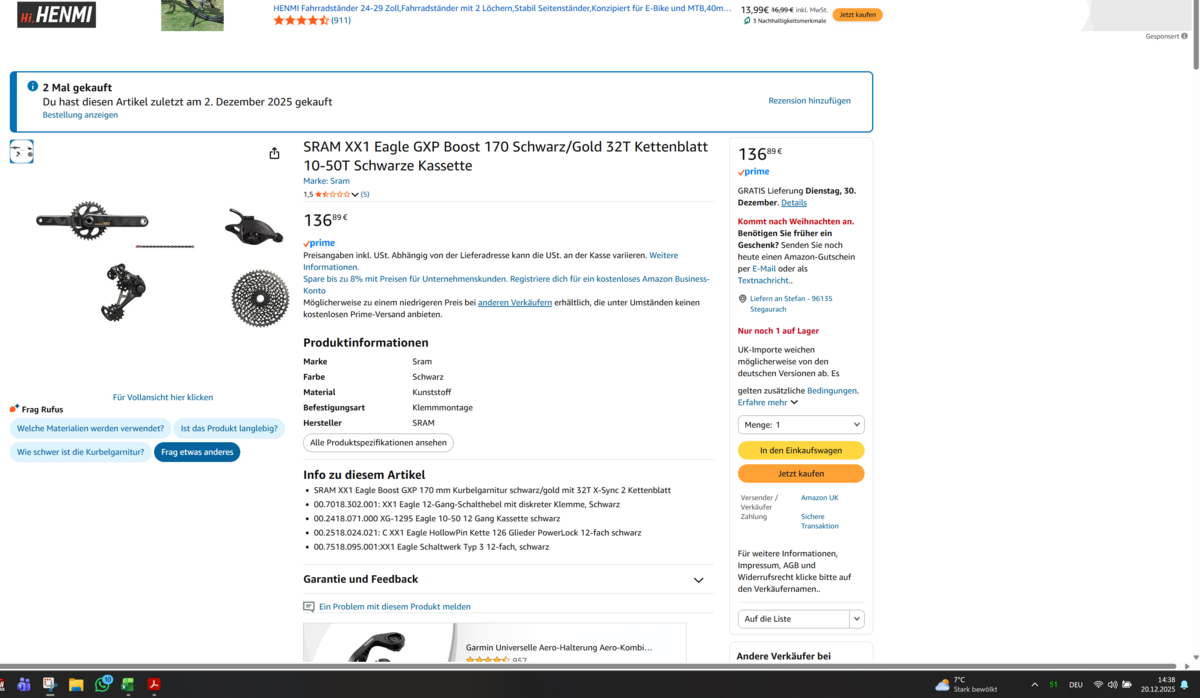
I never ordered from Amazon any bike components, but I saw this deal and wanted to give it a try.
Price was 394€ by the way (including 19% VAT) for a full XX1 Eagle groupset, shipped from Europe:
First time I ordered, I received a RS rear shock (OE product).
Seller told me to send it back and order again.
Guess what I received.
The same thing went on to happen for 4 orders in total, spanning almost one month. They were not able to get their shit right it in 4 (!!!) weeks, let alone at least take it off of Amazon marketplace.
The seller was not Amazon, but a very big online dealer through Amazon.
A few weeks later I saw a similar item offered by Amazon directly, but much cheaper. So I gave it another try.
Well, I got a bleed kit for SRAM brakes.
I opened a ticket and asked for replacement.
Two days later I received the package.
What was in it? The same effin' bleed kit. To be honest, I did not expect to get a SRAM XX1 groupset anyway, but I did it just for the fun of it and to confirm my suspicion.
That was three weeks ago.
And just because it's too funny/sad/ridiculous, look at what is still available for purchase, today, December 20, 2025, more than three weeks after my first purchase of this item:
Ironic, that such a company can't get thigns right, desopite it's efficiency, isn't it?
Another story, but not Bike stuff related. Two years ago or so, I ordered a Philips electronic toothbrush through Amazon.
What I received was a completely different model and on top of that it was a used (!!!) one. Just the (opened) original box was from the model I had ordered.
I do not need to explain to you, how that probably happened. You have all heard these stories about what is going on with fraud in return shipments.
I guarantee you that, in a team full of people who feel and live the importance of their part of the company, none of this would have happened.
Our world is changing so fast, human relations are becoming less and less important and I find it a shame.
It's astonishing, how often I get phone calls only to have customers be surprised when you actually pick up.
I’ll happily pay more to a business with a rep. In an ideal world I never have to talk to him/her for pretty decent periods. But even when you are ordering thru a website the ones with reps are always a million times better to use. And when an issue arises or you could use a favor you have a person who knows you as a person and your business to get things done quickly. And in my hyperlocalized business reps/drivers can also turn into customers versus a screen, fed ex, and a couple guys in a warehouse who knows where. I imagine in the bike world it’s very much the same. Ultimately a community but by interest instead of location (though there is some of the latter too for sure and some brands make the most of it)
I’d be buying my produce from someone else but a rep for a huge company lives like 2 blocks away. Only asked one favor so far but it saved me from going to work on my first day off in two weeks for something pretty dang menial. All for technology to make both our lives easier but the human element is hard to replace.
I have now experienced both Microsoft AX and SAP ERP system and I can understand how small business in the bike industry would not be well served by such massively scalable ERP system in terms of financial cost, database maintenance, programming requirement and other factor required to run properly such system. Ordering by coverage and leadtime instead of min/target/max parameters can be complex but doable still in excel but bills of material are much easier to deal in a ERP system.
What Sam Nichols is probably right is that the bike industry in general could benefit from a common EDI/API system for communications purpose instead of sending back and forth excel/pdf.
I haven't had a chance to listen to the pod yet, but it's on my list. Both of the small industry companies I've worked for have used different ERP systems, but I find that I use them in a more basic/manual vs. automated form. (It's worth noting, neither company needs a full blown ERP in the first place) Thankfully, I have enough time in my day to not have to rely on automation, whereas I recognize some people rely on some automation to do the work that two people should probably be doing. I fully agree that there's a human element that can play a big part in catching issues or making better decisions, especially when that person has been around a company for a while and has developed a good "gut feel" - of course, decisions rely on numbers and calculations too, but good employees can (and should) bridge the gap between numbers and smart/effective decisions and actions.
At the prior OE I worked for, when I left, a very smart colleague of mine said he was tasked with getting some automated demand and purchasing aspects up and running in our ERP. He later told me that he initially thought the more manual way I was doing things in spreadsheets was a bit crazy, but after getting the automations set up, apparently it became really clear why I did things my way.
At my current job, we receive auto generated demand forecasts from a distributor of ours that get sent out on a monthly basis as a rolling 12 month "order forecast". It only took me a few months of comparing them to actual orders to realize there was no consistency with actual orders placed, and thank goodness I never factored it into my ordering or demand planning.
TLDR; I agree wholeheartedly with your analysis. While I believe automation and AI aren't necessarily inherently bad, I'm quite skeptical of placing any degree of full faith in them. I trust the work I do based on best current information, and it doesn't take long (in my opinion) to figure out who, be it customers or suppliers, will also be thorough in their interactions with us. When we all look out for each others mistakes in the name of accuracy and mutual benefit, we find greater success as a whole.
As others noted, thanks for this in depth insight along with other comments.
One more question. Podcast with Jeff when? 🙂
EDIT: actually a genuine question. Considering you have your own operation in Taiwan, how do you handle handlebars and stems? Is it also covered in house?
Obviously I'm grateful for everything shared so far, but I am obviously interested in even more 🙂
@Sacki Incredible insight! we all appreciate the transparency and a glimpse into the manufacturing process and management approach. You have earned my business, I'll be seeking out BikeYoke posts over the winter for my rigs.
I really feel I am given more credit than I deserve, but I am really flattered and feel very honored.
To the podcast question:
I've been part of quite a few podcasts "lately". If you are interested, you can check them out:
https://www.youtube.com/watch?v=wWCqkRvyW3s
https://www.youtube.com/watch?v=pkS7FhHTR08
https://www.youtube.com/watch?v=PnW_yq3gY2w
I don't remember exactly, but if I recall correctly there was a lot of talk about Covid already and also a bit about how all started for me in the bike industry.
For those who don't speak German, Youtube auto transcript might work quite well nowadays.
About the stems and handlebars, I am not exactly sure, how to understand the question.
If you want to know, if we do the actual manufacturing in house (e.g. forging, milling, tapering, bending, heat treatment, ...), then the answer is no.
I wished we had this all of this heavy machinery, but we don't. We have a lathe and a milling machine, and some other small machinery, but nothing worthy for series production.
Our equipment are mainly assembly machines, custom designed and made in cooperation with local machine makers. Some of them you can see on our Instagram, some we can not show for obvious reasons.
As mentioned in one of my previous comments, we have close-by suppliers who make the actual parts for us.

We design or engineer (I find the word designing a bit strange, because "to design" in German merely means "to give something a shape") all of our products ourselves (actually there is exactly one very small product, that was originally not ours, but which we sourced and then redesigned to for better fit). That means, for every single part (unless it is a standard bolt or o-ring or circlip) we start with a 3D drawing, then make our 2D drawing for each part.
Below you can see an example of one page (of a two page) 2D drawing of our lower tubes
After we finish these drawings, we go to our suppliers and discuss them. If needed, corrections are made (e.g. tolerances are too tight or tools are unable to reach a certain area, ...).
That is where it becomes very important that you a) either are or b) have a local with you who speaks their "language" and also understands the actual manufacturing process, so he needs to have experience in machining or forging or whatever. And by "language" I do not mean only the spoken words, but also how to deal with people culture-wise.
After our drawings are confirmed, the supplier will often make their own manufacturing drawings - because that tube does not use a single manufacturing process. It might be forged first, then go on the lathe, then CNC'ed, then anodized, heat treated, lasered, .... you get it. Each step needs it's own drawing, and those drawings have little to do with the finished part drawing.
So, these drawigns are then double checked from our side.
Then we get pricing per part and cost for tooling (e.g. we buy and then own the forging toolings for our parts)
These steps are done for every single part.
Then we have the supplier sample the parts (very small quantities), we build and test the first prototypes, make modifications in correspondence with the suppliers, if needed.
Once everything looks good, we order series production runs for every part, receive them in our factory and build the first batch of finished products.
I might have forgotten or simplified some steps, but you get the idea.
You could also have it a lot easier. You could also go to one of the few big dropper factory and tell them you want this or that dropper from their ODM catalogue, but with your logo on.
And then there are also many options in between, where, for instance, you choose one of those "catalog posts" and modify/redesign some parts (e.g clamps or actuator or change the cartridge to another one) either by yourself or tell them to do it for you.
Long story short, we do "assemble" the stems in house. We do not produce the stem parts.
And for handlebars there's luckily not really much to assemble.
Post a reply to: The Bikeconomics (Mega)Thread