You are right about almost everything. But specifically I have been talking about the stumpy alloy vs stumpy carbon. One is 4 bar one is flex...
You are right about almost everything. But specifically I have been talking about the stumpy alloy vs stumpy carbon. One is 4 bar one is flex stay. The flex stay had a chatter or a “twang” that is just not enjoyable. I believe it is this small amount of undamped spring. It is more flex than would be found on a non-flex stay design, and I believe this twang or “chatter” is an unintended consequence. Some engineers have said it is negligible, some say it doesn’t exist. I just havent seen proof but I am definitely trying to understand how the design of these bikes avoids this problem.
The aluminum stumpy was more similar to the evo. I’d go as far as to say the flex stay stumpjumper had more similarities to the epic than the rest of the stumpjumper line. I think one of the things I’ve been trying to convey is that design choices for a bike on a whole drives the sensation you are talking about way more than anything else. They made a bike that was much more pedal oriented and it behaved as such while happening to have flex stays.
You still haven’t mentioned how a seat stay will flex on a rigid bike, and why that doesn’t apply to a flex stay bike. I’m not...
You still haven’t mentioned how a seat stay will flex on a rigid bike, and why that doesn’t apply to a flex stay bike. I’m not trying to argue I’m really asking for help understanding this!
Edit to add: I am not assuming that the only way the axle can move is by the suspension cycling. I am positing that the axle can move if the rear triangle flexes a.k.a. if the flex stay flexes.
The flex stay will offer an extremely small amount of undamped spring I think, but so does the front triangle, and the rear triangle of bikes...
The flex stay will offer an extremely small amount of undamped spring I think, but so does the front triangle, and the rear triangle of bikes that don't have flex stays, it's just so small that is not really something that you would generally say would introduce significant changes to the feeling of the suspension.
I think what is happening is that generally flex stays are used to reduce weight, but weight reduction won't just be applied to the stay but the rest in the bike as well, and the wheels etc. plus they are shorter travel bikes so the suspension will have to be stiffer, all of that leads to a bike that can feel quite "chattery" but I don't think it's due specifically to the flex stay.
You are right about almost everything. But specifically I have been talking about the stumpy alloy vs stumpy carbon. One is 4 bar one is flex...
You are right about almost everything. But specifically I have been talking about the stumpy alloy vs stumpy carbon. One is 4 bar one is flex stay. The flex stay had a chatter or a “twang” that is just not enjoyable. I believe it is this small amount of undamped spring. It is more flex than would be found on a non-flex stay design, and I believe this twang or “chatter” is an unintended consequence. Some engineers have said it is negligible, some say it doesn’t exist. I just havent seen proof but I am definitely trying to understand how the design of these bikes avoids this problem.
I think before you point the finger at the flex stay you would be to ride the two bikes with identical wheels/tyres/pressure/cranks/handlebar etc, if you isolated the rear end as the only change and it still felt chattery then it's quite possible that in designing the flex stay rear end specialised had introduced some unwanted flex that does manifest in the chatter that you are feeling, however this doesn't mean that a flex stay will inherently have that feeling, and I am extremely sceptical that it's the spring force from the flex stay that is causing it. I think it's much more likely a difference in lateral stiffness (possibly because of the flex stay design, but not specifically due to the extra spring force introduced by it)
I have seen other people get frustrated in trying to talk to you on forums and now I understand why. You still aren’t addressing any questions...
I have seen other people get frustrated in trying to talk to you on forums and now I understand why. You still aren’t addressing any questions I’m asking you!
Of course you can make the bike flexy or stiff! But as the name implies, flex stays have an especially flexy member. So, at least one part of the frame is in the noodle category.
But I don’t think you’re actually interested in having a real convo about this.
This a mtb forum where anybody is free to post or not. You are not paying Cascade components an engineering consultancy fee so they don't owe you shit.
You still haven’t mentioned how a seat stay will flex on a rigid bike, and why that doesn’t apply to a flex stay bike. I’m not...
You still haven’t mentioned how a seat stay will flex on a rigid bike, and why that doesn’t apply to a flex stay bike. I’m not trying to argue I’m really asking for help understanding this!
Edit to add: I am not assuming that the only way the axle can move is by the suspension cycling. I am positing that the axle can move if the rear triangle flexes a.k.a. if the flex stay flexes.
Literally the entire bike will flex when you put load on it. Stress and strain go hand in hand. It’s just a question of how much...
Literally the entire bike will flex when you put load on it. Stress and strain go hand in hand. It’s just a question of how much and that entirely comes down to how you design the frame. You could make something that has no flex stays or suspension and is an absolute noodle very easily.
As they say, "everything is a spring".
Some "springs" are just intrinsically stiffer (and/or differently damped) than others.
You are right about almost everything. But specifically I have been talking about the stumpy alloy vs stumpy carbon. One is 4 bar one is flex...
You are right about almost everything. But specifically I have been talking about the stumpy alloy vs stumpy carbon. One is 4 bar one is flex stay. The flex stay had a chatter or a “twang” that is just not enjoyable. I believe it is this small amount of undamped spring. It is more flex than would be found on a non-flex stay design, and I believe this twang or “chatter” is an unintended consequence. Some engineers have said it is negligible, some say it doesn’t exist. I just havent seen proof but I am definitely trying to understand how the design of these bikes avoids this problem.
The aluminum stumpy was more similar to the evo. I’d go as far as to say the flex stay stumpjumper had more similarities to the epic...
The aluminum stumpy was more similar to the evo. I’d go as far as to say the flex stay stumpjumper had more similarities to the epic than the rest of the stumpjumper line. I think one of the things I’ve been trying to convey is that design choices for a bike on a whole drives the sensation you are talking about way more than anything else. They made a bike that was much more pedal oriented and it behaved as such while happening to have flex stays.
You’ve made your opinion clear and you’ve made it clear that you disagree with mine. I was hoping for a more data driven convo but I guess it is what it is.
I have seen other people get frustrated in trying to talk to you on forums and now I understand why. You still aren’t addressing any questions...
I have seen other people get frustrated in trying to talk to you on forums and now I understand why. You still aren’t addressing any questions I’m asking you!
Of course you can make the bike flexy or stiff! But as the name implies, flex stays have an especially flexy member. So, at least one part of the frame is in the noodle category.
But I don’t think you’re actually interested in having a real convo about this.
This a mtb forum where anybody is free to post or not. You are not paying Cascade components an engineering consultancy fee so they don't owe...
This a mtb forum where anybody is free to post or not. You are not paying Cascade components an engineering consultancy fee so they don't owe you shit.
I agree with you! I definitely got what I paid for today
The flex stay will offer an extremely small amount of undamped spring I think, but so does the front triangle, and the rear triangle of bikes...
The flex stay will offer an extremely small amount of undamped spring I think, but so does the front triangle, and the rear triangle of bikes that don't have flex stays, it's just so small that is not really something that you would generally say would introduce significant changes to the feeling of the suspension.
I think what is happening is that generally flex stays are used to reduce weight, but weight reduction won't just be applied to the stay but the rest in the bike as well, and the wheels etc. plus they are shorter travel bikes so the suspension will have to be stiffer, all of that leads to a bike that can feel quite "chattery" but I don't think it's due specifically to the flex stay.
You are right about almost everything. But specifically I have been talking about the stumpy alloy vs stumpy carbon. One is 4 bar one is flex...
You are right about almost everything. But specifically I have been talking about the stumpy alloy vs stumpy carbon. One is 4 bar one is flex stay. The flex stay had a chatter or a “twang” that is just not enjoyable. I believe it is this small amount of undamped spring. It is more flex than would be found on a non-flex stay design, and I believe this twang or “chatter” is an unintended consequence. Some engineers have said it is negligible, some say it doesn’t exist. I just havent seen proof but I am definitely trying to understand how the design of these bikes avoids this problem.
I think before you point the finger at the flex stay you would be to ride the two bikes with identical wheels/tyres/pressure/cranks/handlebar etc, if you isolated...
I think before you point the finger at the flex stay you would be to ride the two bikes with identical wheels/tyres/pressure/cranks/handlebar etc, if you isolated the rear end as the only change and it still felt chattery then it's quite possible that in designing the flex stay rear end specialised had introduced some unwanted flex that does manifest in the chatter that you are feeling, however this doesn't mean that a flex stay will inherently have that feeling, and I am extremely sceptical that it's the spring force from the flex stay that is causing it. I think it's much more likely a difference in lateral stiffness (possibly because of the flex stay design, but not specifically due to the extra spring force introduced by it)
There is something to your point but there is something to the criticism that a lot of people have about flex stay short travel bikes being chattery/twangy. I think the best responses I have read across the ‘net have been things like “yeah there are drawbacks as far as ride feel is concerned but damn do they pedal good.” So I can just accept that it’s not worth the trade off for me. As for the undamped spring debate, it feels similar to the pedal kickback debate. People arguing for days on end, some swearing it exists and that they feel it, others saying that it’s a myth and no one has ever felt pedal kickback.
You are right about almost everything. But specifically I have been talking about the stumpy alloy vs stumpy carbon. One is 4 bar one is flex...
You are right about almost everything. But specifically I have been talking about the stumpy alloy vs stumpy carbon. One is 4 bar one is flex stay. The flex stay had a chatter or a “twang” that is just not enjoyable. I believe it is this small amount of undamped spring. It is more flex than would be found on a non-flex stay design, and I believe this twang or “chatter” is an unintended consequence. Some engineers have said it is negligible, some say it doesn’t exist. I just havent seen proof but I am definitely trying to understand how the design of these bikes avoids this problem.
I think before you point the finger at the flex stay you would be to ride the two bikes with identical wheels/tyres/pressure/cranks/handlebar etc, if you isolated...
I think before you point the finger at the flex stay you would be to ride the two bikes with identical wheels/tyres/pressure/cranks/handlebar etc, if you isolated the rear end as the only change and it still felt chattery then it's quite possible that in designing the flex stay rear end specialised had introduced some unwanted flex that does manifest in the chatter that you are feeling, however this doesn't mean that a flex stay will inherently have that feeling, and I am extremely sceptical that it's the spring force from the flex stay that is causing it. I think it's much more likely a difference in lateral stiffness (possibly because of the flex stay design, but not specifically due to the extra spring force introduced by it)
There is something to your point but there is something to the criticism that a lot of people have about flex stay short travel bikes being...
There is something to your point but there is something to the criticism that a lot of people have about flex stay short travel bikes being chattery/twangy. I think the best responses I have read across the ‘net have been things like “yeah there are drawbacks as far as ride feel is concerned but damn do they pedal good.” So I can just accept that it’s not worth the trade off for me. As for the undamped spring debate, it feels similar to the pedal kickback debate. People arguing for days on end, some swearing it exists and that they feel it, others saying that it’s a myth and no one has ever felt pedal kickback.
from the first page: "The talk of a flex stay rear triangle as undamped is not really true. It is only undamped in the same way that your coil spring on a shock is "undamped". Both are constrained springs; neither can move on their own without being impacted by the damper of shock."
ironically i have remembered that I dont like the feel of coil shocks because the i don't like feeling the buzzy undamped coil spring. I much prefer the more damped air shock that isolates the feedback of the air spring within the shock body. maybe i can just feel my bike better than some of the people in this thread?!? i think a lot of you have completely misunderstood what I am asking/what I am saying. i will get downvoted to hell (again) but as always I am just trying to home in on the phenomenon i felt on two different bikes.
from the first page: "The talk of a flex stay rear triangle as undamped is not really true. It is only undamped in the same way...
from the first page: "The talk of a flex stay rear triangle as undamped is not really true. It is only undamped in the same way that your coil spring on a shock is "undamped". Both are constrained springs; neither can move on their own without being impacted by the damper of shock."
ironically i have remembered that I dont like the feel of coil shocks because the i don't like feeling the buzzy undamped coil spring. I much prefer the more damped air shock that isolates the feedback of the air spring within the shock body. maybe i can just feel my bike better than some of the people in this thread?!? i think a lot of you have completely misunderstood what I am asking/what I am saying. i will get downvoted to hell (again) but as always I am just trying to home in on the phenomenon i felt on two different bikes.
You are so lost in the sauce. Like 4 different people gave great explanations of how flex stays work and you dismissed every single one, but want a "data driven discussion" when you can't comprehend a literal Microsoft paint diagram.
Now you don't like "buzzy undamped coil spring", this is comedy gold.
@CascadeComponents Can i formally apologize for this member of the forum and please say come back to discuss things with us Vital users that don't have a crayon missing from the box.
from the first page: "The talk of a flex stay rear triangle as undamped is not really true. It is only undamped in the same way...
from the first page: "The talk of a flex stay rear triangle as undamped is not really true. It is only undamped in the same way that your coil spring on a shock is "undamped". Both are constrained springs; neither can move on their own without being impacted by the damper of shock."
ironically i have remembered that I dont like the feel of coil shocks because the i don't like feeling the buzzy undamped coil spring. I much prefer the more damped air shock that isolates the feedback of the air spring within the shock body. maybe i can just feel my bike better than some of the people in this thread?!? i think a lot of you have completely misunderstood what I am asking/what I am saying. i will get downvoted to hell (again) but as always I am just trying to home in on the phenomenon i felt on two different bikes.
You are so lost in the sauce. Like 4 different people gave great explanations of how flex stays work and you dismissed every single one, but...
You are so lost in the sauce. Like 4 different people gave great explanations of how flex stays work and you dismissed every single one, but want a "data driven discussion" when you can't comprehend a literal Microsoft paint diagram.
Now you don't like "buzzy undamped coil spring", this is comedy gold.
@CascadeComponents Can i formally apologize for this member of the forum and please say come back to discuss things with us Vital users that don't have a crayon missing from the box.
So sorry for not thinking like you. Blame my autism/adhd! Thanks!
This will be my last attempt at explaining why rebound damping at the shock will control the flex stay. If you take the blur rear triangle...
This will be my last attempt at explaining why rebound damping at the shock will control the flex stay. If you take the blur rear triangle and attach the upper pivot to the lower pivot with a rigid member, you are forming a triangle and locking out the flex stay. If the shock were to be locked at any given position, it’s effectively doing the same thing. As such, for the flex stay to move the shock just move and therefore the damping at the shock is controlling rebound of the flex stay.
You still haven’t mentioned how a seat stay will flex on a rigid bike, and why that doesn’t apply to a flex stay bike. I’m not...
You still haven’t mentioned how a seat stay will flex on a rigid bike, and why that doesn’t apply to a flex stay bike. I’m not trying to argue I’m really asking for help understanding this!
Edit to add: I am not assuming that the only way the axle can move is by the suspension cycling. I am positing that the axle can move if the rear triangle flexes a.k.a. if the flex stay flexes.
I know this is battling a windmill, but still... Everything flexes. A hardtail, a rigid bike, the wheels, the front triangle, the fork, EVERYTHING.
The thing is, the amount the rear triangle of a hardtail (or the amount a flex stay of an XC bike) flexes and impacts the 'suspension' performance of everything is negligible to what a suspension system does (flex stay or otherwise) travel and/or force control wise. So the effect the flex stay itself has on suspension performance vs. any other design with a link back at the axle can be ignored. Even more so, the twanginess, the vibrations and attemt at buckling of the seatstay you point out on the Blur is LESS than if you had a faux bar - a faux bar is free to rotate at either node and will buckle more easily than if you have a flex stay which is, for all intents and purposes, fixed at the rear axle in rotation.
EDIT: just to add what buckling is: https://en.wikipedia.org/wiki/Buckling And what I was talking about regarding flex stays (fixed at one end) vs. faux-bar (free to rotate at both ends and only loaded axially): A faux bar seatstay is pinned-pinned (left-most) vs. a pinned-fixed flex-stay (third from left). Same deflection, compare the weight applied to it to achieve it.
Would I be correct in saying that there are different types of flex stay? One type will try to push the linkage to full travel because you're trying to open the stays, one type will try to push the linkage away from full travel, because you're squishing the stays together, and another does a little bit of both, with an inflection point in the middle. I'm guessing most XC bikes are trying to squish the stays and will resist compression, further aiding the pedalling efficiency.
It was either @Digit Bikes or @earleb earlier in this thread saying that you're really looking to minimize max stress and thus usually design the flex stays in a way where they will compress and expand a bit through the travel. It depends on the overall layout of the rocker (the direction it rotates in, the general angles relative to the flex stay and the length), but yeah, you want to minimize the stresses as much as possible to prolong the lifetime of the frame.
This will be my last attempt at explaining why rebound damping at the shock will control the flex stay. If you take the blur rear triangle...
This will be my last attempt at explaining why rebound damping at the shock will control the flex stay. If you take the blur rear triangle and attach the upper pivot to the lower pivot with a rigid member, you are forming a triangle and locking out the flex stay. If the shock were to be locked at any given position, it’s effectively doing the same thing. As such, for the flex stay to move the shock just move and therefore the damping at the shock is controlling rebound of the flex stay.
You still haven’t mentioned how a seat stay will flex on a rigid bike, and why that doesn’t apply to a flex stay bike. I’m not...
You still haven’t mentioned how a seat stay will flex on a rigid bike, and why that doesn’t apply to a flex stay bike. I’m not trying to argue I’m really asking for help understanding this!
Edit to add: I am not assuming that the only way the axle can move is by the suspension cycling. I am positing that the axle can move if the rear triangle flexes a.k.a. if the flex stay flexes.
I know this is battling a windmill, but still... Everything flexes. A hardtail, a rigid bike, the wheels, the front triangle, the fork, EVERYTHING.The thing is...
I know this is battling a windmill, but still... Everything flexes. A hardtail, a rigid bike, the wheels, the front triangle, the fork, EVERYTHING.
The thing is, the amount the rear triangle of a hardtail (or the amount a flex stay of an XC bike) flexes and impacts the 'suspension' performance of everything is negligible to what a suspension system does (flex stay or otherwise) travel and/or force control wise. So the effect the flex stay itself has on suspension performance vs. any other design with a link back at the axle can be ignored. Even more so, the twanginess, the vibrations and attemt at buckling of the seatstay you point out on the Blur is LESS than if you had a faux bar - a faux bar is free to rotate at either node and will buckle more easily than if you have a flex stay which is, for all intents and purposes, fixed at the rear axle in rotation.
EDIT: just to add what buckling is: https://en.wikipedia.org/wiki/Buckling And what I was talking about regarding flex stays (fixed at one end) vs. faux-bar (free to rotate at both ends and only loaded axially): A faux bar seatstay is pinned-pinned (left-most) vs. a pinned-fixed flex-stay (third from left). Same deflection, compare the weight applied to it to achieve it.
I feel like I’m also battling a windmill, because I say “undamped spring” and folks act like I’m saying the whole rear end of the bike is pingin and flingin around.
I agree with you about the fact that everything flexes, but like I have said, it seems like some of these bikes have REALLY THIN and super flexy seat stays, way more so than you would find on a hardtail (I think? I dunno! I would love to see a comparison of stiffness of seat stays between an XC Carbon hardtail and a flex stay bike from the same brand…
I’m very curious if the “vertical compliance” seen in a rigid rear triangle would be classified as buckling or flexing/bending. When I am thinking of the flex stay deflecting I’m not thinking about it buckling from the load path of the suspension linkage, I’m thinking that it flexes to allow the axle to move off of the path defined by the linkage. And look, I know it’s not moving much, and I hear people saying “it’s negligible” but I feel like that flex, plus whatever that floppiness/oscillation is that is seen in the blur vid, is adding up to the bad sensation I felt when riding the stumpy and ee.
Also? I am not saying those bikes are dog shit. I am being extremely picky here. Wine snob levels of picky. I’m not saying ”holy shit the rear end has zero damping” I’m just saying when I really lock in to the sensations coming from the rear of the bike, I feel something I don’t like. Since I’m not obsessed with pedal efficiency I’d rather pick a bike that feels a little more controlled and damped out back.
Vertical compliance in a hardtail road or MTB is a myth. It doesn't happen on any real world measurable amount. On a hardtail and flex felt is coming from the seatpost. Here is some analysis for you to dig into.
There is more out there if you go looking. Rob English frame builder and engineer has discussed it on several podcasts. He builds with very thin seatstays and people are always asking him about the vertica compliance.
Hardtails and road bikes have lateral compliance and the bracing between chainstays and seatstays are a big driver here.
I watched the Huck to flat video a bunch of times and there is soon much movement going on through the whole bike to see specific movement in the seatstays. Again to point out at the end where the stay meets the rocker these will be moving in the range of 2-6 mm over full travel, so split that in half
I am working on a new frame design with a Flex stay and once I get the CAD finished I will run some rough Fusion360 few to show just how little these move and flex.
Vertical compliance in a hardtail road or MTB is a myth. It doesn't happen on any real world measurable amount. On a hardtail and flex felt...
Vertical compliance in a hardtail road or MTB is a myth. It doesn't happen on any real world measurable amount. On a hardtail and flex felt is coming from the seatpost. Here is some analysis for you to dig into.
There is more out there if you go looking. Rob English frame builder and engineer has discussed it on several podcasts. He builds with very thin seatstays and people are always asking him about the vertica compliance.
Hardtails and road bikes have lateral compliance and the bracing between chainstays and seatstays are a big driver here.
I watched the Huck to flat video a bunch of times and there is soon much movement going on through the whole bike to see specific movement in the seatstays. Again to point out at the end where the stay meets the rocker these will be moving in the range of 2-6 mm over full travel, so split that in half
I am working on a new frame design with a Flex stay and once I get the CAD finished I will run some rough Fusion360 few to show just how little these move and flex.
thank you. awesome info in here. I will look into this stuff!
Vertical compliance in a hardtail road or MTB is a myth. It doesn't happen on any real world measurable amount. On a hardtail and flex felt...
Vertical compliance in a hardtail road or MTB is a myth. It doesn't happen on any real world measurable amount. On a hardtail and flex felt is coming from the seatpost. Here is some analysis for you to dig into.
There is more out there if you go looking. Rob English frame builder and engineer has discussed it on several podcasts. He builds with very thin seatstays and people are always asking him about the vertica compliance.
Hardtails and road bikes have lateral compliance and the bracing between chainstays and seatstays are a big driver here.
I watched the Huck to flat video a bunch of times and there is soon much movement going on through the whole bike to see specific movement in the seatstays. Again to point out at the end where the stay meets the rocker these will be moving in the range of 2-6 mm over full travel, so split that in half
I am working on a new frame design with a Flex stay and once I get the CAD finished I will run some rough Fusion360 few to show just how little these move and flex.
albatross says that the dropped seat stay design (03) produces increased vertical compliance. am I misunderstanding you or them?
Vertical compliance in a hardtail road or MTB is a myth. It doesn't happen on any real world measurable amount. On a hardtail and flex felt...
Vertical compliance in a hardtail road or MTB is a myth. It doesn't happen on any real world measurable amount. On a hardtail and flex felt is coming from the seatpost. Here is some analysis for you to dig into.
There is more out there if you go looking. Rob English frame builder and engineer has discussed it on several podcasts. He builds with very thin seatstays and people are always asking him about the vertica compliance.
Hardtails and road bikes have lateral compliance and the bracing between chainstays and seatstays are a big driver here.
I watched the Huck to flat video a bunch of times and there is soon much movement going on through the whole bike to see specific movement in the seatstays. Again to point out at the end where the stay meets the rocker these will be moving in the range of 2-6 mm over full travel, so split that in half
I am working on a new frame design with a Flex stay and once I get the CAD finished I will run some rough Fusion360 few to show just how little these move and flex.
"My conclusion from reviewing these connected systems is that the best way to add this mystical “vertical compliance” is by adding air volume and lowering pressure at the tire, and with careful selection of the seatpost."
Hey folks, been reading here. Just wanted to chime in to say I fully agree that vertical compliance is a myth. At best it’s misunderstood. The idea that a frame is deflecting enough to provide any meaningful results when the tyre has over 2” of travel is daft. But marketing exists and here we are. I do believe certain materials and designs can help dissipate vibrations better than others but soft tyres and comfy grips will do much more.
Lateral compliance is a real thing though.
I often get asked about my ‘flex stay’ design - “will it snap”, etc. And my reply is that with just 4mm of total deflection over 450mm, your frame likely flexes more each time you rail a corner or stand up and stomp up a climb. As has already been said, the flex is insignificant, doesn’t affect the kinematic and mtb frames see higher stress in other areas all the time. NB: not all flex stay designs are exactly like mine.
Vertical compliance in a hardtail road or MTB is a myth. It doesn't happen on any real world measurable amount. On a hardtail and flex felt...
Vertical compliance in a hardtail road or MTB is a myth. It doesn't happen on any real world measurable amount. On a hardtail and flex felt is coming from the seatpost. Here is some analysis for you to dig into.
There is more out there if you go looking. Rob English frame builder and engineer has discussed it on several podcasts. He builds with very thin seatstays and people are always asking him about the vertica compliance.
Hardtails and road bikes have lateral compliance and the bracing between chainstays and seatstays are a big driver here.
I watched the Huck to flat video a bunch of times and there is soon much movement going on through the whole bike to see specific movement in the seatstays. Again to point out at the end where the stay meets the rocker these will be moving in the range of 2-6 mm over full travel, so split that in half
I am working on a new frame design with a Flex stay and once I get the CAD finished I will run some rough Fusion360 few to show just how little these move and flex.
"My conclusion from reviewing these connected systems is that the best way to add this mystical “vertical compliance” is by adding air volume and lowering pressure at the tire, and with careful selection of the seatpost."
what do you make of this set of results from the linked albatross post? i am interpreting it one way but i am curious how you see it:
Buckling is when the structure becomes instable and fails under load. So no, what you're looking at is not buckling. But buckling resistance is also a science on it's own.
I think I get it now (kind of got it before you wrote it out in your previous post).
Story time. Take your flex stay bike. Remove the aircan from the shock to be left with what is a damper only. Cycle it through the travel. Let's say it's an XC bike with 100 mm of travel at 45 mm shock stroke. When the shock reaches the 45 mm of stroke, the rear axle moved 100 mm. The rear triangle deformed only by the amount needed to go through the travel, as designed (only by the amount the bearing-to-bearing distance between the main pivot and the stay-rocker pivot changed through the travel). Virtually no force was applied to the system, thus only that flex was seen.
Now imagine you're a brute with 100+ kg pushing that bike hard. Put the aircan back, pump it up to oblivion and go ride. If you want to reach that full 45 mm of stroke, you'll be pushing the bike hard. Because the bike was designed very 'interestingly', it also has a lot of 'vertical compliance'. When you reach the 45 mm of stroke, the axle actually moved by 110 mm, gaining you 10 % of travel.
What people were trying to say in the topic is that the original 100 mm (without the aircan) is completely damped, even though the stays are flexing (to accommodate the movement at all). The additional 10 % of travel you gained in the above situation is more or less undamped (except for what you get from the carbon layup).
Is this what you were trying to say? If yes, this is not a factor of flex stays, it's just bad design. You can have a 6-bar, a sex-bar, a horst link, a single pivot or a flex-bar, if you make the structure wobbly, it will deform and kick back undamped. Heck, the 2017-ish era of carbon Stumpjumpers (the ones from before the shock brace) apparently had a nasty habbit of loading up and kicking back under high load situations because of the way the shock was mounted to the top tube and how it was shaped. Given that the brace was introduced in the next generation, I don't find it hard to believe. But herein lies the crux of your problem, said stumpjumper was not a flex stay bike, it was an honest to god horst link.
As for vertical compliance? This bike finished the stage:
Just to make it clear, there's a reason bikes generally follow the double diamond layout. It's two triangles. Triangles are, if you load them up in the vertices, incredibly strong, stronger than any other shape to do construction with. Ideally, if loaded at the vertices, you only have forces acting along the axis of the elements, which lessens deformation even more. Therefore the rear triangle hardly flexes (vertically) if there are no special actions taken to enable this compliance. As mentioned here, road bikes get the comfort from the seatpost flexing, not the rear triangle. Even with flex stays (or even less so without a pivot at the rear), the triangle will hardly flex vertically (compared to the suspension itself) to make it worth while. Heck, when you mention cross sections of hardtail seatstays vs. full suss, the hardtail takes a lot more beating and experiences higher loads, as everything is taken up by the structure without suspension. The suspension takes up a lot of the energy and distributes over some travel to lower the (peak) force. Same energy intake (roughly), lower force over more time/distance.
Vertical compliance in a hardtail road or MTB is a myth. It doesn't happen on any real world measurable amount. On a hardtail and flex felt...
Vertical compliance in a hardtail road or MTB is a myth. It doesn't happen on any real world measurable amount. On a hardtail and flex felt is coming from the seatpost. Here is some analysis for you to dig into.
There is more out there if you go looking. Rob English frame builder and engineer has discussed it on several podcasts. He builds with very thin seatstays and people are always asking him about the vertica compliance.
Hardtails and road bikes have lateral compliance and the bracing between chainstays and seatstays are a big driver here.
I watched the Huck to flat video a bunch of times and there is soon much movement going on through the whole bike to see specific movement in the seatstays. Again to point out at the end where the stay meets the rocker these will be moving in the range of 2-6 mm over full travel, so split that in half
I am working on a new frame design with a Flex stay and once I get the CAD finished I will run some rough Fusion360 few to show just how little these move and flex.
"My conclusion from reviewing these connected systems is that the best way to add this mystical “vertical compliance” is by adding air volume and lowering pressure at the tire, and with careful selection of the seatpost."
what do you make of this set of results from the linked albatross post? i am interpreting it one way but i am curious how you...
what do you make of this set of results from the linked albatross post? i am interpreting it one way but i am curious how you see it:
That the movement comes from areas other than the rear triangle. Because the front triangle has loads applied to it half way between the vertices, which makes it weaker, as noted above. The rear is more or less kept a perfect triangle (shape and load wise).
Buckling is when the structure becomes instable and fails under load. So no, what you're looking at is not buckling. But buckling resistance is also a...
Buckling is when the structure becomes instable and fails under load. So no, what you're looking at is not buckling. But buckling resistance is also a science on it's own.
I think I get it now (kind of got it before you wrote it out in your previous post).
Story time. Take your flex stay bike. Remove the aircan from the shock to be left with what is a damper only. Cycle it through the travel. Let's say it's an XC bike with 100 mm of travel at 45 mm shock stroke. When the shock reaches the 45 mm of stroke, the rear axle moved 100 mm. The rear triangle deformed only by the amount needed to go through the travel, as designed (only by the amount the bearing-to-bearing distance between the main pivot and the stay-rocker pivot changed through the travel). Virtually no force was applied to the system, thus only that flex was seen.
Now imagine you're a brute with 100+ kg pushing that bike hard. Put the aircan back, pump it up to oblivion and go ride. If you want to reach that full 45 mm of stroke, you'll be pushing the bike hard. Because the bike was designed very 'interestingly', it also has a lot of 'vertical compliance'. When you reach the 45 mm of stroke, the axle actually moved by 110 mm, gaining you 10 % of travel.
What people were trying to say in the topic is that the original 100 mm (without the aircan) is completely damped, even though the stays are flexing (to accommodate the movement at all). The additional 10 % of travel you gained in the above situation is more or less undamped (except for what you get from the carbon layup).
Is this what you were trying to say? If yes, this is not a factor of flex stays, it's just bad design. You can have a 6-bar, a sex-bar, a horst link, a single pivot or a flex-bar, if you make the structure wobbly, it will deform and kick back undamped. Heck, the 2017-ish era of carbon Stumpjumpers (the ones from before the shock brace) apparently had a nasty habbit of loading up and kicking back under high load situations because of the way the shock was mounted to the top tube and how it was shaped. Given that the brace was introduced in the next generation, I don't find it hard to believe. But herein lies the crux of your problem, said stumpjumper was not a flex stay bike, it was an honest to god horst link.
As for vertical compliance? This bike finished the stage:
Just to make it clear, there's a reason bikes generally follow the double diamond layout. It's two triangles. Triangles are, if you load them up in the vertices, incredibly strong, stronger than any other shape to do construction with. Ideally, if loaded at the vertices, you only have forces acting along the axis of the elements, which lessens deformation even more. Therefore the rear triangle hardly flexes (vertically) if there are no special actions taken to enable this compliance. As mentioned here, road bikes get the comfort from the seatpost flexing, not the rear triangle. Even with flex stays (or even less so without a pivot at the rear), the triangle will hardly flex vertically (compared to the suspension itself) to make it worth while. Heck, when you mention cross sections of hardtail seatstays vs. full suss, the hardtail takes a lot more beating and experiences higher loads, as everything is taken up by the structure without suspension. The suspension takes up a lot of the energy and distributes over some travel to lower the (peak) force. Same energy intake (roughly), lower force over more time/distance.
This is huge, thanks for being so detailed and taking time to understand what I was saying, as well as the time to explain where you think I’m wrong.
definitely came to understand the first part of your post and realized that’s what most people were talking about, and that most were assuming that the flex imparted by the intended motion of the suspension was undamped. I recognized that that part of the flex was damped.
As to the second half, well there is a ton to discuss there. Someone was saying that carbon road bikes have such substantial chainstays that the seat stays are really just there for torsional reasons? But these shorter travel flex stay bikes are looking for weight savings and using much thinner and more compliant sections of seat stays so I can’t help but wonder if that is the problem, not the entire concept of “flex stays.” And I have to wonder if the twangy feel is maybe a torsional issue rather than vertical… who knows!!! It seems like there are a lot of very basic concepts that are still hotly debated so it will be fun to see where we are in 5-10 years with all of this!
For all who have been frustrated with this convo, I apologize for saying “flex stays” when I more accurately meant “thinner, more flexible seat stays.” I think that muddied the water up immensely and meant I was generalizing even more than I meant to
Buckling is when the structure becomes instable and fails under load. So no, what you're looking at is not buckling. But buckling resistance is also a...
Buckling is when the structure becomes instable and fails under load. So no, what you're looking at is not buckling. But buckling resistance is also a science on it's own.
I think I get it now (kind of got it before you wrote it out in your previous post).
Story time. Take your flex stay bike. Remove the aircan from the shock to be left with what is a damper only. Cycle it through the travel. Let's say it's an XC bike with 100 mm of travel at 45 mm shock stroke. When the shock reaches the 45 mm of stroke, the rear axle moved 100 mm. The rear triangle deformed only by the amount needed to go through the travel, as designed (only by the amount the bearing-to-bearing distance between the main pivot and the stay-rocker pivot changed through the travel). Virtually no force was applied to the system, thus only that flex was seen.
Now imagine you're a brute with 100+ kg pushing that bike hard. Put the aircan back, pump it up to oblivion and go ride. If you want to reach that full 45 mm of stroke, you'll be pushing the bike hard. Because the bike was designed very 'interestingly', it also has a lot of 'vertical compliance'. When you reach the 45 mm of stroke, the axle actually moved by 110 mm, gaining you 10 % of travel.
What people were trying to say in the topic is that the original 100 mm (without the aircan) is completely damped, even though the stays are flexing (to accommodate the movement at all). The additional 10 % of travel you gained in the above situation is more or less undamped (except for what you get from the carbon layup).
Is this what you were trying to say? If yes, this is not a factor of flex stays, it's just bad design. You can have a 6-bar, a sex-bar, a horst link, a single pivot or a flex-bar, if you make the structure wobbly, it will deform and kick back undamped. Heck, the 2017-ish era of carbon Stumpjumpers (the ones from before the shock brace) apparently had a nasty habbit of loading up and kicking back under high load situations because of the way the shock was mounted to the top tube and how it was shaped. Given that the brace was introduced in the next generation, I don't find it hard to believe. But herein lies the crux of your problem, said stumpjumper was not a flex stay bike, it was an honest to god horst link.
As for vertical compliance? This bike finished the stage:
Just to make it clear, there's a reason bikes generally follow the double diamond layout. It's two triangles. Triangles are, if you load them up in the vertices, incredibly strong, stronger than any other shape to do construction with. Ideally, if loaded at the vertices, you only have forces acting along the axis of the elements, which lessens deformation even more. Therefore the rear triangle hardly flexes (vertically) if there are no special actions taken to enable this compliance. As mentioned here, road bikes get the comfort from the seatpost flexing, not the rear triangle. Even with flex stays (or even less so without a pivot at the rear), the triangle will hardly flex vertically (compared to the suspension itself) to make it worth while. Heck, when you mention cross sections of hardtail seatstays vs. full suss, the hardtail takes a lot more beating and experiences higher loads, as everything is taken up by the structure without suspension. The suspension takes up a lot of the energy and distributes over some travel to lower the (peak) force. Same energy intake (roughly), lower force over more time/distance.
I think you nailed it, that was what @seanfisseli tried to convey. I agree on your "bad design" theory. The only thing that comes to mind is that in theory there could be a higher probability of "bad design" with flex stay designs, but I doubt it. At best, there could a few initial issues when the concept was new to frame designers?
Regarding compliant rear ends, does anyone remember those ugly "Zertz" seatstays Spesh did a while for some of their roadbikes? At least, the layout kind of interrupted the straight line of the stay and created something that looked like a defined deformation zone. While I have zero technical insight into that thing, I doubt that it did much...
I think you nailed it, that was what @seanfisseli tried to convey. I agree on your "bad design" theory. The only thing that comes to...
I think you nailed it, that was what @seanfisseli tried to convey. I agree on your "bad design" theory. The only thing that comes to mind is that in theory there could be a higher probability of "bad design" with flex stay designs, but I doubt it. At best, there could a few initial issues when the concept was new to frame designers?
Regarding compliant rear ends, does anyone remember those ugly "Zertz" seatstays Spesh did a while for some of their roadbikes? At least, the layout kind of interrupted the straight line of the stay and created something that looked like a defined deformation zone. While I have zero technical insight into that thing, I doubt that it did much...
IIRC the Zertz inserts were marketed as damping/calming “road chatter”. No idea if they did anything meaningful tho…
Buckling is when the structure becomes instable and fails under load. So no, what you're looking at is not buckling. But buckling resistance is also a...
Buckling is when the structure becomes instable and fails under load. So no, what you're looking at is not buckling. But buckling resistance is also a science on it's own.
I think I get it now (kind of got it before you wrote it out in your previous post).
Story time. Take your flex stay bike. Remove the aircan from the shock to be left with what is a damper only. Cycle it through the travel. Let's say it's an XC bike with 100 mm of travel at 45 mm shock stroke. When the shock reaches the 45 mm of stroke, the rear axle moved 100 mm. The rear triangle deformed only by the amount needed to go through the travel, as designed (only by the amount the bearing-to-bearing distance between the main pivot and the stay-rocker pivot changed through the travel). Virtually no force was applied to the system, thus only that flex was seen.
Now imagine you're a brute with 100+ kg pushing that bike hard. Put the aircan back, pump it up to oblivion and go ride. If you want to reach that full 45 mm of stroke, you'll be pushing the bike hard. Because the bike was designed very 'interestingly', it also has a lot of 'vertical compliance'. When you reach the 45 mm of stroke, the axle actually moved by 110 mm, gaining you 10 % of travel.
What people were trying to say in the topic is that the original 100 mm (without the aircan) is completely damped, even though the stays are flexing (to accommodate the movement at all). The additional 10 % of travel you gained in the above situation is more or less undamped (except for what you get from the carbon layup).
Is this what you were trying to say? If yes, this is not a factor of flex stays, it's just bad design. You can have a 6-bar, a sex-bar, a horst link, a single pivot or a flex-bar, if you make the structure wobbly, it will deform and kick back undamped. Heck, the 2017-ish era of carbon Stumpjumpers (the ones from before the shock brace) apparently had a nasty habbit of loading up and kicking back under high load situations because of the way the shock was mounted to the top tube and how it was shaped. Given that the brace was introduced in the next generation, I don't find it hard to believe. But herein lies the crux of your problem, said stumpjumper was not a flex stay bike, it was an honest to god horst link.
As for vertical compliance? This bike finished the stage:
Just to make it clear, there's a reason bikes generally follow the double diamond layout. It's two triangles. Triangles are, if you load them up in the vertices, incredibly strong, stronger than any other shape to do construction with. Ideally, if loaded at the vertices, you only have forces acting along the axis of the elements, which lessens deformation even more. Therefore the rear triangle hardly flexes (vertically) if there are no special actions taken to enable this compliance. As mentioned here, road bikes get the comfort from the seatpost flexing, not the rear triangle. Even with flex stays (or even less so without a pivot at the rear), the triangle will hardly flex vertically (compared to the suspension itself) to make it worth while. Heck, when you mention cross sections of hardtail seatstays vs. full suss, the hardtail takes a lot more beating and experiences higher loads, as everything is taken up by the structure without suspension. The suspension takes up a lot of the energy and distributes over some travel to lower the (peak) force. Same energy intake (roughly), lower force over more time/distance.
I think you nailed it, that was what @seanfisseli tried to convey. I agree on your "bad design" theory. The only thing that comes to...
I think you nailed it, that was what @seanfisseli tried to convey. I agree on your "bad design" theory. The only thing that comes to mind is that in theory there could be a higher probability of "bad design" with flex stay designs, but I doubt it. At best, there could a few initial issues when the concept was new to frame designers?
Regarding compliant rear ends, does anyone remember those ugly "Zertz" seatstays Spesh did a while for some of their roadbikes? At least, the layout kind of interrupted the straight line of the stay and created something that looked like a defined deformation zone. While I have zero technical insight into that thing, I doubt that it did much...
Zertz isn't designed to be a deformation zone, it's a rubber insert design to lower the natural frequency of the stay to reduce vibrations felt by the rider.
Road bikes experience a high (ish) frequency vibration from the constant loading unloading of the tires going over not perfectly smooth road (and a low frequency vibration of power being applied in a kind of sine wave shape), if the resonant frequency of the tubes is close enough to the frequency the road is imparting, then the whole bike will resonate and feel very uncomfortable.
If you've ever driven on washboard gravel roads you'll know what I'm referring too. Sometimes there is a perfect frequency of the bumps your car suspension cannot handle and it suddenly goes from bumpy to everything in the cabin is flying everywhere, despite the fact the bumps aren't that large.
This issue was solved as engineers got better at creating tubes that didn't have high natural frequencies to prevent this from occuring.
When I said bad design, I meant it. To make the bike somewhat rideable it also has to be stiff enough. As @CascadeComponents drew out, having a huge arc miiight make it a bit more flexy (Lapierre did this with hardtails 20 years ago), but to have meaningful vertical flex coming from a one piece tear triangle (flex stay full suss or a hardtail), you will basically have something similar to the coil spring bike ride characteristic wise.
When I said bad design, I meant it. To make the bike somewhat rideable it also has to be stiff enough. As @CascadeComponents drew out, having...
When I said bad design, I meant it. To make the bike somewhat rideable it also has to be stiff enough. As @CascadeComponents drew out, having a huge arc miiight make it a bit more flexy (Lapierre did this with hardtails 20 years ago), but to have meaningful vertical flex coming from a one piece tear triangle (flex stay full suss or a hardtail), you will basically have something similar to the coil spring bike ride characteristic wise.
I agree. I think people have assumed I am talking about a massive amount of deflection, but I feel that the added flex in the rear triangle mixed with the potential for flabbiness/floppiness/etc as is potentially seen in the blur video could be what is contributing to the characteristic feeling that I do not like. I guess what I’m saying is that, like that old stumpy mentioned, I am not assuming that these flex stay bikes are inherently good designs just because someone paid a lot of money to have them designed well. Plenty of bikes in the past are now seen to be poorly designed, when at the time they were cutting edge and peak performers. It can take us a while to understand what we have made and what the unintended consequences are. It can even take us a while to even notice/clue in/home in on problems! And some riders wilL NEVER notice the negative traits in a design that others might be very sensitive to.
Anyways, I really appreciate this thread. This is the stuff that got me into mountain biking, and even though I have a ton to learn (and some infuriating opinions/ideas) I am dedicated to improving my understanding of these bikes.


The aluminum stumpy was more similar to the evo. I’d go as far as to say the flex stay stumpjumper had more similarities to the epic than the rest of the stumpjumper line. I think one of the things I’ve been trying to convey is that design choices for a bike on a whole drives the sensation you are talking about way more than anything else. They made a bike that was much more pedal oriented and it behaved as such while happening to have flex stays.
I think before you point the finger at the flex stay you would be to ride the two bikes with identical wheels/tyres/pressure/cranks/handlebar etc, if you isolated the rear end as the only change and it still felt chattery then it's quite possible that in designing the flex stay rear end specialised had introduced some unwanted flex that does manifest in the chatter that you are feeling, however this doesn't mean that a flex stay will inherently have that feeling, and I am extremely sceptical that it's the spring force from the flex stay that is causing it. I think it's much more likely a difference in lateral stiffness (possibly because of the flex stay design, but not specifically due to the extra spring force introduced by it)
This a mtb forum where anybody is free to post or not. You are not paying Cascade components an engineering consultancy fee so they don't owe you shit.
As they say, "everything is a spring".
Some "springs" are just intrinsically stiffer (and/or differently damped) than others.
You’ve made your opinion clear and you’ve made it clear that you disagree with mine. I was hoping for a more data driven convo but I guess it is what it is.
I agree with you! I definitely got what I paid for today
There is something to your point but there is something to the criticism that a lot of people have about flex stay short travel bikes being chattery/twangy. I think the best responses I have read across the ‘net have been things like “yeah there are drawbacks as far as ride feel is concerned but damn do they pedal good.” So I can just accept that it’s not worth the trade off for me.
As for the undamped spring debate, it feels similar to the pedal kickback debate. People arguing for days on end, some swearing it exists and that they feel it, others saying that it’s a myth and no one has ever felt pedal kickback.
why in the hell was this downvoted?
from the first page: "The talk of a flex stay rear triangle as undamped is not really true. It is only undamped in the same way that your coil spring on a shock is "undamped". Both are constrained springs; neither can move on their own without being impacted by the damper of shock."
ironically i have remembered that I dont like the feel of coil shocks because the i don't like feeling the buzzy undamped coil spring. I much prefer the more damped air shock that isolates the feedback of the air spring within the shock body. maybe i can just feel my bike better than some of the people in this thread?!? i think a lot of you have completely misunderstood what I am asking/what I am saying. i will get downvoted to hell (again) but as always I am just trying to home in on the phenomenon i felt on two different bikes.
You are so lost in the sauce. Like 4 different people gave great explanations of how flex stays work and you dismissed every single one, but want a "data driven discussion" when you can't comprehend a literal Microsoft paint diagram.
Now you don't like "buzzy undamped coil spring", this is comedy gold.
@CascadeComponents Can i formally apologize for this member of the forum and please say come back to discuss things with us Vital users that don't have a crayon missing from the box.
So sorry for not thinking like you. Blame my autism/adhd! Thanks!
I know this is battling a windmill, but still... Everything flexes. A hardtail, a rigid bike, the wheels, the front triangle, the fork, EVERYTHING.
The thing is, the amount the rear triangle of a hardtail (or the amount a flex stay of an XC bike) flexes and impacts the 'suspension' performance of everything is negligible to what a suspension system does (flex stay or otherwise) travel and/or force control wise. So the effect the flex stay itself has on suspension performance vs. any other design with a link back at the axle can be ignored. Even more so, the twanginess, the vibrations and attemt at buckling of the seatstay you point out on the Blur is LESS than if you had a faux bar - a faux bar is free to rotate at either node and will buckle more easily than if you have a flex stay which is, for all intents and purposes, fixed at the rear axle in rotation.
EDIT: just to add what buckling is: https://en.wikipedia.org/wiki/Buckling
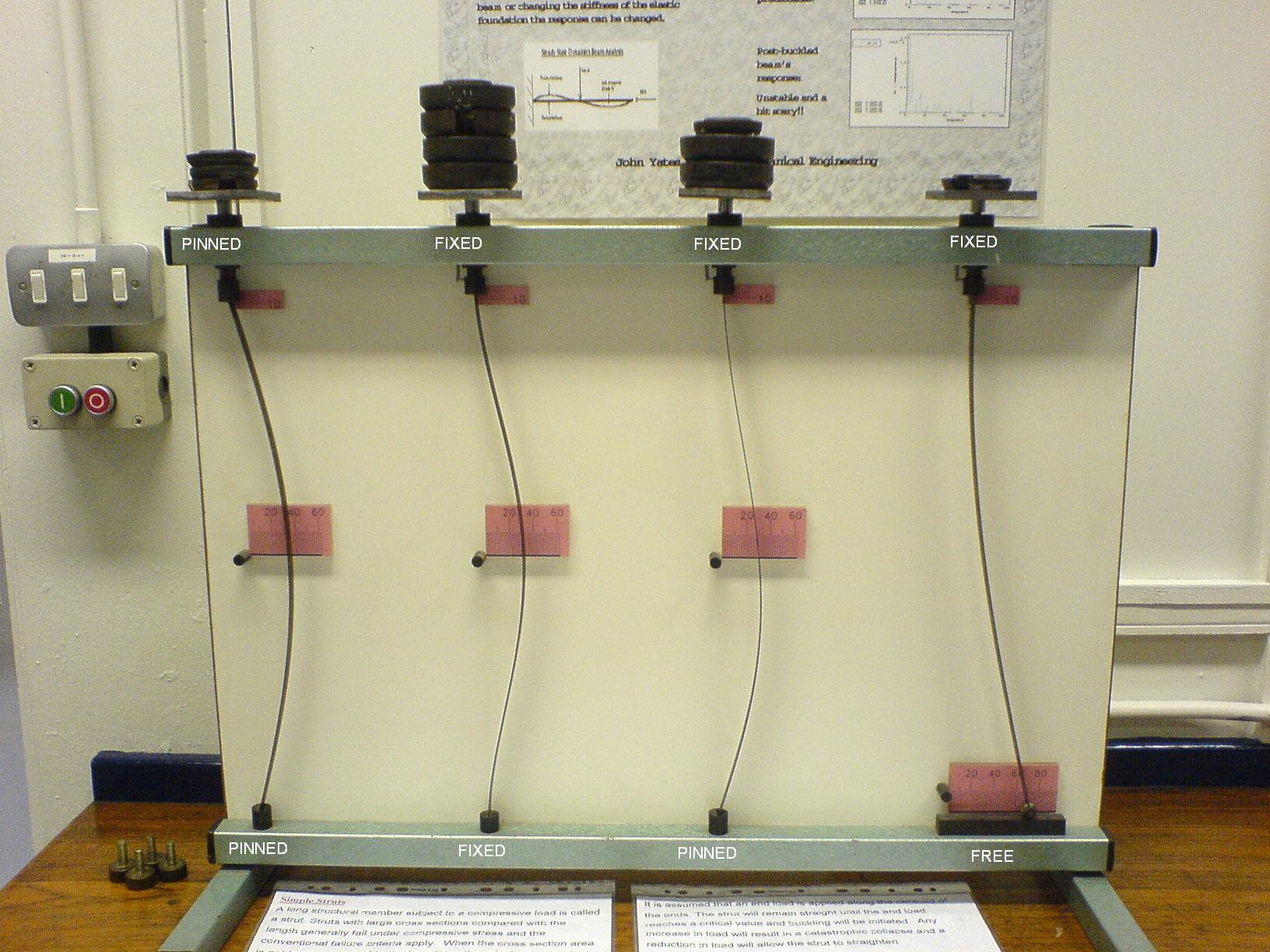
And what I was talking about regarding flex stays (fixed at one end) vs. faux-bar (free to rotate at both ends and only loaded axially):
A faux bar seatstay is pinned-pinned (left-most) vs. a pinned-fixed flex-stay (third from left). Same deflection, compare the weight applied to it to achieve it.
Would I be correct in saying that there are different types of flex stay? One type will try to push the linkage to full travel because you're trying to open the stays, one type will try to push the linkage away from full travel, because you're squishing the stays together, and another does a little bit of both, with an inflection point in the middle. I'm guessing most XC bikes are trying to squish the stays and will resist compression, further aiding the pedalling efficiency.
It was either @Digit Bikes or @earleb earlier in this thread saying that you're really looking to minimize max stress and thus usually design the flex stays in a way where they will compress and expand a bit through the travel. It depends on the overall layout of the rocker (the direction it rotates in, the general angles relative to the flex stay and the length), but yeah, you want to minimize the stresses as much as possible to prolong the lifetime of the frame.
I feel like I’m also battling a windmill, because I say “undamped spring” and folks act like I’m saying the whole rear end of the bike is pingin and flingin around.
I agree with you about the fact that everything flexes, but like I have said, it seems like some of these bikes have REALLY THIN and super flexy seat stays, way more so than you would find on a hardtail (I think? I dunno! I would love to see a comparison of stiffness of seat stays between an XC Carbon hardtail and a flex stay bike from the same brand…
I’m very curious if the “vertical compliance” seen in a rigid rear triangle would be classified as buckling or flexing/bending. When I am thinking of the flex stay deflecting I’m not thinking about it buckling from the load path of the suspension linkage, I’m thinking that it flexes to allow the axle to move off of the path defined by the linkage. And look, I know it’s not moving much, and I hear people saying “it’s negligible” but I feel like that flex, plus whatever that floppiness/oscillation is that is seen in the blur vid, is adding up to the bad sensation I felt when riding the stumpy and ee.
Also? I am not saying those bikes are dog shit. I am being extremely picky here. Wine snob levels of picky. I’m not saying ”holy shit the rear end has zero damping” I’m just saying when I really lock in to the sensations coming from the rear of the bike, I feel something I don’t like. Since I’m not obsessed with pedal efficiency I’d rather pick a bike that feels a little more controlled and damped out back.
Vertical compliance in a hardtail road or MTB is a myth. It doesn't happen on any real world measurable amount. On a hardtail and flex felt is coming from the seatpost. Here is some analysis for you to dig into.
https://www.albatrossbikes.com/projectgallery/2020/12/17/dropped-stay-c…
There is more out there if you go looking. Rob English frame builder and engineer has discussed it on several podcasts. He builds with very thin seatstays and people are always asking him about the vertica compliance.
Hardtails and road bikes have lateral compliance and the bracing between chainstays and seatstays are a big driver here.
I watched the Huck to flat video a bunch of times and there is soon much movement going on through the whole bike to see specific movement in the seatstays. Again to point out at the end where the stay meets the rocker these will be moving in the range of 2-6 mm over full travel, so split that in half
I am working on a new frame design with a Flex stay and once I get the CAD finished I will run some rough Fusion360 few to show just how little these move and flex.
thank you. awesome info in here. I will look into this stuff!
albatross says that the dropped seat stay design (03) produces increased vertical compliance. am I misunderstanding you or them?
Here's an article by Rob on the topic: https://escapecollective.com/the-whys-of-bike-tech-the-myth-of-vertical-compliance/
"My conclusion from reviewing these connected systems is that the best way to add this mystical “vertical compliance” is by adding air volume and lowering pressure at the tire, and with careful selection of the seatpost."
Hey folks, been reading here. Just wanted to chime in to say I fully agree that vertical compliance is a myth. At best it’s misunderstood. The idea that a frame is deflecting enough to provide any meaningful results when the tyre has over 2” of travel is daft. But marketing exists and here we are. I do believe certain materials and designs can help dissipate vibrations better than others but soft tyres and comfy grips will do much more.
Lateral compliance is a real thing though.
I often get asked about my ‘flex stay’ design - “will it snap”, etc. And my reply is that with just 4mm of total deflection over 450mm, your frame likely flexes more each time you rail a corner or stand up and stomp up a climb. As has already been said, the flex is insignificant, doesn’t affect the kinematic and mtb frames see higher stress in other areas all the time. NB: not all flex stay designs are exactly like mine.
what do you make of this set of results from the linked albatross post? i am interpreting it one way but i am curious how you see it:
Buckling is when the structure becomes instable and fails under load. So no, what you're looking at is not buckling. But buckling resistance is also a science on it's own.
I think I get it now (kind of got it before you wrote it out in your previous post).
Story time. Take your flex stay bike. Remove the aircan from the shock to be left with what is a damper only. Cycle it through the travel. Let's say it's an XC bike with 100 mm of travel at 45 mm shock stroke. When the shock reaches the 45 mm of stroke, the rear axle moved 100 mm. The rear triangle deformed only by the amount needed to go through the travel, as designed (only by the amount the bearing-to-bearing distance between the main pivot and the stay-rocker pivot changed through the travel). Virtually no force was applied to the system, thus only that flex was seen.
Now imagine you're a brute with 100+ kg pushing that bike hard. Put the aircan back, pump it up to oblivion and go ride. If you want to reach that full 45 mm of stroke, you'll be pushing the bike hard. Because the bike was designed very 'interestingly', it also has a lot of 'vertical compliance'. When you reach the 45 mm of stroke, the axle actually moved by 110 mm, gaining you 10 % of travel.
What people were trying to say in the topic is that the original 100 mm (without the aircan) is completely damped, even though the stays are flexing (to accommodate the movement at all). The additional 10 % of travel you gained in the above situation is more or less undamped (except for what you get from the carbon layup).
Is this what you were trying to say? If yes, this is not a factor of flex stays, it's just bad design. You can have a 6-bar, a sex-bar, a horst link, a single pivot or a flex-bar, if you make the structure wobbly, it will deform and kick back undamped. Heck, the 2017-ish era of carbon Stumpjumpers (the ones from before the shock brace) apparently had a nasty habbit of loading up and kicking back under high load situations because of the way the shock was mounted to the top tube and how it was shaped. Given that the brace was introduced in the next generation, I don't find it hard to believe. But herein lies the crux of your problem, said stumpjumper was not a flex stay bike, it was an honest to god horst link.
As for vertical compliance? This bike finished the stage:

Just to make it clear, there's a reason bikes generally follow the double diamond layout. It's two triangles. Triangles are, if you load them up in the vertices, incredibly strong, stronger than any other shape to do construction with. Ideally, if loaded at the vertices, you only have forces acting along the axis of the elements, which lessens deformation even more. Therefore the rear triangle hardly flexes (vertically) if there are no special actions taken to enable this compliance. As mentioned here, road bikes get the comfort from the seatpost flexing, not the rear triangle. Even with flex stays (or even less so without a pivot at the rear), the triangle will hardly flex vertically (compared to the suspension itself) to make it worth while. Heck, when you mention cross sections of hardtail seatstays vs. full suss, the hardtail takes a lot more beating and experiences higher loads, as everything is taken up by the structure without suspension. The suspension takes up a lot of the energy and distributes over some travel to lower the (peak) force. Same energy intake (roughly), lower force over more time/distance.
That the movement comes from areas other than the rear triangle. Because the front triangle has loads applied to it half way between the vertices, which makes it weaker, as noted above. The rear is more or less kept a perfect triangle (shape and load wise).
This is huge, thanks for being so detailed and taking time to understand what I was saying, as well as the time to explain where you think I’m wrong.
definitely came to understand the first part of your post and realized that’s what most people were talking about, and that most were assuming that the flex imparted by the intended motion of the suspension was undamped. I recognized that that part of the flex was damped.
As to the second half, well there is a ton to discuss there. Someone was saying that carbon road bikes have such substantial chainstays that the seat stays are really just there for torsional reasons? But these shorter travel flex stay bikes are looking for weight savings and using much thinner and more compliant sections of seat stays so I can’t help but wonder if that is the problem, not the entire concept of “flex stays.” And I have to wonder if the twangy feel is maybe a torsional issue rather than vertical… who knows!!! It seems like there are a lot of very basic concepts that are still hotly debated so it will be fun to see where we are in 5-10 years with all of this!
For all who have been frustrated with this convo, I apologize for saying “flex stays” when I more accurately meant “thinner, more flexible seat stays.” I think that muddied the water up immensely and meant I was generalizing even more than I meant to
I think you nailed it, that was what @seanfisseli tried to convey. I agree on your "bad design" theory. The only thing that comes to mind is that in theory there could be a higher probability of "bad design" with flex stay designs, but I doubt it. At best, there could a few initial issues when the concept was new to frame designers?

Regarding compliant rear ends, does anyone remember those ugly "Zertz" seatstays Spesh did a while for some of their roadbikes? At least, the layout kind of interrupted the straight line of the stay and created something that looked like a defined deformation zone. While I have zero technical insight into that thing, I doubt that it did much...
IIRC the Zertz inserts were marketed as damping/calming “road chatter”. No idea if they did anything meaningful tho…
Zertz isn't designed to be a deformation zone, it's a rubber insert design to lower the natural frequency of the stay to reduce vibrations felt by the rider.
Road bikes experience a high (ish) frequency vibration from the constant loading unloading of the tires going over not perfectly smooth road (and a low frequency vibration of power being applied in a kind of sine wave shape), if the resonant frequency of the tubes is close enough to the frequency the road is imparting, then the whole bike will resonate and feel very uncomfortable.
If you've ever driven on washboard gravel roads you'll know what I'm referring too. Sometimes there is a perfect frequency of the bumps your car suspension cannot handle and it suddenly goes from bumpy to everything in the cabin is flying everywhere, despite the fact the bumps aren't that large.
This issue was solved as engineers got better at creating tubes that didn't have high natural frequencies to prevent this from occuring.
Alright, thanks for the clarification!
When I said bad design, I meant it. To make the bike somewhat rideable it also has to be stiff enough. As @CascadeComponents drew out, having a huge arc miiight make it a bit more flexy (Lapierre did this with hardtails 20 years ago), but to have meaningful vertical flex coming from a one piece tear triangle (flex stay full suss or a hardtail), you will basically have something similar to the coil spring bike ride characteristic wise.
https://www.youtube.com/watch?v=N39uwTykTQk
I agree. I think people have assumed I am talking about a massive amount of deflection, but I feel that the added flex in the rear triangle mixed with the potential for flabbiness/floppiness/etc as is potentially seen in the blur video could be what is contributing to the characteristic feeling that I do not like. I guess what I’m saying is that, like that old stumpy mentioned, I am not assuming that these flex stay bikes are inherently good designs just because someone paid a lot of money to have them designed well. Plenty of bikes in the past are now seen to be poorly designed, when at the time they were cutting edge and peak performers. It can take us a while to understand what we have made and what the unintended consequences are. It can even take us a while to even notice/clue in/home in on problems! And some riders wilL NEVER notice the negative traits in a design that others might be very sensitive to.
Anyways, I really appreciate this thread. This is the stuff that got me into mountain biking, and even though I have a ton to learn (and some infuriating opinions/ideas) I am dedicated to improving my understanding of these bikes.