So I get that the shock rotated 90 degrees is to allow for a straight down tube which is stronger then a bent one, but I...
So I get that the shock rotated 90 degrees is to allow for a straight down tube which is stronger then a bent one, but I am confused on why the shock is oriented with reservoir on bottom in the first place, wouldn’t reservoir up give the same clearance?
Does anyone know if the lower shock mount piece where it ties into the frame has a bearing in it (DU, or Cartridge, etc)?
Yeah like Zuestman says above, Neko says it's to keep the weight of the moving part of the suspension as low as possible. He shows the lower shock mount here https://youtu.be/nZADPtNg_Js?t=589, it doesn't look like a cartridge bearing and it looks like the tube that holds the shock bolt is metal and then the larger plastic looking tube around that must be the bushing.
I would bet on knee clearance. I pedal and ride with knees fairly close to the frame and would prefer to have the shock rotated by 90° the way Neko did it. It would be quite a wide behemoth upside down to what he has now.
Don't think a bearing is needed in the yoke, looks like a standard shock hardware mounting set is used. It would make sense to make it the same dimensions to a shock eyelet and have a 30 mm width in the frame to give some more freedom, but the bottom shock mount sees fairly little rotation compared to the rocker... A lot of bikes have a bearing on only one eyelet.
What I would prefer to see is a pair of these yokes to fully release the shock from side to side loads.
Possibly better knee clearance or a slimmer rocker by mounting with resi on the bottom.
has to have some kind of bearing on the tiny yoke.
Interesting that it can rotate on two axes with this mount. sounds like it’s purpose is solely to allow for a 90 degree rotation of shock but I wonder if there is any performance advantages, like reduction in shock loads due to frame flex/alignment?
Yeah like Zuestman says above, Neko says it's to keep the weight of the moving part of the suspension as low as possible. He shows the lower...
Yeah like Zuestman says above, Neko says it's to keep the weight of the moving part of the suspension as low as possible. He shows the lower shock mount here https://youtu.be/nZADPtNg_Js?t=589, it doesn't look like a cartridge bearing and it looks like the tube that holds the shock bolt is metal and then the larger plastic looking tube around that must be the bushing.
Thanks, wish I would have watched that before posting lol.
Neko's bike is super interesting. REALLY long chainstays across all sizes, and a pretty high antisquat value. I remember in his early test videos, he settled for a low pivot/mid pivot bike with more rearward axle path, and used an ochain instead of an idler pulley to overcome the pedal kickback from the rearward axle path. So if you buy a Frameworks, maybe budget an extra few hundred dollars for an Ochain. The bike also has a very low BB for a long wheelbase/long travel bike, so don't forget to buy a good bashguard or three.
Am I completely off base thinking the frameworks bike is very similar to the 29'er Banshee legend in terms of geo and leverage ratio? I'm biased as it's my personal bike but the more I look the more I think the banshee was ahead of the curve in 2019 when it got released.
Am I completely off base thinking the frameworks bike is very similar to the 29'er Banshee legend in terms of geo and leverage ratio? I'm biased...
Am I completely off base thinking the frameworks bike is very similar to the 29'er Banshee legend in terms of geo and leverage ratio? I'm biased as it's my personal bike but the more I look the more I think the banshee was ahead of the curve in 2019 when it got released.
Unless the 2019 is different(I found 16 and 21 Banshee), doesn’t look the same leverage to me. But below the frameworks(3rd image), is the trek session, and the leverage is almost exactly the same. 3.4 down to 2.4
Neko's bike is super interesting. REALLY long chainstays across all sizes, and a pretty high antisquat value. I remember in his early test videos, he settled...
Neko's bike is super interesting. REALLY long chainstays across all sizes, and a pretty high antisquat value. I remember in his early test videos, he settled for a low pivot/mid pivot bike with more rearward axle path, and used an ochain instead of an idler pulley to overcome the pedal kickback from the rearward axle path. So if you buy a Frameworks, maybe budget an extra few hundred dollars for an Ochain. The bike also has a very low BB for a long wheelbase/long travel bike, so don't forget to buy a good bashguard or three.
The high anti-squat was interesting but he made some good points about how it drops off when you are standing out of the seat, (as your centre of gravity gets higher) so thats what they are designed around. Alot of the Anti-squat figures you see will be done in linkage with a generic CoG height and drivetrain configuration which isn't a perfect comparison, and I know Neko went over the numbers he uses in an early video.
The other thing is it stays quite high through the whole travel so it will at least feel consistent - some bike have high AS at sag but it falls away steeply which means the bike feels wildly different depending on what part of the stroke you're in. Having a high but relatively constant amount seems to make sense
Haven’t seen this posted anywhere yet, but I came across it on Instagram. Looks like ND Tuned is prototyping a 38mm stanchion fork, with a less...
Haven’t seen this posted anywhere yet, but I came across it on Instagram. Looks like ND Tuned is prototyping a 38mm stanchion fork, with a less than conventional construction of the lowers as well? Anyone know any details?
Neko's bike is super interesting. REALLY long chainstays across all sizes, and a pretty high antisquat value. I remember in his early test videos, he settled...
Neko's bike is super interesting. REALLY long chainstays across all sizes, and a pretty high antisquat value. I remember in his early test videos, he settled for a low pivot/mid pivot bike with more rearward axle path, and used an ochain instead of an idler pulley to overcome the pedal kickback from the rearward axle path. So if you buy a Frameworks, maybe budget an extra few hundred dollars for an Ochain. The bike also has a very low BB for a long wheelbase/long travel bike, so don't forget to buy a good bashguard or three.
The high anti-squat was interesting but he made some good points about how it drops off when you are standing out of the seat, (as your...
The high anti-squat was interesting but he made some good points about how it drops off when you are standing out of the seat, (as your centre of gravity gets higher) so thats what they are designed around. Alot of the Anti-squat figures you see will be done in linkage with a generic CoG height and drivetrain configuration which isn't a perfect comparison, and I know Neko went over the numbers he uses in an early video.
The other thing is it stays quite high through the whole travel so it will at least feel consistent - some bike have high AS at sag but it falls away steeply which means the bike feels wildly different depending on what part of the stroke you're in. Having a high but relatively constant amount seems to make sense
Without an idler antisquat and pedal kickback should be closely related. A drop off of AS deep into the travel means there will be less overall pedal kickback in deep stroke events. And lack of antisquat shouldn't be a major issue as you're bracing for and handling the impact in the part of the travel, not pedalling...
I'm fairly certain 6bar systems make this much easier to achieve and is the strategy that yeti employs with the switch platforms (4 and 6 bar) - link switching direction of travel will cause a big drop in antisquat values as the axle starts moving forwards from the inflection point towards the end of the travel.
IMO dropping AS off deep into the travel like Yeti does, or the majority of horst link bikes do, is pointless.
You get pedal kickback when the rate that your suspension is compressing exceeds the pedal kickback rate. And if your suspension is compressing quickly enough at the very bottom of your suspension stroke to engage your freehub at that point, you have much bigger problems than feedback through your pedals.
Your suspension is moving the fastest at the beginning of the hit, and the spring and damper is only going to act to slow it down from there. Bikes that have really high AS at the beginning of their stroke, through sag into midstroke, have the most noticeable feedback through the pedals because that's when the wheel is most likely moving fast enough to actually invoke it.
Give me a bike with neutral, rising AS through the sag point please. I don't care what happens to AS after ~70% travel.
AS happens ONLY while you're pedalling. It happens only when chain is tensioned to propel you forward. Do you pedal, or at least start pedalling in the middle of rear suspension travel? I doubt.
AS happens ONLY while you're pedalling. It happens only when chain is tensioned to propel you forward. Do you pedal, or at least start pedalling in...
AS happens ONLY while you're pedalling. It happens only when chain is tensioned to propel you forward. Do you pedal, or at least start pedalling in the middle of rear suspension travel? I doubt.
Antisquat is caused by the chain length changing through the travel and the suspension geometry (in both cases the effect is either positive or negative). With the chain portion of the antisquat it can be connected to pedal kickback. And it can also bind the rear suspension, even more so with modern clutch derailleurs.
Even if the sprocket on the crank can rotate freely (no pedal kickback and also no pedalling function possible) the suspension will still be bound as lengthening the chain through the derailleur cage requires a lot of force when done by lengthening the chainstay (bad mechanical advantage).
That's why chainless bikes "work better". An Ochain doesn't necessarily help here, just lowers the kickback.
AntiSquat is reaction of suspension to compression induced by acceleration. On chain driven drivetrain you have to include chainline into diagram. That's why it occurs only when you're pedalling. If you are just cruising it doesn't occur and you can feel only pedalkickback.
Antisquat is the reaction of a driven wheel to the driving torque, caused by the suspension geometry (and chain in chain driven systems). Squat is caused by the weight transfer because of the acceleration applied to the vehicle.
Again, pedal kickback is not caused by antisquat, it is caused by the chain lengthening going through the travel. And it is this lengthening of the chain that is part of the antisquat characteristic. As you pull on the chain (pedalling and driving the rear wheel) you oppose this lengthening of the chain and usually pull the suspension out of the travel, thus opposing the squat.
This squat opposition can also be achieved by a higher pivot (if it is higher than the rear axle).
It seems a little bit wasteful, being forced to buy the stock shock mount + The MX mount. Yeah, it's 45 or wathever euros and then you have the two options, but still, if you really dont care about big and flimshy rear wheels... Its a chunk of metal that will end up being recycled without any use.
Other than that it looks amazing and a good evolution from the previous version
ns fuzz "6 bar" proto from our bike check section. if this is old news, ignore, but figured worth a look if not.
https://www.vitalmtb.com/community/bmag247/ns-bikes-fuzz-29-custom-6bar-mullet-prototype
ns fuzz "6 bar" proto from our bike check section. if this is old news, ignore, but figured worth a look if not.
AntiSquat is reaction of suspension to compression induced by acceleration. On chain driven drivetrain you have to include chainline into diagram. That's why it occurs only...
AntiSquat is reaction of suspension to compression induced by acceleration. On chain driven drivetrain you have to include chainline into diagram. That's why it occurs only when you're pedalling. If you are just cruising it doesn't occur and you can feel only pedalkickback.
Indeed. Though unless you're using a high pivot bike with an idler, the natural AS you get from the suspension geometry is pretty low and so AS is fairly well directly related to PK. Bikes that drop off the AS later in the stroke are doing it to drop the PK rate rather than drop the AS itself, and so it wasn't worth making the clarification.
Looks like Fox has published part info for their 2024 forks. New Grip2 valving. Upgrade kit will be available.
https://www.ridefox.com/fox17/help.php?m=bike&listall=partlist
Looks like Fox has published part info for their 2024 forks. New Grip2 valving. Upgrade kit will be available.
AntiSquat is reaction of suspension to compression induced by acceleration. On chain driven drivetrain you have to include chainline into diagram. That's why it occurs only...
AntiSquat is reaction of suspension to compression induced by acceleration. On chain driven drivetrain you have to include chainline into diagram. That's why it occurs only when you're pedalling. If you are just cruising it doesn't occur and you can feel only pedalkickback.
Indeed. Though unless you're using a high pivot bike with an idler, the natural AS you get from the suspension geometry is pretty low and so...
Indeed. Though unless you're using a high pivot bike with an idler, the natural AS you get from the suspension geometry is pretty low and so AS is fairly well directly related to PK. Bikes that drop off the AS later in the stroke are doing it to drop the PK rate rather than drop the AS itself, and so it wasn't worth making the clarification.
Modern 29ers have mostly a pro-squat suspension geometry when you disregard the chain. The BB is lower than the rear axle at zero travel, let alone at sag. You can help out a bit with orientation of links (make the instant centre higher and further towards or past the front axle), but high pivots have a big advantage in this regard, thus the lower pedal kicback values at decent antisquat values.
I don't know how differently to say it so it'll be my last attempt.
Term "Anti-Squat" as defined in current vehicle dynamics for example in Tony Foale's book or propagated by Dave Weagle, means suspension reaction to tendency to squat under chain tension. I repeat chain tension. If you don't pedal then there's no "anti squat". AntiSquat graphs behind the 50 or 60% of travel are nonsense because you are not pedalling at this point. Every bike, old or modern, will squat in high-berm high speed turn on pumptrack.
I don't know how differently to say it so it'll be my last attempt.
Term "Anti-Squat" as defined in current vehicle dynamics for example in Tony...
I don't know how differently to say it so it'll be my last attempt.
Term "Anti-Squat" as defined in current vehicle dynamics for example in Tony Foale's book or propagated by Dave Weagle, means suspension reaction to tendency to squat under chain tension. I repeat chain tension. If you don't pedal then there's no "anti squat". AntiSquat graphs behind the 50 or 60% of travel are nonsense because you are not pedalling at this point. Every bike, old or modern, will squat in high-berm high speed turn on pumptrack.
Sweet, now try to find something to quote about pedal kickback in that book.


Yeah like Zuestman says above, Neko says it's to keep the weight of the moving part of the suspension as low as possible. He shows the lower shock mount here https://youtu.be/nZADPtNg_Js?t=589, it doesn't look like a cartridge bearing and it looks like the tube that holds the shock bolt is metal and then the larger plastic looking tube around that must be the bushing.
I would bet on knee clearance. I pedal and ride with knees fairly close to the frame and would prefer to have the shock rotated by 90° the way Neko did it. It would be quite a wide behemoth upside down to what he has now.
Don't think a bearing is needed in the yoke, looks like a standard shock hardware mounting set is used. It would make sense to make it the same dimensions to a shock eyelet and have a 30 mm width in the frame to give some more freedom, but the bottom shock mount sees fairly little rotation compared to the rocker... A lot of bikes have a bearing on only one eyelet.
What I would prefer to see is a pair of these yokes to fully release the shock from side to side loads.
Interesting that it can rotate on two axes with this mount. sounds like it’s purpose is solely to allow for a 90 degree rotation of shock but I wonder if there is any performance advantages, like reduction in shock loads due to frame flex/alignment?
Pole uses a fully rotated shock with a 90° yoke on both ends BTW.
Thanks, wish I would have watched that before posting lol.
Neko's bike is super interesting. REALLY long chainstays across all sizes, and a pretty high antisquat value. I remember in his early test videos, he settled for a low pivot/mid pivot bike with more rearward axle path, and used an ochain instead of an idler pulley to overcome the pedal kickback from the rearward axle path. So if you buy a Frameworks, maybe budget an extra few hundred dollars for an Ochain. The bike also has a very low BB for a long wheelbase/long travel bike, so don't forget to buy a good bashguard or three.
Am I completely off base thinking the frameworks bike is very similar to the 29'er Banshee legend in terms of geo and leverage ratio? I'm biased as it's my personal bike but the more I look the more I think the banshee was ahead of the curve in 2019 when it got released.
Unless the 2019 is different(I found 16 and 21 Banshee), doesn’t look the same leverage to me. But below the frameworks(3rd image), is the trek session, and the leverage is almost exactly the same. 3.4 down to 2.4
The high anti-squat was interesting but he made some good points about how it drops off when you are standing out of the seat, (as your centre of gravity gets higher) so thats what they are designed around. Alot of the Anti-squat figures you see will be done in linkage with a generic CoG height and drivetrain configuration which isn't a perfect comparison, and I know Neko went over the numbers he uses in an early video.
The other thing is it stays quite high through the whole travel so it will at least feel consistent - some bike have high AS at sag but it falls away steeply which means the bike feels wildly different depending on what part of the stroke you're in. Having a high but relatively constant amount seems to make sense
screenshot from Blenki/Cascades Story. I don‘t know if it already has seen daylight before?
Norco.
These look like BOS lowers.
Without an idler antisquat and pedal kickback should be closely related. A drop off of AS deep into the travel means there will be less overall pedal kickback in deep stroke events. And lack of antisquat shouldn't be a major issue as you're bracing for and handling the impact in the part of the travel, not pedalling...
I'm fairly certain 6bar systems make this much easier to achieve and is the strategy that yeti employs with the switch platforms (4 and 6 bar) - link switching direction of travel will cause a big drop in antisquat values as the axle starts moving forwards from the inflection point towards the end of the travel.
My 2 cents...
IMO dropping AS off deep into the travel like Yeti does, or the majority of horst link bikes do, is pointless.
You get pedal kickback when the rate that your suspension is compressing exceeds the pedal kickback rate. And if your suspension is compressing quickly enough at the very bottom of your suspension stroke to engage your freehub at that point, you have much bigger problems than feedback through your pedals.
Your suspension is moving the fastest at the beginning of the hit, and the spring and damper is only going to act to slow it down from there. Bikes that have really high AS at the beginning of their stroke, through sag into midstroke, have the most noticeable feedback through the pedals because that's when the wheel is most likely moving fast enough to actually invoke it.
Give me a bike with neutral, rising AS through the sag point please. I don't care what happens to AS after ~70% travel.
AS happens ONLY while you're pedalling. It happens only when chain is tensioned to propel you forward. Do you pedal, or at least start pedalling in the middle of rear suspension travel? I doubt.
Just a norco sight from his norco days that has crestline branding and his current parts 👍
Antisquat is caused by the chain length changing through the travel and the suspension geometry (in both cases the effect is either positive or negative). With the chain portion of the antisquat it can be connected to pedal kickback. And it can also bind the rear suspension, even more so with modern clutch derailleurs.
Even if the sprocket on the crank can rotate freely (no pedal kickback and also no pedalling function possible) the suspension will still be bound as lengthening the chain through the derailleur cage requires a lot of force when done by lengthening the chainstay (bad mechanical advantage).
That's why chainless bikes "work better". An Ochain doesn't necessarily help here, just lowers the kickback.
AntiSquat is reaction of suspension to compression induced by acceleration. On chain driven drivetrain you have to include chainline into diagram. That's why it occurs only when you're pedalling. If you are just cruising it doesn't occur and you can feel only pedalkickback.
Antisquat is the reaction of a driven wheel to the driving torque, caused by the suspension geometry (and chain in chain driven systems). Squat is caused by the weight transfer because of the acceleration applied to the vehicle.
Again, pedal kickback is not caused by antisquat, it is caused by the chain lengthening going through the travel. And it is this lengthening of the chain that is part of the antisquat characteristic. As you pull on the chain (pedalling and driving the rear wheel) you oppose this lengthening of the chain and usually pull the suspension out of the travel, thus opposing the squat.
This squat opposition can also be achieved by a higher pivot (if it is higher than the rear axle).
Madonna V3 just dropped, looks rad! Like the V2 offers lots of adjustability.
https://raawmtb.com/en-us/pages/madonna-v3
It seems a little bit wasteful, being forced to buy the stock shock mount + The MX mount. Yeah, it's 45 or wathever euros and then you have the two options, but still, if you really dont care about big and flimshy rear wheels... Its a chunk of metal that will end up being recycled without any use.
Other than that it looks amazing and a good evolution from the previous version
ns fuzz "6 bar" proto from our bike check section. if this is old news, ignore, but figured worth a look if not.
https://www.vitalmtb.com/community/bmag247/ns-bikes-fuzz-29-custom-6bar…
This one is indeed a "real" 6-bar.
Looks like Fox has published part info for their 2024 forks. New Grip2 valving. Upgrade kit will be available.
https://www.ridefox.com/fox17/help.php?m=bike&listall=partlist
Indeed. Though unless you're using a high pivot bike with an idler, the natural AS you get from the suspension geometry is pretty low and so AS is fairly well directly related to PK. Bikes that drop off the AS later in the stroke are doing it to drop the PK rate rather than drop the AS itself, and so it wasn't worth making the clarification.
And that page also mentions new shock Float SL
Modern 29ers have mostly a pro-squat suspension geometry when you disregard the chain. The BB is lower than the rear axle at zero travel, let alone at sag. You can help out a bit with orientation of links (make the instant centre higher and further towards or past the front axle), but high pivots have a big advantage in this regard, thus the lower pedal kicback values at decent antisquat values.
Indeed. Which is why I have this on the go. Pretty? not really. Nails the kinematics and functionality though, for me.
Please ignore the unfinished business in many areas.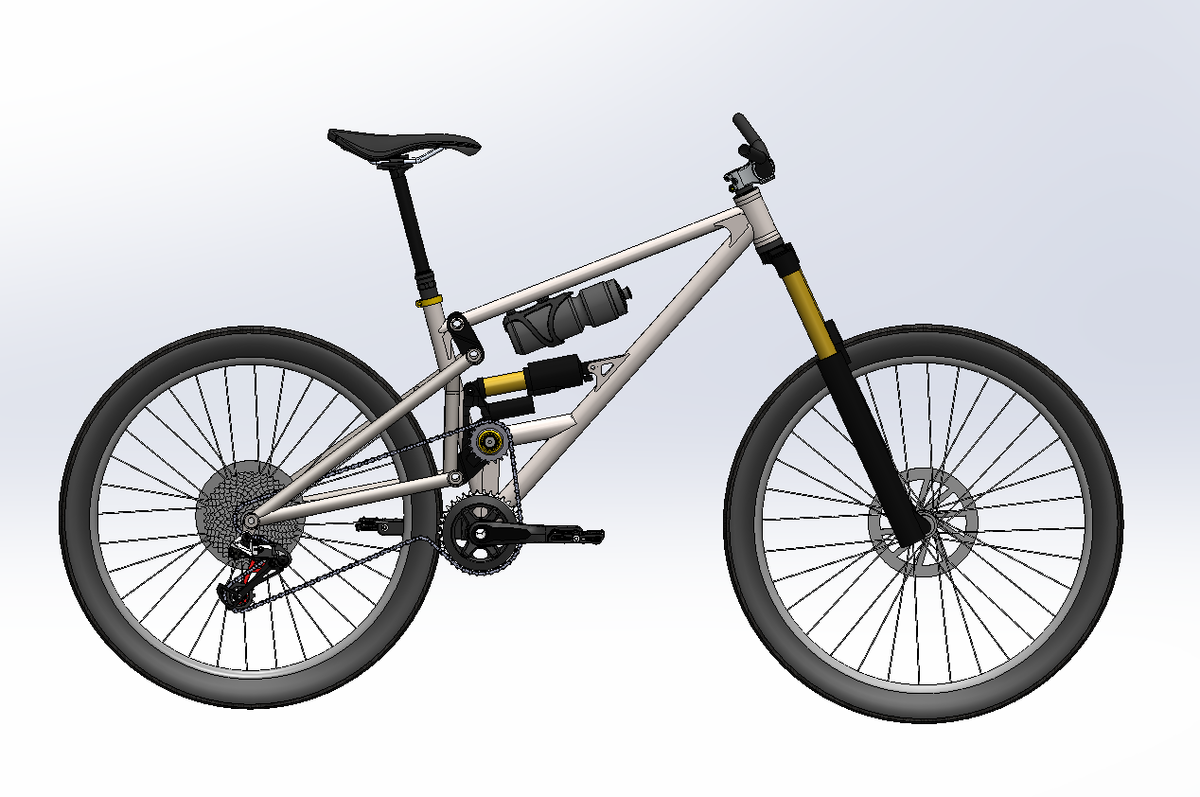
I don't know how differently to say it so it'll be my last attempt.
Term "Anti-Squat" as defined in current vehicle dynamics for example in Tony Foale's book or propagated by Dave Weagle, means suspension reaction to tendency to squat under chain tension. I repeat chain tension. If you don't pedal then there's no "anti squat". AntiSquat graphs behind the 50 or 60% of travel are nonsense because you are not pedalling at this point. Every bike, old or modern, will squat in high-berm high speed turn on pumptrack.
Sweet, now try to find something to quote about pedal kickback in that book.