I've definitely seen ads from Ari for HSA-qualified purchasing. I imagine the bike companies are all using the same third-party service to determine qualification.That said, if...
I've definitely seen ads from Ari for HSA-qualified purchasing. I imagine the bike companies are all using the same third-party service to determine qualification.
That said, if you have an HSA and can afford not tap into it regularly, there is no better investment vehicle in the US. Tax-deductible contributions, tax-free investment growth, tax-free withdrawals for qualified expenses. I don't currently have an HDHP that is HSA eligible, but when I did, I maxed it whenever possible and fully invested every dollar without spending any of it. It is my long-term care plan.
Sorry for digging up ancient posts, but I just noticed that Fanatic lists HSA/FSA-eligible parts, connecting you with Truemed to determine if the items is medically...
Sorry for digging up ancient posts, but I just noticed that Fanatic lists HSA/FSA-eligible parts, connecting you with Truemed to determine if the items is medically necessary. Has anyone gone through this process for ritzy-part purchases? Seems like something that might come back to bite me when I file taxes, but maybe after the DOGE reworking of the IRS it's less of an issue.😉
If I understand this correctly it's just a (driver development?) team, not a parts development company. It's even based at Thermal, in Califronia, while ENVE is...
If I understand this correctly it's just a (driver development?) team, not a parts development company. It's even based at Thermal, in Califronia, while ENVE is Utah based.
Here's a rough idea. I'm sure there are some details missing, and despite my best efforts, this rabbit hole has some twists.So you have Mark Hancock...
Here's a rough idea. I'm sure there are some details missing, and despite my best efforts, this rabbit hole has some twists.
So you have Mark Hancock, co-founder of PACS Group, owner of 323 skilled nursing facilities in 17 states. Current net worth estimated at $2.4 billion. PACS went public on the NYSE in 2024 at $21/share, currently at ~$36.50, and Hancock reportedly still holds 35%. The chart, since IPO had some wild moments, but seems to be back on track.
Obviously, a very successful entrepreneur at this stage. In April of 2024, Hancock's own PV3 Investments (later PV3 Enterprises) acquires Enve Composites for $20 million. Amer paid $50 million in 2016, so they took a hit, and he got a deal, comparatively. PV3, relying on the guidance of Proverbs 3 (hmm, PV3 sounds like Proverbs 3), deploys capital to do some kind of "good" in the world. More of a patient capital approach, and doesn't say it, but seems to operate more like a family office, possibly. They also hold a couple of restaurants, a golf course, a marketing agency, some retail space, and, most recently, a racetrack.
The state of Utah passed a law in 2024 that "prevents companies owned or controlled by the governments of China, Iran, North Korea and Russia from owning land in Utah." That meant that Mitime Utah Investment (Chinese-owned) had to divest the track facility (Burt Brothers Motor Park), which was sold and thus acquired by PV3 just weeks ago. The track is close to the Tooele Army Depot so Governor Cox hailed it as "This is a huge win for Utah. It's a big win for the United States. It's a win for our servicemembers, and it's a win for national security,"
To PV3's credit, they state that they want to invest in and improve the facility, which is believable given that it appears two of Hancock's sons are part of the leadership team, and at least one of them is a driver for Enve Motorsports. A couple of the Enve Motorsports race team sponsors are also in the PV3 portfolio, ie. a lot of money is coming from one place. One can speculate that the Enve MS team could be moving from California to Utah.
Now, to tie this Saturday morning ramble back together, I give you a quote from the track purchase press release:
"PV3’s perspective is informed by hands-on experience in performance-driven environments. Following PV3’s acquisition of ENVE Composites in 2024, the company continued expanding the advanced fabrication, testing, and engineering work it was already known for, work that increasingly moved from controlled environments into real-world applications. That evolution led to the launch of ENVE Motorsports, which competes across open-wheel, GT, and high-performance racing programs, using the track as a proving ground where ideas are tested, refined, and translated into broader advancements.
That experience reinforces a long-held belief: at its best, motorsports is not just competition, it’s an engine for innovation. It pushes materials, aerodynamics, safety systems, and manufacturing techniques that eventually influence transportation, cycling, and other performance industries. Utah is well-positioned to participate more meaningfully in that ecosystem, and this venue can once again play an active role."
Seems plausible that Enve Composites will be developing, or at least making, some racecar parts and perhaps lots of other carbon fiber things in transportation and performance industries. Or not.
I'm guessing the aspirations may be related to being involved in motorsports and other things, not necessarily being a media company that also peddles sugar water.
Unrelated, @jeff.brines given your intersecting worlds of AI and Outdoor, I'm curious what your take is on the recent run of acquisitions at Backcountry. Their parent, CSC Generation, has been on a tear with Biketiresdirect, LevelNine, Motosport.com, Dennis Kirk, Velofix, and now Christy's. The outward explanation of their approach makes sense (https://www.cscgeneration.com/). I'm just more curious if you're seeing this in other industries or what this all might look like in a couple years time.
Unrelated, @jeff.brines given your intersecting worlds of AI and Outdoor, I'm curious what your take is on the recent run of acquisitions at Backcountry. Their parent, CSC Generation, has been on a tear with Biketiresdirect, LevelNine, Motosport.com, Dennis Kirk, Velofix, and now Christy's. The outward explanation of their approach makes sense (https://www.cscgeneration.com/). I'm just more curious if you're seeing this in other industries or what this all might look like in a couple years time.
I can't tell you what's behind this particular string of acquisitions, nor have I done any research specific to them. But what I've seen more broadly in the market is a new kind of roll-up strategy emerging, driven in part by the fact that seemingly everything not AI is suddenly being suppressed in value. The king of this strategy, at least in my world, is Bending Spoons, though its focus is primarily on tech.
There's a certain kind of economy of scale that comes with this approach. If you've figured out how to improve the systems and operations of one company, there's a good chance you can apply those same improvements (systems/tech/process) across a dozen similar businesses. The marginal cost of making each subsequent company better can be relatively small.
I'm actually pretty interested in this idea in a different form. It feels like there's a real opportunity to arm the little guys with some of the same advantages that larger companies have historically enjoyed.
Unrelated, @jeff.brines given your intersecting worlds of AI and Outdoor, I'm curious what your take is on the recent run of acquisitions at Backcountry. Their parent, CSC Generation, has been on a tear with Biketiresdirect, LevelNine, Motosport.com, Dennis Kirk, Velofix, and now Christy's. The outward explanation of their approach makes sense (https://www.cscgeneration.com/). I'm just more curious if you're seeing this in other industries or what this all might look like in a couple years time.
I can't tell you what's behind this particular string of acquisitions, nor have I done any research specific to them. But what I've seen more broadly...
I can't tell you what's behind this particular string of acquisitions, nor have I done any research specific to them. But what I've seen more broadly in the market is a new kind of roll-up strategy emerging, driven in part by the fact that seemingly everything not AI is suddenly being suppressed in value. The king of this strategy, at least in my world, is Bending Spoons, though its focus is primarily on tech.
There's a certain kind of economy of scale that comes with this approach. If you've figured out how to improve the systems and operations of one company, there's a good chance you can apply those same improvements (systems/tech/process) across a dozen similar businesses. The marginal cost of making each subsequent company better can be relatively small.
I'm actually pretty interested in this idea in a different form. It feels like there's a real opportunity to arm the little guys with some of the same advantages that larger companies have historically enjoyed.
More on that in my Substack this week.
Pardon my ignorance, but isn't what you described just what every company does when they buy competitors in the same field? I.e, where a company that is an expert in Y and has cash, will buy smaller competitor in the Y field and optimise it with our knowledge of being good in Y.
This isn't some new strategy, it's more like horizontal expansion 101 no?
I think a non zero amount of people didn't spring for that bike because of the cable routing thing. Coupled with the rise of e bikes as the blingy purchase, I am not surprised they overbought. That bike's release felt like it happened right at a divide between the stumpy evo and the levo being at the forefront of their high end sales.
Pardon my ignorance, but isn't what you described just what every company does when they buy competitors in the same field? I.e, where a company that...
Pardon my ignorance, but isn't what you described just what every company does when they buy competitors in the same field? I.e, where a company that is an expert in Y and has cash, will buy smaller competitor in the Y field and optimise it with our knowledge of being good in Y.
This isn't some new strategy, it's more like horizontal expansion 101 no?
Again, probably missing something?
No, you're not missing anything. At its core, it is a pretty conventional roll-up strategy. What I didn't really articulate in my original post is why I think the economics of that strategy are becoming more compelling right now.
Two things:
AI materially changes the economics of integration. Historically, integrating businesses, consolidating systems, and building software around operational efficiencies has been expensive, slow, and often unsuccessful. I've personally watched "quick ERP integrations" cost hundreds of thousands of dollars. In this era, the cost and complexity of doing that work is falling dramatically. You can now build bespoke systems that actually work the way a business needs them to and drive meaningful ROI without the sort of engineering budget that was previously required. (and then adopt that system in ways that previously was impossible)
Valuations. The amount of capital and investor attention being directed toward AI has, in my view, further depressed the relative valuations of a lot of businesses outside of AI. There is an interesting opportunity to buy businesses that aren't particularly exciting to the capital markets and apply the very technology everyone is chasing to improve their underlying economics. This is doubly the case if those businesses actually make money.
This is why I brought up Bending Spoons. What differentiates them from a more conventional acquirer is the caliber of their technical talent, how they integrate businesses, and their ability to apply a repeatable set of operational and technological improvements across their portfolio.
So, yes, the underlying strategy isn't new. What's changing is the cost of acquiring these businesses relative to their potential value and the cost of actually realizing the...synergies (lol) everyone talks about.
Pardon my ignorance, but isn't what you described just what every company does when they buy competitors in the same field? I.e, where a company that...
Pardon my ignorance, but isn't what you described just what every company does when they buy competitors in the same field? I.e, where a company that is an expert in Y and has cash, will buy smaller competitor in the Y field and optimise it with our knowledge of being good in Y.
This isn't some new strategy, it's more like horizontal expansion 101 no?
No, you're not missing anything. At its core, it is a pretty conventional roll-up strategy. What I didn't really articulate in my original post is why...
No, you're not missing anything. At its core, it is a pretty conventional roll-up strategy. What I didn't really articulate in my original post is why I think the economics of that strategy are becoming more compelling right now.
Two things:
AI materially changes the economics of integration. Historically, integrating businesses, consolidating systems, and building software around operational efficiencies has been expensive, slow, and often unsuccessful. I've personally watched "quick ERP integrations" cost hundreds of thousands of dollars. In this era, the cost and complexity of doing that work is falling dramatically. You can now build bespoke systems that actually work the way a business needs them to and drive meaningful ROI without the sort of engineering budget that was previously required. (and then adopt that system in ways that previously was impossible)
Valuations. The amount of capital and investor attention being directed toward AI has, in my view, further depressed the relative valuations of a lot of businesses outside of AI. There is an interesting opportunity to buy businesses that aren't particularly exciting to the capital markets and apply the very technology everyone is chasing to improve their underlying economics. This is doubly the case if those businesses actually make money.
This is why I brought up Bending Spoons. What differentiates them from a more conventional acquirer is the caliber of their technical talent, how they integrate businesses, and their ability to apply a repeatable set of operational and technological improvements across their portfolio.
So, yes, the underlying strategy isn't new. What's changing is the cost of acquiring these businesses relative to their potential value and the cost of actually realizing the...synergies (lol) everyone talks about.
Thanks for the reply. This all makes sense to me and seems logical.
I think the only pressing concern will be the cost of capital. Your right that because of the AI fever companies with much better fundamentals may be looked over, but from the sheer scale of the bond sales and other forms of capital raising, the cost for any buyout is rapidly rising. So on the one hand, you have AI decreasing the costs of this strategy, while on the other, AI capital demand making it more expensive to do so.
Not to mention the US government are still going to force primary dealers to sell 7% of GDP in treasuries again next year. Capital is getting tight.
Pardon my ignorance, but isn't what you described just what every company does when they buy competitors in the same field? I.e, where a company that...
Pardon my ignorance, but isn't what you described just what every company does when they buy competitors in the same field? I.e, where a company that is an expert in Y and has cash, will buy smaller competitor in the Y field and optimise it with our knowledge of being good in Y.
This isn't some new strategy, it's more like horizontal expansion 101 no?
No, you're not missing anything. At its core, it is a pretty conventional roll-up strategy. What I didn't really articulate in my original post is why...
No, you're not missing anything. At its core, it is a pretty conventional roll-up strategy. What I didn't really articulate in my original post is why I think the economics of that strategy are becoming more compelling right now.
Two things:
AI materially changes the economics of integration. Historically, integrating businesses, consolidating systems, and building software around operational efficiencies has been expensive, slow, and often unsuccessful. I've personally watched "quick ERP integrations" cost hundreds of thousands of dollars. In this era, the cost and complexity of doing that work is falling dramatically. You can now build bespoke systems that actually work the way a business needs them to and drive meaningful ROI without the sort of engineering budget that was previously required. (and then adopt that system in ways that previously was impossible)
Valuations. The amount of capital and investor attention being directed toward AI has, in my view, further depressed the relative valuations of a lot of businesses outside of AI. There is an interesting opportunity to buy businesses that aren't particularly exciting to the capital markets and apply the very technology everyone is chasing to improve their underlying economics. This is doubly the case if those businesses actually make money.
This is why I brought up Bending Spoons. What differentiates them from a more conventional acquirer is the caliber of their technical talent, how they integrate businesses, and their ability to apply a repeatable set of operational and technological improvements across their portfolio.
So, yes, the underlying strategy isn't new. What's changing is the cost of acquiring these businesses relative to their potential value and the cost of actually realizing the...synergies (lol) everyone talks about.
Thanks, Jeff.
That's where my head was going too, particularly #1. How quickly this is advancing the strategy of the roll-up of like businesses. On the surface, an outsider would often say, "I can see those brands coming together." Outwardly, the parent talks "synergy" 🤮, and inwardly the struggle for most of the employees who get to stay is blending systems and software together while they pull their hair out is often the reality.
Thanks for the reply. This all makes sense to me and seems logical. I think the only pressing concern will be the cost of capital. Your right...
Thanks for the reply. This all makes sense to me and seems logical.
I think the only pressing concern will be the cost of capital. Your right that because of the AI fever companies with much better fundamentals may be looked over, but from the sheer scale of the bond sales and other forms of capital raising, the cost for any buyout is rapidly rising. So on the one hand, you have AI decreasing the costs of this strategy, while on the other, AI capital demand making it more expensive to do so.
Not to mention the US government are still going to force primary dealers to sell 7% of GDP in treasuries again next year. Capital is getting tight.
I keep meaning to write a piece titled "Why You Should Care About AI, Even If You Don't Care About AI," and this is one of the biggest reasons.
AI is fundamentally distorting return expectations across capital markets. The sheer amount of capital these companies are raising, combined with the promise of astronomical returns, has made investing in almost anything else look relatively unattractive. We're even seeing a world in which the 10-year Treasury isn't necessarily responding to Fed policy the way many have historically expected.
Why should someone in the bike industry care? A bunch of reasons. First, capital isn't unlimited, and opportunity cost is a very real thing. If you're an investor, why put money into a bike company with inventory risk, modest margins, physical infrastructure and cyclical demand when you're being sold the prospect of exponential world-will-never-be-the-same "we are coming for all jobs" returns elsewhere?
This has implications for everything from the valuation of existing bike companies to the ability of new brands to raise capital, the cost of financing inventory, the willingness of lenders to extend credit and, ultimately, the diversity of companies and products available to us as riders.
You don't have to use ChatGPT, Claude, XYZ AI or care about large language models or believe in artificial general intelligence for AI to materially reshape the bike industry. It can do so without a single AI-powered product ever making its way onto your bike, simply by changing where capital flows, what it costs and what investors expect in return.
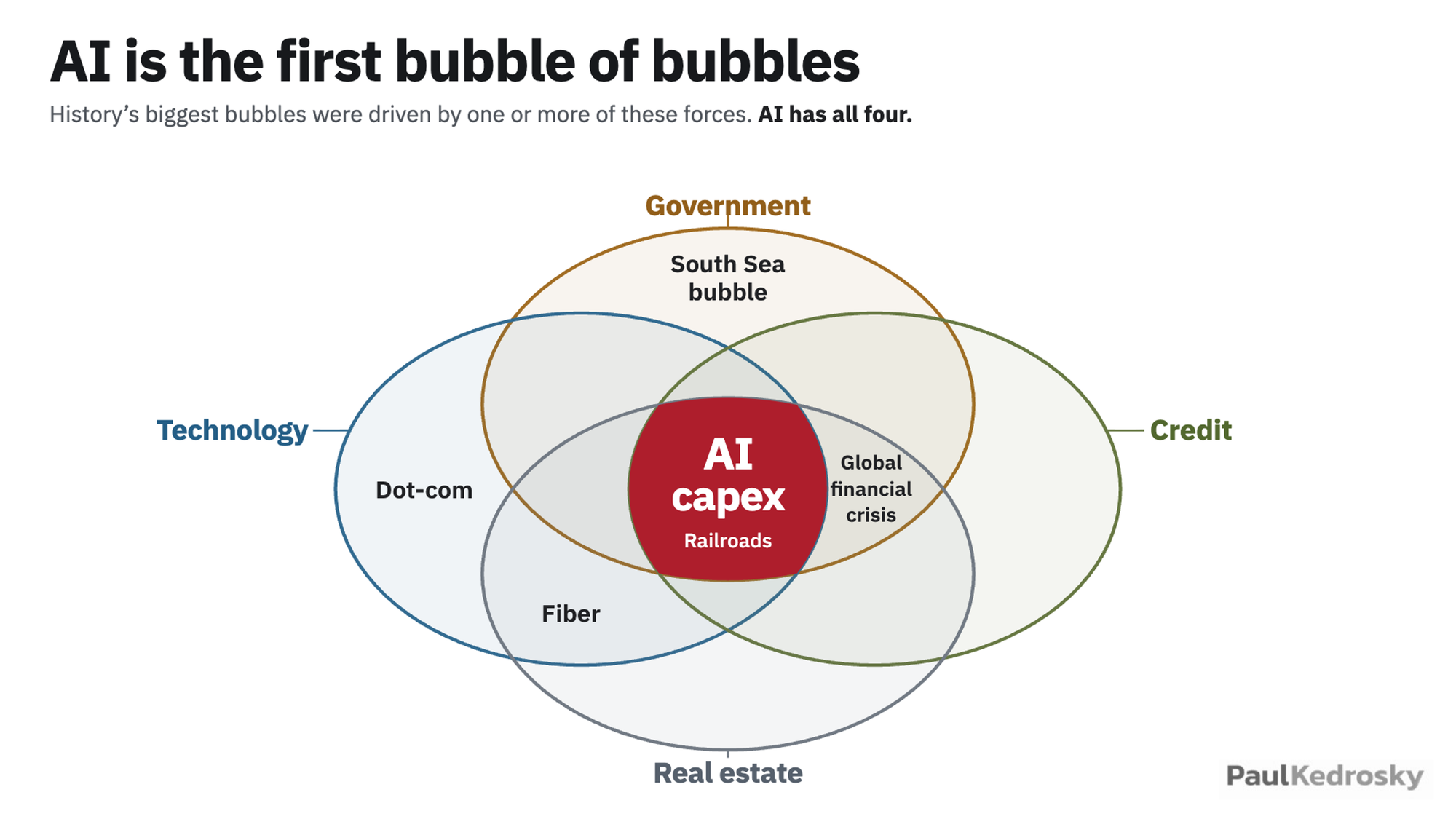
I don't particularly like this dynamic. I also firmly believe a technology can be enormously important while simultaneously being at the center of an asset bubble. Those two things are not mutually exclusive. From railroads to electricity to the internet, the commercialization of transformative technologies has often been accompanied by speculative excess, misallocated capital and some pretty spectacular boom-and-bust cycles.
The internet changed virtually everything. That didn't make every internet company in 1999 a good investment.
Anytime you hear the words "this time is different," you ought to be scratching your head.


Seth’s Bike Tax
Molly Maguires?
Interesting comments, and no doubt pulled for the juicy sound bite: https://www.instagram.com/reel/DfvfT2aGbmh/?cnvx=YjVyM3ZlcW9tMG1w I can't seem to find the YouTube video (link in post is not found).
I'm guessing the aspirations may be related to being involved in motorsports and other things, not necessarily being a media company that also peddles sugar water.
Looks like Lapierre and Raleigh have a new owner: https://cyclingindustry.news/lapierre-and-raleigh-reprieve-as-quanta-capital-reportedly-acquires-brands-from-accell
Unrelated, @jeff.brines given your intersecting worlds of AI and Outdoor, I'm curious what your take is on the recent run of acquisitions at Backcountry. Their parent, CSC Generation, has been on a tear with Biketiresdirect, LevelNine, Motosport.com, Dennis Kirk, Velofix, and now Christy's. The outward explanation of their approach makes sense (https://www.cscgeneration.com/). I'm just more curious if you're seeing this in other industries or what this all might look like in a couple years time.
I can't tell you what's behind this particular string of acquisitions, nor have I done any research specific to them. But what I've seen more broadly in the market is a new kind of roll-up strategy emerging, driven in part by the fact that seemingly everything not AI is suddenly being suppressed in value. The king of this strategy, at least in my world, is Bending Spoons, though its focus is primarily on tech.
There's a certain kind of economy of scale that comes with this approach. If you've figured out how to improve the systems and operations of one company, there's a good chance you can apply those same improvements (systems/tech/process) across a dozen similar businesses. The marginal cost of making each subsequent company better can be relatively small.
I'm actually pretty interested in this idea in a different form. It feels like there's a real opportunity to arm the little guys with some of the same advantages that larger companies have historically enjoyed.
More on that in my Substack this week.
Pardon my ignorance, but isn't what you described just what every company does when they buy competitors in the same field? I.e, where a company that is an expert in Y and has cash, will buy smaller competitor in the Y field and optimise it with our knowledge of being good in Y.
This isn't some new strategy, it's more like horizontal expansion 101 no?
Again, probably missing something?
I think a non zero amount of people didn't spring for that bike because of the cable routing thing. Coupled with the rise of e bikes as the blingy purchase, I am not surprised they overbought. That bike's release felt like it happened right at a divide between the stumpy evo and the levo being at the forefront of their high end sales.
No, you're not missing anything. At its core, it is a pretty conventional roll-up strategy. What I didn't really articulate in my original post is why I think the economics of that strategy are becoming more compelling right now.
Two things:
This is why I brought up Bending Spoons. What differentiates them from a more conventional acquirer is the caliber of their technical talent, how they integrate businesses, and their ability to apply a repeatable set of operational and technological improvements across their portfolio.
So, yes, the underlying strategy isn't new. What's changing is the cost of acquiring these businesses relative to their potential value and the cost of actually realizing the...synergies (lol) everyone talks about.
Thanks for the reply. This all makes sense to me and seems logical.
I think the only pressing concern will be the cost of capital. Your right that because of the AI fever companies with much better fundamentals may be looked over, but from the sheer scale of the bond sales and other forms of capital raising, the cost for any buyout is rapidly rising. So on the one hand, you have AI decreasing the costs of this strategy, while on the other, AI capital demand making it more expensive to do so.
Not to mention the US government are still going to force primary dealers to sell 7% of GDP in treasuries again next year. Capital is getting tight.
Thanks, Jeff.
That's where my head was going too, particularly #1. How quickly this is advancing the strategy of the roll-up of like businesses. On the surface, an outsider would often say, "I can see those brands coming together." Outwardly, the parent talks "synergy" 🤮, and inwardly the struggle for most of the employees who get to stay is blending systems and software together while they pull their hair out is often the reality.
I keep meaning to write a piece titled "Why You Should Care About AI, Even If You Don't Care About AI," and this is one of the biggest reasons.
AI is fundamentally distorting return expectations across capital markets. The sheer amount of capital these companies are raising, combined with the promise of astronomical returns, has made investing in almost anything else look relatively unattractive. We're even seeing a world in which the 10-year Treasury isn't necessarily responding to Fed policy the way many have historically expected.
Why should someone in the bike industry care? A bunch of reasons. First, capital isn't unlimited, and opportunity cost is a very real thing. If you're an investor, why put money into a bike company with inventory risk, modest margins, physical infrastructure and cyclical demand when you're being sold the prospect of exponential world-will-never-be-the-same "we are coming for all jobs" returns elsewhere?
This has implications for everything from the valuation of existing bike companies to the ability of new brands to raise capital, the cost of financing inventory, the willingness of lenders to extend credit and, ultimately, the diversity of companies and products available to us as riders.
You don't have to use ChatGPT, Claude, XYZ AI or care about large language models or believe in artificial general intelligence for AI to materially reshape the bike industry. It can do so without a single AI-powered product ever making its way onto your bike, simply by changing where capital flows, what it costs and what investors expect in return.
I don't particularly like this dynamic. I also firmly believe a technology can be enormously important while simultaneously being at the center of an asset bubble. Those two things are not mutually exclusive. From railroads to electricity to the internet, the commercialization of transformative technologies has often been accompanied by speculative excess, misallocated capital and some pretty spectacular boom-and-bust cycles.
The internet changed virtually everything. That didn't make every internet company in 1999 a good investment.
Anytime you hear the words "this time is different," you ought to be scratching your head.
Please do.
Post a reply to: The Bikeconomics (Mega)Thread