

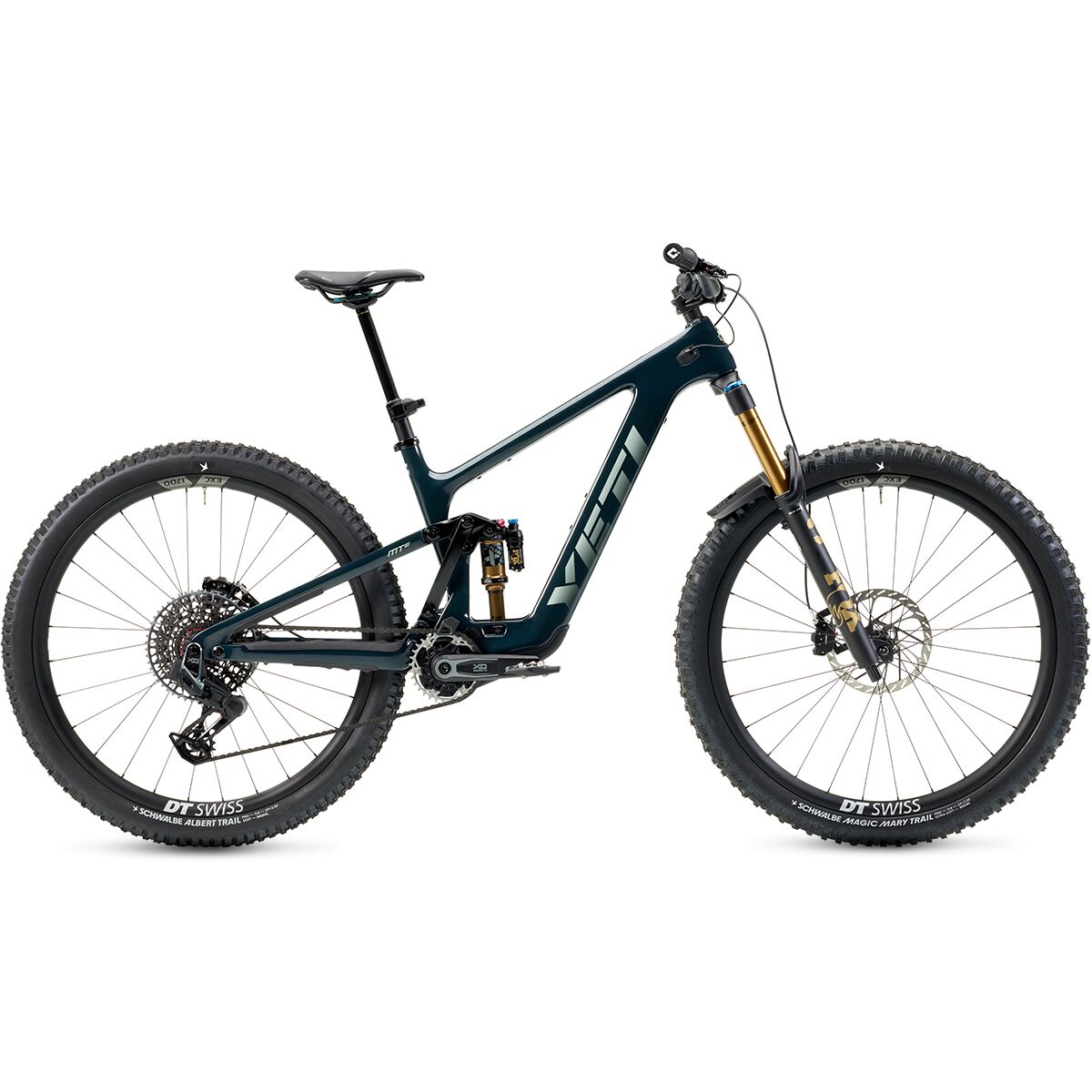
2026 Yeti MTe T3 X0 Transmission E-Bike


| Where To Buy | |||
|---|---|---|---|

|
Free shipping on orders over $69 (continental U.S. only).
International shipping available. Some exclusions apply. |
Free shipping on orders over $69 (continental U.S. only).
International shipping available. Some exclusions apply. $12,650.00
|
|
|
|||

|
Free shipping on orders over $50 (contiguous U.S. only).
International shipping available. Some exclusions apply. |
Free shipping on orders over $50 (contiguous U.S. only).
International shipping available. Some exclusions apply. $12,650.00
|
|
|
|||

|
Free U.S. shipping on everything.
International shipping available. Some exclusions apply. |
||

|
Free standard UK delivery on orders over £50.
|
||

|
Free shipping on orders over $50 (continental U.S. only).
International shipping available. Some exclusions apply. |
||

Yeti has entered the SL eMTB arena with its MTe model, a 145mm travel platform powered by TQ's sleek new HPR 60 drive unit—which promises to blend analog feel with e-powered efficiency. With two battery options and featherweight builds claimed to be as light as 38 pounds, can the legendary, premium trail bike brand's new offering stand out in an increasingly competitive eMTB environment? Let's find out.
Highlights
- 145mm rear wheel travel // 160mm fork (compatible with up to 180mm forks)
- Carbon frame enhanced with Vectran plies
- 29-inch wheels with mullet compatibility via a flip chip
- Sixfinity suspension design
- TQ HPR 60 Drive Unit
- 290Wh or 580Wh battery options
- Integrated removable battery
- Integrated top tube display
- Adjustable leverage rate
- 64-degree head tube angle
- 449mm chainstay length
- Internal cable routing
- 12X148 Boost rear spacing
- Sizes: S - XL
- 3 build kits
- MSRP: C2 Eagle 90 Transmission - $9,850 | T3 XO Transmission - $12,650 | T4 XX Transmission - $14,300
- Weight (M, T3 Build, 580Wh battery, no pedals): 45 lbs (20.4 kgs)

What's New?
Until now, the Colorado brand renowned for its cult-like following among high-elevation trail lovers has merely dabbled in the eMTB segment with one full-power offering, the 160E.


With builds ranging from 38 to 45 pounds, the MTe goes in a different direction, albeit maintaining Yeti's proprietary eMTB suspension platform, Sixfinity. The new TQ HPR60 motor produces 60Nm of tourque and 350 watts of power matched to two battery options, a 290Wh (T4 build only) and a 580Wh.
The MTe has 145mm of rear wheel travel paired with a 160mm fork. Rolling on 29-inch wheels front and rear, a flip chip permits the use of a 27.5-inch rear wheel while maintaining geometry. Two pairs of flip chips located at the lower shock mount give riders access to four unique leverage rates to match the bike's feel to personal riding style preferences.
Frame Details
The MTe frame is constructed of carbon enhanced with polymer-based Vectran plies, a high-performance multifilament with similar properties to Kevlar. Yeti tested the material on their Special Projects DH bike, determining it possesses exceptional impact resistance, dissipation of impact forces, and increases overall strength.


An integrated rear fender keeps debris from impeding suspension movement of the Sixfinity switch link. To protect against rock strikes, the MTe features a downtube guard that also acts as an access door, permitting battery swaps and service access to the internally routed cables. There is also a hidden spot by the battery to store an AirTag or Tile.


Floating collet axles and pinch bolts on the linkage extend bearing life and ensure consistent alignment and smooth operating suspension.
Suspension Design
Yeti specifically developed the six-bar Sixfinity suspension system to accommodate the added power and mass of an e-MTB, thus increasing pedaling efficiency and traction.

Sixfinity utilizes three linkages: switch link, rocker link, and timing link. As the suspension progresses through its travel, the Switch link rotates up until it reaches the inflection point. Pedaling support is provided with a higher anti-squat around sag. It then "switches" directions to rotate down, with a lower anti-squat past sag. The unique anti-squat curve is inversely scaled for the acceleration and traction provided by the motor's assistance.


MTe's anti-rise remains consistent throughout suspension travel, striking a balance between traction and geometry preservation while under braking.

Riders can tweak Sixfinity's progression rate to match individual riding style— linear for a consistent, predictable feel or progressive for a lively feel and bottom-out resistance. Yeti includes two sets of chips with the MTe. Both sets can be run in either direction, allowing for four leverage rate possibilities.
The C2 and T3 builds come with the 12% or 25% progression chips installed to match the Float X shock, while the T4 build kit comes with the 14% or 23% progression chips installed to match the Float shock. All builds come with chips to run all four leverage rate positions. The choice of shock does not influence the leverage rate figures.
Changing wheel sizes along with using their respective wheel chip settings will preserve all leverage rates and geometry as there is no correlation between 27.5-inch chips and leverage rate.
Geometry
The MTe's geometry is a mix of numbers we are used to seeing on modern all-mountain bikes, such as a 64-degree head angle and 460mm reach on the size medium. However, some numbers are more reminiscent of longer-travel enduro bikes, such as a 1248mm wheelbase (size M) and 449mm chainstay length. Both of which are on the long side for a 145mm travel bike. Compared to the 160e, the MTe is a touch slacker (64 vs. 64.5 degrees), has a 12mm lower standover height, an 8mm lower bottom bracket, and the stack has increased by 5-10mm on sizes M-XL, while reach remains identical.

eMTB System: TQ HPR60
The MTe is powered by the new TQ HPR60 drive unit, which replaces TQ's HPR50. Adding 10Nm of torque (a 20% increase in power), the new motor provides 350 watts of peak power, improves cooling and efficiency via new cooling fins, and produces less noise. Two new battery options, 290Wh and 580Wh, comprise the system. A 160Wh range extender is also available as an add-on.

The German brand claims the HPR60 drive unit is the smallest, lightest, and quietest motor with the highest torque density on the market. TQ achieved this through its harmonic pin ring technology (HPR). Where conventional drive units use numerous cog wheels with only a few teeth engaging at any one time to transfer power, the HPR achieves its power transfer with fewer parts. Centered around the oscillating motion of the cycloidal gear reduction mechanism, the unit applies power evenly and naturally. It consists of a double-tooth ring where many teeth are engaged simultaneously. The tooth shape is selected to be precisely matched and to maximize surface pressure.


Due to the direct power transmission of the gearbox, the motor operates at a lower rotational speed, causing less wear and tear and noise. The drive unit features three assist modes controlled by a handlebar-mounted remote: Eco, Mid, and High, plus a walk mode. A new high-resolution integrated top tube display features the power button and various data screens. An app controls motor tuning, personal profiles, battery and software information, and support.
Build Kits
Yeti offers three build kits for the MTe. In typical Yeti fashion, there is no "budget" build. The C2 Eagle 90 Transmission is the least expensive at $9,850 with SRAM's mechanical Transmission, Maven Bronze brakes and FOX Performance suspension. The T3 XO Transmission build bumps up the drivetrain to SRAM's XO Transmission, Maven Silver brakes and FOX Factory suspension for $12,650. The sub-40-pound T4 XX Transmission swaps the 580Wh battery for the 290Wh battery— scraping three pounds—but bumps up the price up to $14,300.


On The Trail
Yeti sent us an MTe T3 XO size medium to put to the test on our local trails in the Sierra Nevada mountains. Our testing took place in early spring, with mixed conditions as snow began to melt on the local trails. We took advantage of both flowy and technical trails for the testing period.

Out of the box, the MTe resembles an e-bike, albeit not particularly sleek for an SL. The Sixfinity layout draws the eye to the six-bar configuration, and a closer inspection reveals the flip chip for the suspension adjustments.
Testing began in the stock 12% progression rate, though unknowingly, as we had yet to read any details on the MTe. The initial few rides gave a very neutral perception of the bike's ride feel and handling, perhaps even slightly muted. It wasn't a negative trait, but nothing stood out as exceptionally great or underperforming. That's when we dove into the press materials Yeti sent us followed by a detailed discussion about the MTe platform with the product and engineering teams. Learning more about the design ethos of the Sixfinity suspension system and the customizable leverage rates from the team, we abruptly closed the laptop and sprinted for the trail.

The flip chip takes a few minutes to swap, and its best done in the garage where you won't lose track of the parts. Trust us.
Yeti has a nifty suspension calculator to help set the air pressure and sag, but in our experience, it's light on the air pressure. We aired up about 15% more than the suggested pressure, especially in the 12% progression setting. Rear suspension was set at 30% sag with a few clicks of compression damping.
In the more linear setting, the MTe used up its 145mm of travel with ease. There was never a harsh bottom out, but the suspension consistently exercised its full range. The bike felt planted to the ground, requiring a bit of effort to pop over obstacles. Upon flipping the chips to achieve the 25% leverage rate, things started to get very interesting very quickly. The neutral, unassuming ride feel we initially experienced was quickly forgotten, replaced with a much livelier and playful persona. Our favorite test trails were rediscovered, bringing to life anything that could be jumped, gapped, or shredded. On trails that allow for speed to be carried, the MTe felt wickedly fast, building speed and accelerating with any rider input.

Where the Sixfinity's suspension design becomes most noteworthy is in technical rock gardens. The MTe feels like it skims the top of the obstacles, always moving forward, refusing to get hung up. At times, the travel feels more than 145mm because of the lack of feedback.
TQ's new motor is a welcomed upgrade with increased power, and it's incredibly quiet to the degree that you have to try to hear it. However, compared to many other SL bikes and motors, the peak power is less. We conducted an unscientific drag race against Transition's new Regulator SX outfitted with the Bosch SX motor, which produces 600 watts of power. The Regulator sprinted off the line and pulled ground on the MTe with ease. That said, the TQ delivers the power it hassmoothly and efficiently. Just don't expect any last-second surges of power when you're suffering on a hard climb.

While outright speed and torque aren't the point of an SL eMTB, the MTe and TQ package suffers on steep, technical climbs against more powerful SL offerings. We had some difficulty successfully climbing technical features that were doable on other SL bikes. With time, we eventually chalked most of our climbs off the list, but our success rate was lower with the TQ.
At 45 pounds, the T3 build isn't breaking any lightweight SL records, especially considering the TQ's lightest in-class status. But the MTe handles its weight well. Jumping and cornering feel natural, closely resembling a traditional mountain bike. Yeti fans beware— This IS an eMTB, and it's designed to ride with the power on. Despite being an SL, turning off the motor and going sans assist on anything uphill isn't realistic.
Remember the long chainstay and wheelbase we mentioned? The MTe's long rear end was noticeable when the corners became tight. It's not a detriment but takes getting used to. Down fast descents, the added stability was welcomed.

The Schwalbe tires were the only critique of the component spec. The Albert Trail Pro rear tire struggled to grab traction on loose steeps, choosing instead to slide on top of the surface, too often uncontrollably.

What's The Bottom Line?
In a time of rapid eMTB advancements, Yeti's MTe has landed itself towards the top ranks without hesitation. It's a unique addition to the eMTB SL category, a refreshingly fun and capable bike that can cater to a wide range of riding styles and preferences.
Yeti's Sixfinity suspension design is impressive, making fast work of technical terrain and delivering little feedback to the rider. The ability to tune the suspension with the flip chips is no gimmick, and it's worth taking the time to find a proper setup to reap its full benefits. Once unleashed, there isn't much that can keep this Yeti in a cage.
Packaged with enduro-like geometry, the MTe is at home on enduro terrain, often disregarding its 145mm of rear travel that often limits most trail bikes. The MTe resembles a traditional mountain bike in many instances on the trail, but it's still an eMTB and requires some input to bring it to life. For those that can unlock its full potential, it's wildly fun and capable.
While the TQ HPR60 motor's output is on the lighter side, it best rewards riders who are willing to put in the work to pedal and climb. If your group rides are comprised of full-power eMTBs, the MTe might not be the tool for social hour.
Starting at $9,850, the MTe is no bargain. But that's the Yeti buy-in, and regardless of which build kit you consider, it's hard to point a finger at a questionable component choice.
For more information on Yeti's MTe, please visit yeticycles.com
View key specs, compare e-bikes, and review all the new Yeti MTe models in the Vital MTB Product Guide.
About the Tester
Rick Reed - Age: 42 // Years Riding MTB: Who's counting? // Height: 5' 9" (1.75m) // Weight: 142 pounds (64.4kg)
A veteran of the bike industry, Rick "E" Reed is a regular contributor to Vital. Rick enjoys riding fast tech, backcountry singletrack, and bike parks, occasionally sharing his chocolate with a select human being or two (you know who you are). He resides in Reno, Nevada, with his terror dog, Zuul.

Specifications
• Bottom bracket heights are listed as "estimated" by Yeti
Option: TQ 160 Wh range extender (compatible with MD-XL only)
Rotors: SRAM HS2, 200mm
Rear: Schwalbe Albert, Trail Pro Radial casing, Soft compound, 29" x 2.5"
Drop: 150mm (SM), 175mm (MD), 200mm (LG/XL)
• Rear suspension leverage rate adjustable via 4-position flip chips in lower shock mount, with 12/14/23/25% options
• Compatible with mixed ("Mullet") wheels (29" front, 27.5" rear) via flip chips in upper linkage
• Internally tunneled cable routing
• SRAM UDH (Universal Derailleur Hanger)
• Integrated rear mudguard/fender
• Can be ridden without the battery
• Power settings customizable via TQ E-Bike Mobile App
• Includes TQ 4A battery charger
| Where To Buy | |||
|---|---|---|---|
|
|
Free shipping on orders over $69 (continental U.S. only).
International shipping available. Some exclusions apply. |
Free shipping on orders over $69 (continental U.S. only).
International shipping available. Some exclusions apply. $12,650.00
|
|
|
|
|||
|
|
Free shipping on orders over $50 (contiguous U.S. only).
International shipping available. Some exclusions apply. |
Free shipping on orders over $50 (contiguous U.S. only).
International shipping available. Some exclusions apply. $12,650.00
|
|
|
|
|||
|
|
Free U.S. shipping on everything.
International shipping available. Some exclusions apply. |
||
|
|
Free standard UK delivery on orders over £50.
|
||
|
|
Free shipping on orders over $50 (continental U.S. only).
International shipping available. Some exclusions apply. |
||


14 comments
Post a reply to: We Ride Yeti's New MTe Lightweight eMTB