



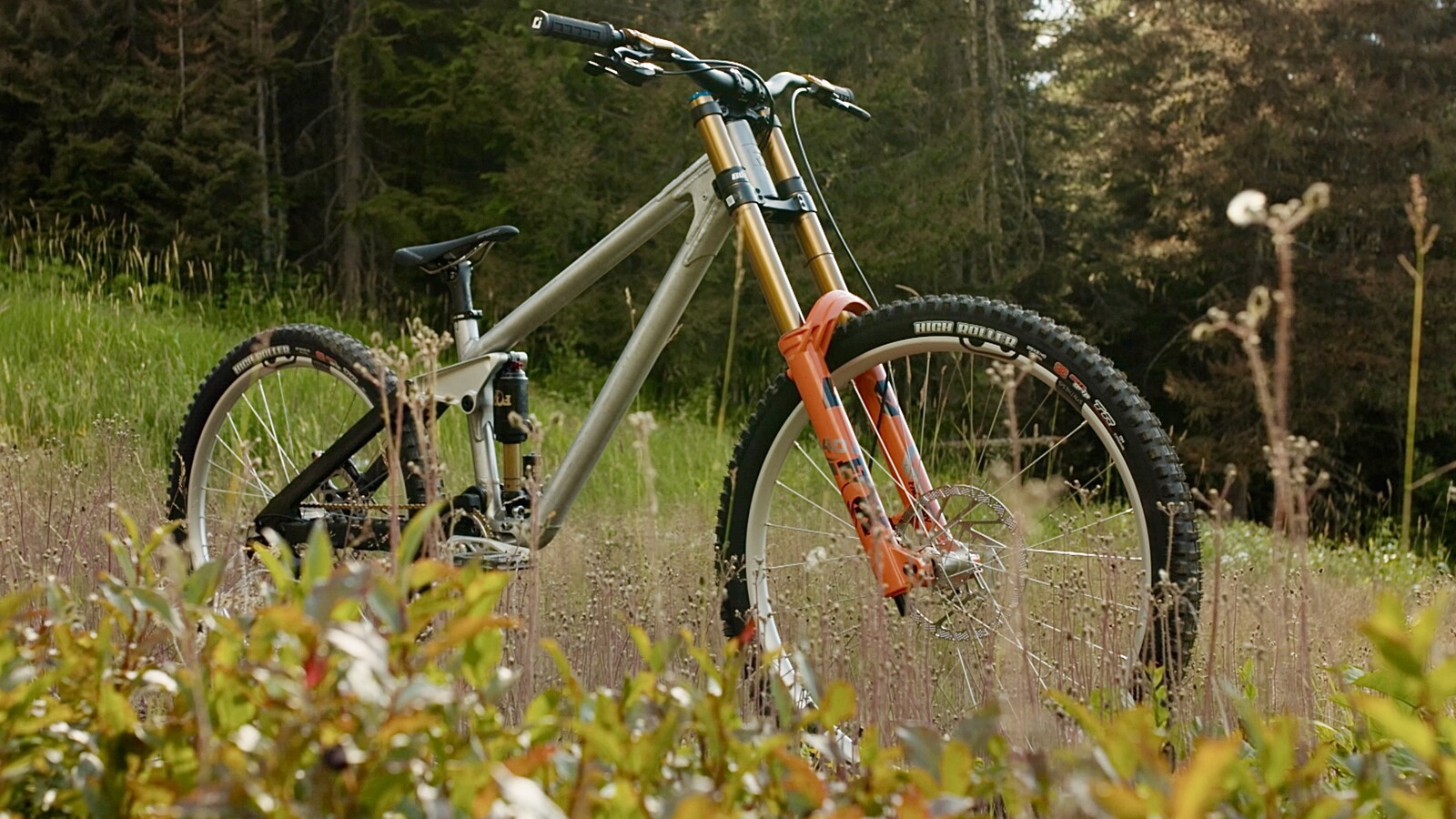
Few bikes or brands have resonated with core downhill riders and racers more than Neko Mulally's anti-establishment project, Frameworks. There are no gimmicks and no fancy marketing fluff. Just American-made, race-proven frames that are intentionally designed.
The downhill bike has quickly turned into one of the more popular options for privateer racers in the U.S., not to mention the success it's seen at World Cups under Asa Vermette, Anna Newkirk, and Angel Suarez.
There isn't a bike that better fits the ethos of Vital and our passionate community of riders, so the excitement couldn't be higher to finally test this bike. And to add to that excitement, since Frameworks sells frames only, we were lucky enough to get our hands on one of their spare team bikes—Angel's spare bike, to be exact.
We've got no excuses not to go fast, and a lot of expectations for what this bike is capable of. So let's dive into it—Neko Mulally's home-grown, World Cup-winning downhill bike.
Frameworks DH Highlights
- 203-208mm of rear wheel travel // 200mm fork
- 6061 T6 aluminum front triangle, carbon rear triangle
- MX wheels only
- 4-Bar Horst pivot suspension design
- Three leverage rate positions: linear, mid, progressive
- External cable routing
- 63-degree head tube angle
- Straight ZS56 head tube accommodates reach adjust headsets
- 12x148mm rear hub spacing
- 200mm rear rotor post mount
- 5-year frame warranty
- Two sizes
- Weight (size L): 37.26 lb // 16.8 kg
- MSRP: frame only with Float X2 shock - $3,899 USD (available for purchase outside the U.S.)
- rideframeworks.com

Frame Details
Predictable and reliable frame design—Neko's main objective with his downhill bike was to give riders a kinematics package that's predictable and a frame that's not overly complex and easy to work on. They didn't have millions of dollars of R&D to create a bike. But they did have Neko's experience from years of racing World Cups, and the ingenuity that comes from having limited resources.
Metal up front, carbon out back—6061 T6 aluminum makes up the front triangle, while a molded carbon rear triangle is connected via a two-piece 7075 T6 aluminum link. The top and down tubes are straight without any bends to increase strength and simplify manufacturing, and the bottom bracket junction is made from a single CNC piece of aluminum to ensure consistent frame and pivot alignment. The carbon rear end further guarantees frame alignment and reduces weight.


Made in the USA—Frames are welded by Frank the Welder in Vermont, and the CNC parts are made by 5Dev in San Diego. Frame assembly is handled by Neko and his brother, Logan. They also handle any warranty claims or customer service issues, meaning the layers between you and those behind the bike you're riding couldn't be thinner.
Suspension design—The bike uses a 4-bar Horst-link suspension layout with a mid-pivot. This design was chosen because it was easy to tweak pivot locations to test different kinematics during development, and it's easier to manufacture due to its lack of complexity.

Kinematics—The bike offers three leverage rates adjustable by changing the lower shock mount. You have the option between 30, 32, and 34% progression. The anti-rise is kept fairly low and consistent throughout travel to improve suspension feel under braking. The axle path moves backwards 6mm for the first 120mm of travel, before moving 12mm forward by the end of travel. Neko figured out that you spend the most time between sag and 120mm of travel, which is when the axle growth is the smallest. This makes the bike predictable in corners, as the rear center remains constant. The downside is that it gives the bike a higher anti-squat value and more pedal kickback. An Ochain or other kickback devices are recommended to minimize this.


Air shock optimized—Frameworks worked with FOX on a custom tune for the 2026 Float X2 air shock to match the kinematics of the bike. Air was chosen over coil based on the team's feedback after testing air vs. coil. Air also allows riders to easily arrive at the perfect spring rate, and Frameworks provides a good baseline for damper and spring settings online.
Geometry—The frame is only offered in two sizes, with either a 455 or 485mm reach. A reach-adjust headset can be installed to make either size bigger or smaller, thanks to a straight ZS56 headset. Chainstay length is fixed, with the medium sporting a 450mm rear center, while the large has a 460mm rear center. Stack heights are also quite high, and the bottom bracket is quite low. The size large we rode has a 661mm stack paired with a 342mm bottom bracket. Updated for 2025, the head angle is a touch slacker, going from 63.3 to 63 degrees. The head tube is also 15mm taller on the large frame.

Other frame details—
- The shock mounts to an extender so that the shock can be mounted at 90 degrees with the reservoir pointed down to clear the downtube. This means that the heavy part of the shock is not moving as the suspension compresses.
- Rear end spacing is Boost 148x12mm
- External cable routing (except for the shifter cable, which runs internally through the rear swingarm)
- Uses standard steel hardware throughout the frame for ease of replacement
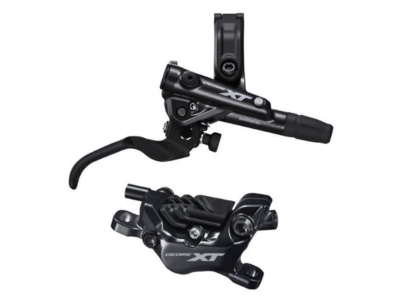
Frame + shock only—The frame only with a FOX Float X2 air shock retails for $3,899. The team bike we tested was decked out with Framework's sponsored components, including a FOX 40 fork with a Grip X2 damper, TRP's EVO Pro brakes with 220mm rotors, a TRP EVO 7-speed drivetrain, 5Dev cranks with an Ochain spider, Spank Vibrocore bars with a 40mm Spank stem, and then we swapped the ENVE wheels and Continental tires for our control wheels and tires: Crankbrothers Synthesis 2.0 alloys with Maxxis DH-casing, MaxxGrip High Rollers.
Test Riders
| 
|
What's The Bottom Line?
Jason's Bottom Line
Strengths | Weaknesses |
|
|
Shock / Fork Settings
- 220 psi (27% sag), HSC: 5, LSC: 10, HSR: 5, LSR: 9
- 85 psi, 2 VR, HSC: 4, LSC: 14, HSR: 5, LSR: 5

Neko succeeded in creating a purpose-built race bike that rides tall, low, and long—a recipe for composure at speed. The sensation of standing deep in the bike and behind the handlebars, matched with the rear axle being a ways behind your center of gravity, makes the bike feel really safe. I loved how centered I felt whipping around berms, and when the going got bumpy, I could literally just lean back and run into things. There were a few instances of the bike feeling too big. I started to run out of arm length on steep trials with big compressions. I'd likely install a shorter reach headset if I spent more time on the bike. I also bent one pedal axle and eliminated a handful of pins thanks to the low bb #scraperbike.
The suspension was fairly active under braking, and once I switched to the mid progressive chip, the bike felt more consistent through its travel. There was less ramp at bottom out and wallow off the top. The Frameworks was clearly happiest on trails with high average speeds or gradients. I struggled to throw the bike around as much on jump trails and could feel my momentum fade on flatter or slower trails that required more pumping to hold pace. Clearly, Asa doesn't have any issues getting the bike sideways, but I don't possess half the skills that he does (and you probably don't either).
I really appreciate the simplicity and utilitarian approach of the frame. You have most of the adjustments you'd need to race and be competitive, and everything is well thought out. And for being a frame that was developed by a small crew and hand-welded (by a legend), it was impressive how refined the frame rode. If I got a wild hair and decided to do some DH racing again, I'd buy a Frameworks—the bike rips, it's easy to live with and maintain, and I dig what Neko has created with the brand.
Ryan's Bottom Line
Strengths | Weaknesses |
|
|
Shock / Fork Settings
- 220 psi (30% sag), HSC: 5, LSC: 10, HSR: 5, LSR: 9
- 85 psi, 2 VR, HSC: 4, LSC: Open, HSR: 5, LSR: 6

This bike ate bumps like a mid pivot. The rear end could move out of the way of bumps easily, and its stiffness was well balanced in that it was never too stiff and fatiguing, nor did it wind up or squirm in corners. It is low… like very low. Sometimes you drag your feet through the rocks. I would not recommend riding this in your skate shoes because you might break a toe. But it is worth it, because you can get buck wild and it almost does not feel possible to go over the bars. One thing I had not felt on a downhill bike before was how the rear wheel reacted when it got knocked sideways off the ground, it just kept going. The bike was long and felt light, so when the rear wheel got knocked off line it could side-step but was still easy to redirect, kind of like running around with a wooden 2x4 and bumping into things. This bike has a high moment of inertia (long = stable), but it can be thrown around fairly easily by either you or the trail because the rear end is light. Kind of neat. If you even notice it, just add some weight to the downtube and the problem (that I just made up) is gone.
I would also try a shorter reach headset cup. At 6 foot with a normal wingspan, the fit was good most of the time, but the rear end does extend slightly under braking (it has low anti-rise). That gives great rear wheel braking traction as the suspension holds the tire against the ground for grip. You can brake later into corners because of it. But it comes with a tradeoff. In steep bumpy braking zones the rear suspension would stiffen and rise slightly, and since I was already almost topped out on arm travel from the long reach, the bike pitching forward sometimes pulled me along with it, arms fully extended, just hanging on for the ride. You can get away with it because the high bars keep you out of trouble, but you have a moment of vulnerability where you're maxed out on arm travel and can't adjust body position. It did not happen often, but the steeper and rougher the track, the more it shows up. Really it is just a note for sizing, the bike was a little long for me. You can also adapt by leaning further forward, but if you are between sizes I would go shorter. With a shorter reach cup this thing would be perfect for how I ride and my height, and the frame allows me to make that adjustment.
I wish I had this bike when I tried to race my first (and only) World Cup. Local race tracks often have lower average speeds and tighter sections, and that is what most of us are used to and train on. But when you arrive at a World Cup, the track is more open and lets you ride so much faster, and the extra safety net and stability of the Frameworks would have been perfect for that transition. I would have been more confident and it would have been easier to reach that next level of speed required to ride those tracks. If you are an aspiring racer and want to be ready for that first World Cup, this is your bike. It might not be the most fun on your smaller, tighter trails, but who cares, it is not for that.
View key specs, compare frames, and review the new Frameworks DH in the Vital MTB Product section.
9/15/2025 6:56am




View replies to: Home Grown - Frameworks DH Bike Tested
Comments