



Last year, DT Swiss launched its Ratchet DEG rear hub as an answer to rider demand for a durable, high engagement hub. But then a few months later, e*thirteen came out with its Sidekick hub, sparking a worldwide craze to manage the ominous forces of pedal kickback that was happening right between our feet. Who even cares about P.O.E. when chains are literally ruining the feel of our suspension??
Realizing they had the opportunity to create a similar product thanks to the extra space inside the DEG hub, DT has developed the DF (Degrees of Freedom) upgrade kit.
Retailing for $176.20 and backwards compatible with all DEG hubs, it offers riders a simple path to combating pedal kick with three degrees of float—0°, 10°, and 20°.
DEG DF Highlights
- Most appropriate for aggressive trail, enduro, and DH riders
- Compatible with all Ratchet DEG hubs
- 0º, 10º and 20º of float available
- Requires no additional parts
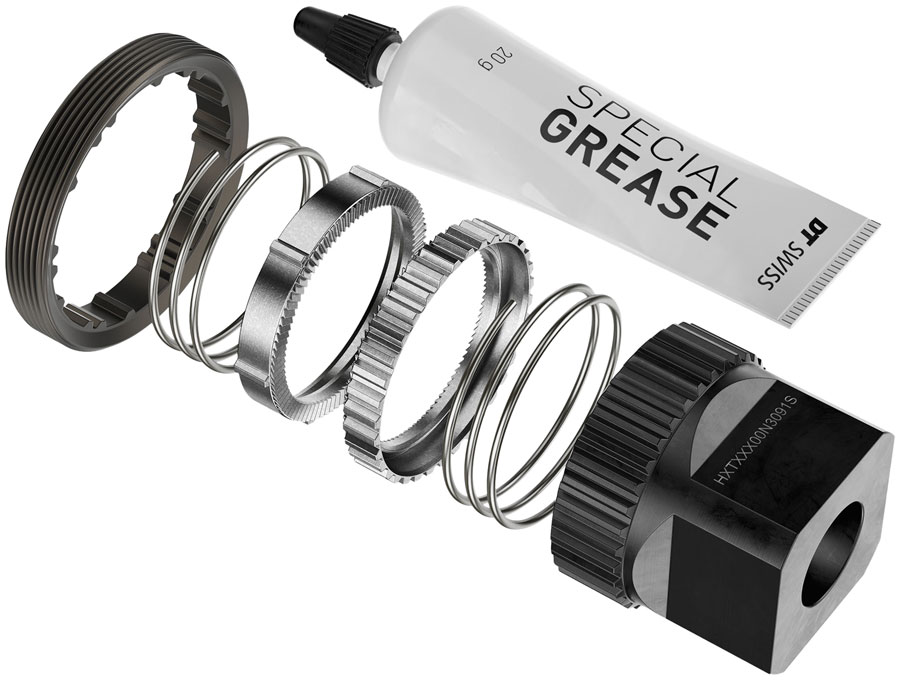
- Does require special DT tool to remove the drive ring
- DEG DF upgrade kit: 90T ratchets with 4° engagement angle // 0°, 10°, & 20° of freehub movement // $176.20 / 129.90€ / 129.90CHF
- DEG Hybrid DF upgrade kit for e-bikes: 60T ratchets with 6° engagement angle // 0° & 10° of freehub movement // $176.20 / 129.90€ / 129.90CHF
- Full press release HERE
How Does it Work?
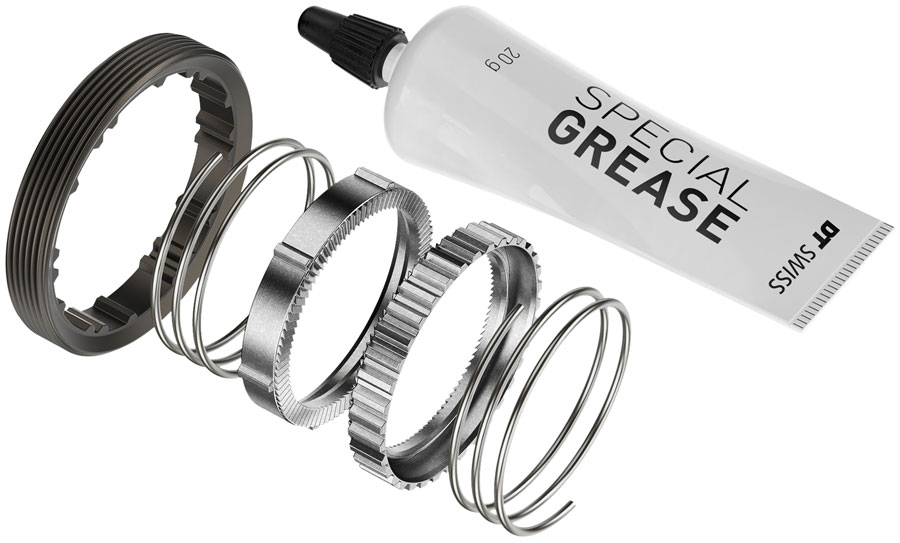
The DF kit works by replacing the drive ring that threads into the hub and the inner ratchet that engages it. The DF drive ring is notched to create three different length slots around its perimeter. The DF inner ratchet has six teeth that slip into the slots of the drive ring.

By rotating the inner ratchet, you can align its teeth to fit into one of the drive ring slots, giving you 0°, 10° or 20° degrees of freehub movement. When coasting, this allows the freehub/cassette to rotate as your suspension compresses and your chain grows, reducing kickback.

The rest of the internals are unchanged—there is a spring between the hub body and inner ratchet, and another between the freehub and outer ratchet. These ratchets function the same as a regular Ratchet DEG hub, slipping past each other when coasting and locking together when pedaling. This means that with the DF upgrade, the hub still produces the same high engagement whine, regardless of float position.
For comparison, DT Swiss's 18T ratchet has a 20° engagement angle, and a 36T ratchet has 10°. e*thirteen’s Sidekick hub offers 12°, 15° and 18° of deadband. The mechanism that gives the Sidekick float functions differently, but the feel and goal are the same as the DF kit.
The DF kit is NOT the same as the Williams Racing Products Zero Drag kit, which uses a double-clutching system to disengage the ratchet rings when coasting to reduce drag and allow the wheel to move forward or backward like a freecoaster. WRP doesn't claim its product will reduce kickback.
What's included in the DF Kit?
The DF upgrade kit includes freehub grease, the drive ring, ratchet rings, and two springs. It retails for $176.20. There is also a Hybrid DF kit for e-bikes that includes 60T ratchet rings to reduce engagement to 6 °, and the drive ring only offers 0° or 10° of freehub movement. There will be kits that include the proprietary tool needed to remove the drive ring; however, DT Swiss has yet to provide an exact price.

On the Trail Impressions
I've spent a month and a half riding with a DEG DF hub on my Stumpjumper 15. The hub arrived with the DF kit already installed, but I imagine that installing the new drive ring in the hub is the most time-intensive step of the otherwise straightforward process.

Being able to ride the hub with no float made it really easy to see what benefit the higher two settings can offer. Which, if I'm being honest, was not a massive difference or as life-changing as I'd maybe hoped for. As you'd expect, the 20° float position netted the most change and improvement. The edge was taken off chatter bumps and medium-sized compressions, especially when impacts were more isolated or I was simultaneously pushing energy into the bike. This caused my rear wheel to get less hung up, and my bike rode calmer. Once I got into rough sections with constant impacts and more frequent bottom outs, it was harder to distinguish a performance benefit.
The Stumpjumper does have a normal amount of kickback. It's also just a 145mm travel bike. Being realistic, even if the hub fully eliminated kickback, that wouldn't turn the Stumpy into an enduro bike. I do believe that small gains in setup can equate to feeling more confident and riding faster. The DF DEG hub calmed my bike down in enough sections to improve my overall ride, which I'd consider a win. I do plan to toss the hub on more bikes that come through for testing, as I'm curious how different kinematics will benefit from the extra movement.

The difference in feel between the 20° and 10° positions was minimal on descents. I did some back-to-back runs, and since they felt so similar, I figured I'd go with the most float to give the hub the best chance of doing its thing. What both float positions shared was an amount of slack pedaling that sucked on technical climbs. It was less an issue of timing pedal strokes to clear features, but rather a need to hold a constant output. If I paused pedaling to let my bike roll up a ledge or over a root, the added slack on my next pedal stroke often caused my leading foot to kick forward and off my pedal. Riding with clips would probably avoid this issue. Or just riding a downhill bike.
e*thirteen Sidekick vs. DT Swiss DEG DF
I did some comparative testing with a Sidekick hub. Both hubs shared a very similar feel when it came to reducing the harshness of some compressions and calming down my bike. I would not say one was better in this department, and you get similar degrees of float with either. Climbing they felt the same, with a solid 'clunk' produced when the freehub engages. You can adjust the float of both hubs trailside, which I did a few times—just drop your wheel, pop the cassette and freehub out, and turn the ratchet or timing pusher to the position you want.


Rolling speed, weight, and price are the other main differences between the hubs. The Sidekick produces less drag due to its retractable pawls, making for a noticeably higher coasting speed. It was also really quiet, which I preferred to the whizz of the DT. The DF DEG hub is around 150g lighter, and if you already have the hub, the upgrade kit ($176) is much cheaper than a Sidekick hub ($500). What I think is more valuable is the ability to run the DT hub with no float. You could always give it a try, and if don't like the feel, you can make take out the float and go back to 4° of engagement.
Durability
We tested the 240 Ratchet DEG hub when it was released and had no issues after seven months of testing. I've got a couple hundred miles on my hub with a decent amount of wet, sloppy days, and it's still spinning like new. The larger diameter ratchets definitely help even the load, and I'd expect the internals to live a long life like most DT Swiss hubs.

What's The Bottom Line?
If you already have a DT Swiss Ratchet DEG hub, then the DF kit is a no-brainer upgrade, as there isn't a cheaper or easier way to experiment with managing kickback and chain forces. Results will vary depending on your bike and riding style, but most riders should expect their bike to ride calmer and smoother. If you end up not liking it, you can always set the hub to zero float, and you're back to having high engagement.
For those who don't have a DEG hub and are anti-kickback-curious, going the route of building a wheelset to try the DF system is not the most cost-effective or easy route. You're probably better off trying an Ochain or a simpler chain management device first.
More information available at dtswiss.com
| Where To Buy | |||
|---|---|---|---|

|
Free U.S. shipping on everything.
International shipping available. Some exclusions apply. |
Free U.S. shipping on everything.
International shipping available. Some exclusions apply. $184.31
|
|
|
|||
|
|||

|
Free shipping on orders over $50 (continental U.S. only).
International shipping available. Some exclusions apply. |
||
9/18/2025 6:00am



View replies to: Another Anti-Kickback Device - DT Swiss DF Upgrade Kit for DEG Hubs Tested
Comments