



This thread is dedicated to the FOX Float X Live Valve Neo, we'll kick the discussion off with our review, feel free to add your own experience, observations, and questions to bring it alive!
Tested: FOX Float X Live Valve Neo

At the end of 2024, FOX launched the Neo generation of Live Valve shocks. Based on FOX’s own, ultra-fast wireless protocol, these shocks use electronics to switch between open and closed compression modes in a fraction of a second, reacting to on-trail events in real time. We tested the Live Valve Neo version of the DHX coil shock on a long-travel enduro bike back then, but we were also curious to see how this technology performs in a shorter-travel trail bike application. Read on to see what benefits we unlocked – and feel free to chime in with your own thoughts or further questions!
FOX Float X Live Valve Neo Highlights
- About 20 hours of use for one battery
- Trail, all-mountain, gravity focus
- Compatible with any fork or crankset
- Single rechargeable battery
- "Shake to wake" function (no power button required)
- Trunnion and standard eyelet options
- Standard: 190x45 or 210x47.5 up to 55
- Trunnion: 185x47.5 up to 55 or 205x60/62.5
- Tool-free external platform, compression, & rebound adjust
- LED battery life indicator
- Phone app tracks hours, service intervals, and gives access to Bike Park and Transport modes
- Live Valve tunes can be downloaded, modified, and shared via the app
- Weight: 689g (190x45 Float X)
- MSRP: $1099 USD (shock) / $439 USD (controller kit)
System Overview
The Live Valve version of the Float X is built around the same platform as the regular version of that shock. It offers adjustable low-speed compression and rebound, with tokens used to adjust internal air volume and travel spacers available to adjust the stroke length. There is also a 7-position dial used to adjust the firmness of the shock when it is in firm mode. This is a hydraulic adjustment in the classic sense, which works together with the tune of the electronic part of the shock to alter how the shock behaves and feels in action. It’s important to keep these two aspects separate in your mind as we delve deeper into how the system works.

The brain of the system is housed in the piggy-back part of the shock. It is of course a bit bigger than a regular shock, as it contains the extra electronics and a battery to run it all (it’s the same battery as the one used in the Transfer Neo wireless dropper post, BTW), but the dimensions are still reasonable. Do check the fitment for your particular frame though.

So what about the whole Live Valve part then? The core principle behind the design of the system is that it is purely reactive, meaning that it reads the terrain via sensors placed on the front and rear wheels and then switches the shock from firm to open mode near-instantaneously if it detects an event that meets the criteria of the currently active (software) tune. This stands in contrast to the competing system from RockShox, which uses more sensors and more heavy integration with other parts of your bike to try to predict what the system should do in advance. This difference also explains why there is no Live Valve fork available from FOX – they feel that locking out the fork is less beneficial in most trail riding situations, and with a system built to be reactive, there will be scenarios where there is simply not time enough to open the fork if you hit an obstacle at speed, regardless of how fast the system operates.

On the topic of speed, FOX realized early on that existing tech would not offer them the kind of reactivity they wanted from the system. That is why they developed the Neo protocol, which is said to be 100 times faster than Bluetooth and 20 times faster than their nearest competitor. Thanks to this impressive system speed, Live Valve can read the terrain 400 times per second and execute the switch between closed and open mode on the shock in 1/70th of a second. More on what that translates to later.

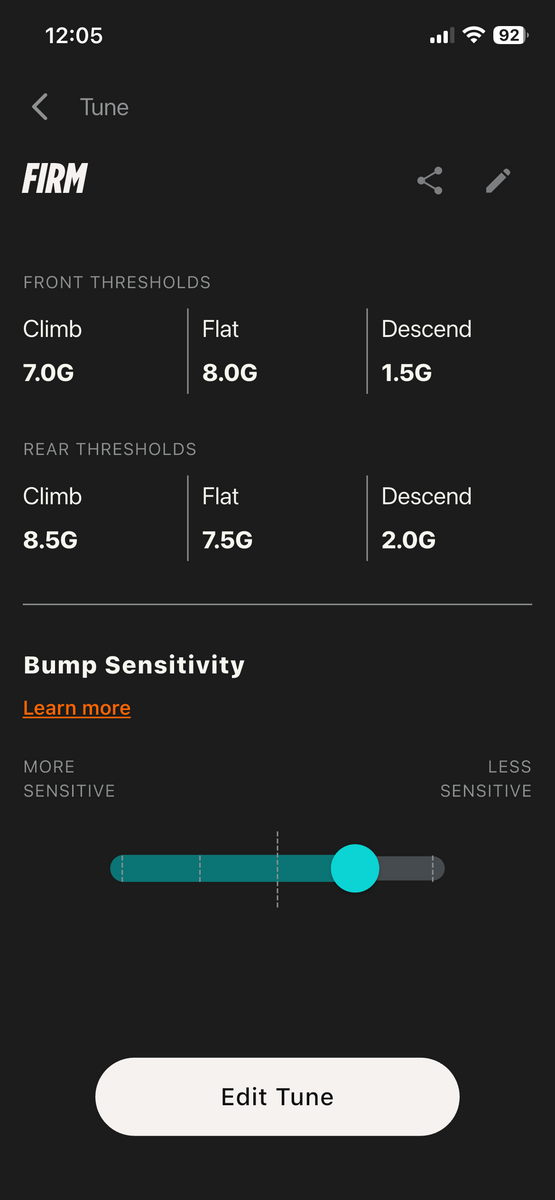
The system is managed by an app on your phone. Aside from doing things like tracking service intervals or accessing Transport or Bike Park modes, the app also opens up impressively detailed tuning capabilities. Once again, keep in mind that we are now talking about the SOFTWARE component of tuning, which is separate from the actual damping behavior (which is still controlled by the classic hydraulic circuits of the shock). Once powered on, the Live Valve shock defaults to Firm mode (the switch between modes is driven by a magnetic solenoid, capable of supporting the 1/70th of a second reaction time mentioned previously). The system switches to Open mode when one of the wheel sensors detects a bump that exceeds the threshold set for that particular sensor in a given mode and tune. The system offers very granular levels of control over what that threshold is in a multitude of riding situations. You can adjust the amount of force required to open the shock as well as how long the shock should remain open for after each event. You can set these thresholds individually per wheel, and you can also set different values depending on whether you’re climbing, on flat ground, or descending (the system uses accelerometers to keep track of the bike’s attitude). The bike also knows when you’re airborne, and it will open the shock before you land to make sure there is no unwanted spiking as your wheels touch down. There are several tunes already preconfigured out of the box, with more available to download as well. In our experience, these provide a great place to start out (or even keep using).


The settings are grouped together in tunes. Three such tunes can be loaded onto the shock itself at any one time, with more held “in reserve” on the app. Within each main tune, the individual aspects discussed above can be modified and saved as part of that tune. That means you can have several different settings packages available to activate with one simple switch in the app, without having to modify the individual settings again. FOX also makes a handlebar remote that allows for switching between the three tunes loaded onto the shock in action, but it is not available as an aftermarket product at this time. Note: each tune already contains different behaviors for Flat, Climb, and Descend, so there is no need to switch tunes when you get to a climb for example. That’s the whole point of the system really. You only switch tunes if you need the bike to behave in a significantly different way, say for example hitting the bike park and not wanting the shock to ride too high in berms and on the lips of jumps, you could have a way more open tune available to switch into for that day. As mentioned, the switch is as simple as one click in the app.


On The Trail
Let’s start with the shock itself. Much like the regular Float X that we’ve tested with good results, the Live Valve version performs really well as “just a shock”. If you turn the Live Valve system off, the shock behaves pretty much like a regular Float X in open mode, and we were able to get it to perform at a high level on our current test bike (a Propain Hugene). The shock provides an excellent mix of comfort and support, and it has dealt with everything from fast and rough trail sections to bottom-out events with poise. The Hugene frame itself offers a balanced amount of anti-squat, but some bobbing is still present when pedaling with an open shock. Note that the sensors are mounted on the brake mounts, they should work with a variety of brakes but they definitely do not play nice with Hope EVO brakes – the mounting plate is not long enough to allow the sensor to clear the bleed nipple on the EVO calipers. We had to get creative to overcome this obstacle…

FOX positions the Float X Live Valve shock squarely in the trail/all-mountain category, and we really think that this is where it truly shines. On the climbs, you can set the shock up to be pretty much locked-out, which removes all the bobbing and also holds you up a little higher in your travel. To achieve this, we cranked up the firm mode setting on the shock to the max, and then we ran a firm tune for the Live Valve system. This set-up provides for a bike that is firm, fast, and responsive to pedal input both on flat ground and on the climbs. In this mode we also took the front wheel sensor out of the equation for the climbs, which means that the shock remains in the firm mode even as you’re pushing to get the front wheel up and over an obstacle. It still switches to open mode when the rear wheel hits, and because this tends to occur at slower speeds when climbing, it manages to open up before transmitting any harshness to the rider in this scenario. The result is a bike that is better at both generating and maintaining speed when climbing, which can be readily felt at the pedals – the shock introduces a directness that reminded us more of an XC bike than a relatively comfortable trail bike in this mode. Impressively, the bike still felt smooth and comfortable as soon as we hit any rougher sections.

If you want to soften your set-up a little bit, there are several avenues open to you. You can reduce the firmness of the firm mode by using the 7 clicks of hydraulic adjustment available on the shock itself. Or you can switch to a softer Live Valve tune, which will lower the thresholds for valve opening and/or keep the shock open for longer after each event, and you can also modify the angles that are considered “Climb” and “Descend” by the system. The former case changes HOW the shock behaves when in firm mode, the latter changes WHEN and under WHAT circumstances it switches from firm to open and back again. This can really allow you to adapt the bike’s behavior to your specific trails and riding style, which is pretty cool. The amount of adjustment available may seem overwhelming at first, but there is a certain logic to it all that is relatively easy to understand, and you can then really pinpoint typical behaviors and address them. For example, if you regularly ride on flat and rough terrain, you might want the shock to stay open for a little while longer after a bump is detected by the front wheel, to ensure that the shock is open when the rear wheel reaches the bump in question. You can dial that setting in specifically for the “Flat” part of the tune, without affecting how the bike behaves on climbs or descents. Or you may need the shock to stay locked out even as the front wheel hits something, to help with tech climbing – again, you can adjust that setting independently of anything else to achieve the desired behavior. It’s pretty neat stuff.


For descending, the default setting provides for a much higher degree of sensitivity, where smaller bumps can trigger the shock and where it stays open for a longer period of time after each bump. If you ride fast on a rough trail, you’ll never notice the shock entering the firm mode in this scenario (although it will firm up as soon as you enter a smooth patch, which can still be helpful for pumping through undulating sections or adding a pedal stroke here and there). Try as we might, we’ve not been able to fault the system in Descend mode; we’ve never had any unexpected spiking, nor has it surprised us with any harsh landings after jumps. On that topic, hitting smooth jumps with Live Valve can be extra fun, as the shock will often remain firm until you’re in the air in this scenario, which adds a degree of pop to the takeoff. This leads us to an important observation here: we think this system is really well suited to trail bikes of all sorts, while it might be less seamless in action on a longer-travel shred sled.

Let us explain that last part in more detail. As the shock switches from firm to open mode and vice versa, the bike’s behavior and balance changes. On a bike with a lot of travel, the difference between firm and open mode is more drastic, which can be beneficial in a climbing scenario but can get in the way while descending. If you set the system up with too much firmness for the descents, because you’re looking for extra support to generate speed in a race scenario for example, you may find that it upsets the bike’s balance every time the mode switches. On a shorter travel bike, the bike’s natural balance and behavior are by default on the firmer side, so the effect of the shock firming up further is less drastic. The aforementioned example of the shock remaining locked out when hitting a smooth jump lip is a good case in point: if you are used to your long-travel bike pumping through its travel when hitting a jump (or compressing into a berm), any sudden lock out of the shock is going to feel very strange. On the shorter-travel bike, the contrast is more limited, which actually makes it more fun to play with. When we tested the coil DHX Live Valve shock on a Scott Ransom, our tester found himself consistently running it on the soft side, whilst the author of this article runs his Float X Live Valve cranked to the max and is really enjoying how his Propain Hugene trail bike behaves in this setting.
A Word About Efficiency (and Some Numbers)
Riding the Live Valve shock back-to-back with a regular shock was revealing. The bike feels noticeably “snappier” on the pedals with the system in the firmer settings (while sitting higher in its travel as well), which translates to a feeling of fresher legs while climbing. It also makes the bike easier to push up and over obstacles when negotiating more technical uphill sections, and we found it "poppier" on side hits on the way down as well. We wanted to find out if we could quantify this feeling with some data, so we measured our energy consumption in a back-to-back comparison on a test loop. The loop in question is about 10kms long, with 300 meters (900 feet) of climbing. There’s a mix of climbing sections, from a few minutes on smooth asphalt to begin the ride to technical uphill singles throughout, and 4 main descending segments that offer a fun mix of tech and flow. According to Strava, we consumed 488KJ of energy with the system on, and 496KJ with the system off (same shock, same ride, same trail conditions, one day apart). The only difference between the two rides was turning off the Live Valve system to leave it in open mode. This isn’t a statistically relevant measurement perhaps, but we did also compare data over a longer period of time with different shocks on the same test loop, and the live valve shock always required a little bit less energy to complete the same ride. The effect SEEMS more significant in real life though, as the bike sits a bit higher in its travel and there is less of that slightly “sticky legs” feeling on the pedals that comes from a bobbing shock. Definitely something we’re always thankful for towards the end of a ride when the legs are getting more tired.
What’s The Bottom Line?
Marginal efficiency gains for a lot of money sounds like the description of a very niche product, and while we’re not going to pretend that everybody should do everything they can to save up for one of these, we’re also not going to sit here and dismiss it as a gadget. The technology behind the Live Valve shocks is very impressive, and we think that it really finds its home on a shorter-travel bike. It adds a dimension of snappiness and reactivity to the frame, without introducing any unwanted harshness in rougher trail sections. After a little bit of tuning, we’ve arrived at a set-and-forget setting that lets us just ride the bike without ever thinking about what the shock is doing or if we should stop to further tweak something. That’s pretty high praise, and we absolutely feel like this shock keeps its promise and delivers what it says on the box.
For more information head on over to ridefox.com.
About The Reviewer
Johan Hjord - Age: 53 // Years Riding MTB: 21 // Weight: 190-pounds (87 kg) // Height: 6'0" (1.84m)
Johan loves bikes, which strangely doesn’t make him any better at riding them. After many years spent practicing falling off cliffs with his snowboard, he took up mountain biking in 2005. Ever since, he’s mostly been riding bikes with too much suspension travel to cover up his many flaws as a rider. His 200-pound body weight coupled with unique skill for poor line choice and clumsy landings make him an expert on durability - if parts survive Johan, they’re pretty much okay for anybody. Johan rides flat pedals with a riding style that he describes as "none" (when in actuality he rips!). Having found most trail features to be not to his liking, Johan uses much of his spare time building his own. Johan’s other accomplishments include surviving this far and helping keep the Vital Media Machine’s stoke dial firmly on 11.
Photos by Johan Hjord

What do you think the cutt-off would be travel wise? Would a 145-150 bike be outsdie the range?
I think it would be great there, depending on how your bike is set up you might find that the opening and closing of the valve is a little bit more noticeable in certain scenarios than what I experienced on my 130 bike, but I doubt it would be drastic. I suspect it gets trickier to find a good set-up as you get up towards 160/170 (and coil, certainly). Do report back if you try it!
I've run Live Valve on both an Epic Evo and a Spec Enduro. I think they both have a good place. On the 170mm Enduro, I really like the ability to setup the shock for the best downhill performance. For me this means running a slightly softer spring rate (coil), less compression, etc. that might normally feel pretty bad for climbing but Live Valve takes care of that. I've yet to feel any harsh transitions from open to close but on the Enduro run a slightly softer firm mode. I think the real benefit here, even on downhills, is running the best feeling setup with the Live Valve adding firmness / snap for any traverses or uphills.
How does the battery size up relative to the Di2 batteries?
Fox have had a reasonable kind of partnership with Shimano over the years, and every time I see a manufacturer use a new style/shape of battery instead of what isn’t there it decreases the likelihood I’ll use it.
They weigh within 2 grams of each other (22 grams for the Shimano battery, 24 grams for the FOX). The form factor is a bit different, the FOX battery is more elongated.
Post a reply to: FOX Float X Live Valve Neo Review and Discussion