

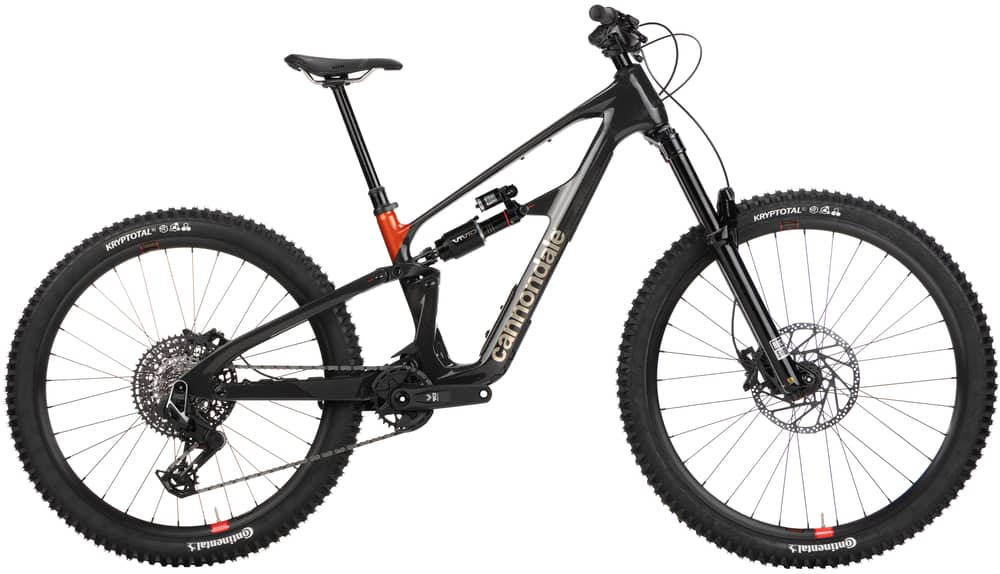
2026 Cannondale Bad Habit 1 Bike


| Where To Buy | |||
|---|---|---|---|

|
Free shipping on orders over $50 (continental U.S. only).
International shipping available. Some exclusions apply. |
Free shipping on orders over $50 (continental U.S. only).
International shipping available. Some exclusions apply. $7,999.00
|
|
|
|||
|
|||
|
|||

|
Free U.S. shipping on everything.
International shipping available. Some exclusions apply. |
||

|
Free shipping on orders over $69 (continental U.S. only).
International shipping available. Some exclusions apply. |
||

Cannondale’s Bad Habit is one of those bikes that sells the do-everything experience. It’s an enduro race bike. It’s an all-mountain adventure vessel. It's playful enough to rip a bike park. It’s ready to go for an all-day pedal. I generally appreciate bikes like this because if you can afford only one bike to serve most use cases, it’s often money well spent. However, striving to maximize versatility can lead to mediocrity. That’s the line bikes like the Bad Habit walk.
When the bike launched, it caught my attention because it was spec'd like an enduro bike (minus the Lyrik fork) but had trail-oriented geometry. Having spent a lot of time riding over-built mid-travel bikes, the Bad Habit looked right up my alley. Its abilities may be predictable, but intriguing nonetheless. Two months and lots of tweaking later, the Bad Habit has been a consuming affair that’s left me equal parts enthralled and ready to move on to the next bike.
Highlights
- 155mm of rear wheel travel // 160mm fork
- Mixed wheels only
- Full carbon frame
- Proportional Response size-specific kinematics & geometry
- Coil or air compatible
- StashPort frame storage
- 64° head tube angle
- Compatible with a 170mm single crown and 180mm dual-crown forks
- Sizes: S, M, L, XL
- Weight (size L, no pedals or bottle): 35.74 lb (16.21 kg)
- MSRP (USD): Bad Habit 1 - $7,999 (tested) // Bad Habit 2 - $5,999 USD // Bad Habit Frameset - $3,499 USD
Strengths | Weaknesses |
|
|

Overview
The Bad Habit is the longest travel bike to carry the Habit badge, with 155mm of rear wheel travel and a 160mm fork. It sits between Cannondale’s Habit LT (140/150mm) and Jekyll (165/170mm) models, and steals attributes from both. It uses the same 4-bar linkage design as the Habit LT, with geometry and component choices similar to the Jekyll. The idea is to create a bike that pedals like a trail bike but doesn’t get as sketchy when you’re getting sendy. You know, the classic jack-of-all-trades model that’s abilities skew a touch towards descending.


Skimming over the bike, it's a pretty standard affair. A full carbon frame is offered in four sizes with geometry and kinematics tailored to each size. There is a healthy amount of rubber and clear sticker protectors in high-wear and noise-prone areas. Cables can be run through the headset (but why?) or the front of the head tube. Either way, the cables run tube-in-tube for ease of maintenance. Bike storage is provided by an under-the-top-tube mount and in-frame downtube storage.


All sizes use mixed wheels. There are no geometry adjustments, except for the option to install an angle-adjust headset thanks to a straight 1.5-inch head tube.
During a time when most new bikes over-deliver on ways to alter geometry or kinematics, Cannondale’s nonconformity is interesting. Especially on a bike like the Bad Habit, which could easily shape-shift in various directions given some adjustability. Granted, fewer flippy chips minimize potential creak points.
Suspension Design
The Bad Habit is yet another crab-linked bike utilizing a Horst-link 4-bar design. It has a fairly linear leverage ratio to play nicely with air or coil shocks. The anti-squat sits just around 100% at sag to balance pedaling efficiency with pedal kickback. Anti-rise stays close to 50% through travel to help provide traction under braking.

Geometry
Cannondale didn’t paint too far outside the lines when it came to geometry. Most of the numbers are very par the course for a bike like the Bad Habit. Still, stack heights are higher than average, the rear end is short and stubby by 2026 standards, and the standover is really low. Lowering the dropper is like doing a deep squat. Ella Conolly actually uses a shorter dropper to speed up the process of lowering her seat.

Build Kit
You’ve got two Bad Habits to pick from, or a frameset option. All component choices are what I’d consider enduro-rated. Except for the RockShox Lyrik fork. It falls into the trail/all-mountain category. I love the Lyrik, but I do think a Zeb would have been appropriate, especially to match the frame’s stiffness (more on that below).


Both builds are decently-priced and thoughtfully specced. It’s how I’d build a bike to get rowdy on—upper-tier suspension, good brakes, good tires, alloy wheels and bars, and a mix of drivetrain pieces.

I tested the nicer build and appreciated the bold choice to mix Eagle 90 cranks with an XO AXS derailleur, a GX cassette, and Eagle 70 chain. I can see arguments for or against each choice. Cheaper cranks place more weight low and centered, but bring up the overall weight. The cheaper chain cuts costs but could wear out faster (I have no proof of this). The GX cassette has proven solid and reliable. However, I honestly can’t get behind the fancier derailleur. A GX AXS derailleur would have been fine.
Splurging on the more expensive Bad Habit build yields the most fruit with the upgrade to wireless shifting and TRP’s EVO Pro brakes, which offer more lever adjustments. You also get an extra external adjustment on the fork (ABO) and shock (HSC), but those are marginal gains. If it were my money, I'd go with the Bad Habit 2 build and run it stock until things wear out, and then upgrade as I go.
My size large test bike weighed 35.7 lb. With pedals, a bottle, a multi-tool and snacks inside, it was over 37 pounds. That’s on the border of being heavy. The meatier casing tires added to the sensation of lugging a heavier bike around, especially climbing.
Set Up & Initial Impressions
The Bad Habit wasn’t a love-at-first-ride or a set-it-and-forget bike. We had our differences early on, and it took time to get comfortable. Which is totally fine. Some relationships require more energy than others. What never faltered was my appreciation for its stout, low rider stance.
Getting balanced over the bike, specifically getting my weight forward, was my main challenge. The combination of a tall stack height, short rear end, decently low bottom bracket, and a short 35mm stem pushed me off the back. With less weight on the front wheel, traction was reduced, and I regularly pushed the front in corners. The front wheel also felt far away, and steering became vague.

My solution was multifaceted, but mostly cockpit-centric. The bike shipped with like 35mm of headset spacers under the stem. I quickly relocated 25mm of spacers to above the stem and swapped to a 42mm, then a 50mm stem. Both changes pulled my weight closer to the front axle. I also ran my fork at or a few psi below the recommended pressure with less low-speed compression damping. This lowered the fork's dynamic ride height, allowing me to get over the front of the bike more easily. I then relied on high-speed compression and the ABO feature to add support.
The other end of the bike took some finagling to set up as well. Cannondale recommends 30% (16.5mm) sag, so I obliged. Initially, I was reaching bottom out too quickly and aggressively during big, fast compressions. The bike also wasn’t very smooth through smaller impacts and almost felt like it was getting hung up. It was a conflicting sensation—I felt oversprung and unsettled down most trails, but undersprung during any big hits.
Twisting adjustments on the shock netted minimal change. I tried more Adjustable Bottom Out (ABO), less low-speed compression, and more high-speed compression. It all felt like band-aid solutions.

Phase two was adding a volume reducer and pressure. I double-checked the shocks’ stroke and measured it at 49mm. The bike claims to use a 55mm stroke. This signaled that I was running more sag than I realized (closer to 32%). With two volume reducers and pressure increased to have 26.5% sag (13mm), bottom outs were less severe, and I wasn’t wallowing in the shock as much. There was more mid-stroke support and smoother performance during small- to medium-sized compressions.
My conclusion is that when I was under sprung, I was spending more time in the back half of travel, which is why I was bottoming out too easily. It also felt like I was sitting near the ramp in the spring curve or deeper in the leverage rate. This caused a lot of harshness. With more air, I had more travel to play with, and the spring rate felt better blended from mid- to full-stroke.
Having the rear end sit a touch higher further helped shift my weight forward over the bike.
Climbing Performance
The Bad Habit was average on the climbs. The rear suspension was comfortably active, offering decent roll-over efficiency. The shock lockout wasn’t necessary, and pedal bob was minimal. However, the nature of its tall stack, low-ish bottom bracket, and modest seat angle created an upright pedaling position. This was great for chilling up climbs, but not great for trying to climb fast. The bike's weight didn’t do it any favors either.

Pedaling the Bad Habit was more similar to an enduro bike than a trail bike. This didn’t stop me from doing some big rides. I just accepted a slower average speed going up. Lighter tires or a lower-profile rear tread could help the situation. But it will always be a balance of how much you’re willing to compromise descending for climbing performance with component choices. I’d rather just live with a mediocre climbing bike that’s built for hammering descents.
Descending Performance
With my setup debacles in the rear view, the Bad Habit’s numerous personalities rose to the surface. It did live up to its promise of having mixed abilities. Albeit, its strengths leaned more in the direction of engaging and responsive than stable and composed.
Three design factors defined the way the Bad Habit rode—for better and worse: its tall-and-low geometry, its stiff frame, and its braking abilities.

I stood upright and deep in the bike. This made the 480mm reach feel shorter than expected, and the 435mm chainstay feel every bit as short as anticipated. The 27.5-inch rear wheel added to the experience. Steep trails, tight turns, and jumps—that’s where the Bad Habit shined. I didn’t have to ‘get back’ when trails dropped in. I was already sitting backseat, with my weight heavy on my feet.
Diving into turns, no matter how tight the radius, and Bad Habit whipped around with a degree of responsiveness that few bikes have matched. The bigger the turning radius, or the less predictable a turn became, the more I would have preferred a longer chainstay. However, it did make it easy to toss around on jumps or explore sneaky lines. It was like steering a stand up versus a sit down jetski—I could turn on a dime, and going fast in a straight line was exhilarating.


The Bad Habit’s stiff frame was the other part of this responsiveness equation. Grabbing the rear wheel and moving it side to side produced little linkage flex. This made the bike lively and efficient. However, the entire frame as a unit produced excessive feedback. I’m not a frame engineer, but I think the beefy 1.5-inch head tube was a major culprit in the feedback I experienced.
The combination of the short rear end and stiff frame gave the Bad Habit a lower ceiling of comfort the rougher and faster the trail. It took extra focus to keep the bike tracking and on line. My home trails are firm, rocky, and loose. They are not damp or soft. I expect some feedback, but the Bad Habit was more on the harsh side. I swapped the Continental Enduro casing tires for a Maxxis EXO+ front and DoubleDown rear tire, as they are my go-to. Unfortunately, this did not change the feedback situation.
The Bad Habit’s saving grace on proper downhills was how active it remained under braking. This gave the bike some much-needed control and ground feel. There also wasn’t much feedback through my feet. I tossed on an Ochain out of curiosity, and while it filtered out some chatter, it didn’t have a big enough effect feel to warrant it necessary. During very aggressive braking events, I experienced some forward pitch. Thankfully, the tall and low geometry helped neutralize this sensation for the most part.

Because the Bad Habit was reactive and less comfy on rough trails, I gravitated towards tight, technical trails. Or any trails that had jumps and flow. The bike enjoyed being thrown around, and I enjoyed pushing its limits, even if that meant not going super fast.
Long Term Durability
I subjected the Bad Habit to a good mix of weather during our two-month relationship, and it's still looking and feeling fresh. The headset has creaked on two separate occasions, but was resolved with grease the first time and re-preloading the top cap the second time.
The cables exit their in-frame housing near the bottom bracket and were rattling against the inside of the frame. Luckily, you can access this spot via the storage door. I slapped some electrical tape over the cables, and they’ve been silent ever since.

The Bad Habit has been an easy bike to live with, and I would expect that to be the case for a while. It’s also very quiet, easy to clean (that counts for something!), and the build is durable—happy long-term shredding.

What’s The Bottom Line?
The Bad Habit was at its best when paired with a creative mindset and an acceptance that it wasn’t the most planted bike. Chasing air time, sending sketchy tech lines, apexing corners, and riding loose—that’s where the Bad Habit flexed its strengths. It wouldn’t be my first pick to serve as a quiver killer because it's a little heavy and slow climbing. It also wouldn't be my first pick to take racing because its geometry and stiff frame limit its composure at speed. But it's specced really well, and would be a hoot in a bike park, down steep tracks, or getting jibby on flowy trails.
Vital Rating
- Climbing: 3.5
- Descending: 4
- Fun Factor: 5
- Value: 4
- Overall Impression: 4.125
View key specs, compare bikes and frames, and review the newest Cannondale Bad Habit models in the Vital MTB Product section.
About The Tester
Jason Schroeder - Age: 31 // Years Riding MTB: 20 // Height: 6' (1.8m) // Weight: 170-pounds (77.1 kg)
A once-upon-a-time World Cup downhill racer turned desk jockey, Jason has spent years within the bicycle industry from both sides of the tape. A fan of all-day adventures in the saddle or flowing around a bowl at the skatepark, he doesn't discriminate from any form of two-wheeled riding. A SoCal native who doesn't spend too much time in any single place, you can find Jason camped out in his van most weekends somewhere on the West Coast.

Specifications
• All specifications listed are with 160mm travel fork with 573mm axle-to-crown length and 44mm offset, for a trail values of 135mm (all sizes)
Rotors: TRP, 220mm front, 200mm rear
Rear: Continental Kryptotal-R, Enduro casing, Soft compound, 27.5" x 2.4"
Drop: 180mm (SM), 240mm (MD-XL)
• Mixed ("Mullet") wheels: 29" front, 27.5" rear
• StashPort internal storage in down tube; includes large and small zippered StashBags
• DirectLine tube-in-tube internal cable routing with option to route through headset
• SRAM UDH (Universal Derailleur Hanger)
• Frame weight, without shock: 3370 g (7.4 lbs)
• Includes Reserve Fillmore tubeless valve stems
• Includes SRAM AXS battery charger
• Canadian price: 9999 CAD
• European price: 7999 EUR
• UK price: 7795 GBP
| Where To Buy | |||
|---|---|---|---|
|
|
Free shipping on orders over $50 (continental U.S. only).
International shipping available. Some exclusions apply. |
Free shipping on orders over $50 (continental U.S. only).
International shipping available. Some exclusions apply. $7,999.00
|
|
|
|
|||
|
|
|||
|
|
|||
|
|
Free U.S. shipping on everything.
International shipping available. Some exclusions apply. |
||
|
|
Free shipping on orders over $69 (continental U.S. only).
International shipping available. Some exclusions apply. |
||


1 comments
Post a reply to: Maneuverability Before Stability | Cannondale Bad Habit Long-Ter