

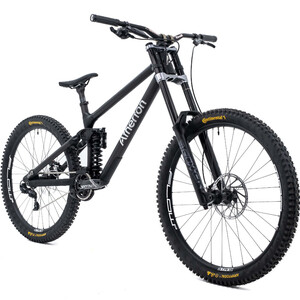
2027 Commencal Supreme DH V5.2 Team Replica Bike


| Where To Buy | |||
|---|---|---|---|

|
Free shipping on orders over $69 (continental U.S. only).
International shipping available. Some exclusions apply. |
||

|
Free shipping on orders over $50 (contiguous U.S. only).
International shipping available. Some exclusions apply. |
||

|
Free U.S. shipping on everything.
International shipping available. Some exclusions apply. |
||

|
Free shipping on orders over $50 (continental U.S. only).
International shipping available. Some exclusions apply. |
||

Commencal’s Supreme downhill bike has a very decorated history on the World Cup circuit. It’s evolved a lot over its 20+ year existence, but one thing has always remained consistent—it’s a race-developed bike that’s tested and proven by the world’s best racers, often in plain sight.
The latest version, the Supreme DH V5.2, was developed and won races during the 2025 season before being released to the public this summer. The changes are visually minor, but pivot points were moved, and the bike's personality was altered. And it's clearly been a change for the better, with Max Alran scoring his first Elite win last season, and Vali Holl wrapping up her 5th Elite title two rounds early.
The bike is obviously a rocket ship, but what enables it to go so dang fast? And what's it like to manage and direct that speed when you don’t have World Cup-level abilities? That’s what set out to find over a few days as we tested the Supreme DH in the Whistler Bike Park.
Supreme V5.2 Highlights
- Alloy 6066 triple-butted frame
- 220mm of rear wheel travel // 200mm fork
- Mixed wheels
- VCS six-bar suspension design
- Low/high geometry adjustment
- Linear/progressive leverage rate position
- Removable seatstay bridge
- Press fit bottom bracket
- Internally guided cable routing
- 63.3° head tube angle
- 12x157mm rear hub spacing
- Sizes: XS, S, M, L, XL
- Weight (size L): 41.58 lb (18.86 kg)
- MSRP (USD): Team Replica Edition - $10,950 // Signature - $8,900 // RockShox - $7,900 // Frame (no shock) - $3,500
The Supreme V5.2 uses the same six-bar high-pivot suspension layout as the V5 released in 2022. Like most 6-bar bikes, it enables independent tuning of different kinematic metrics. The major update with the V5.2 is that the rear wheel now attaches to the chainstay instead of the seatstay. Commencal doesn’t disclose exact kinematic values, but they say the change has increased the bike's support and responsiveness to rider input. But in doing so, they maintained traction and comfort.


The leverage rate has not changed; however, the idler position was moved to dial in anti-squat and reduce kickback. Anti-rise was also reduced to keep the bike higher in its travel under braking, and allow the rear wheel to bite into the ground and provide traction.
The other main frame update is the stays are slightly stiffer, and the rear brake mount has moved from the seat to the chainstay. This gives the caliper a stronger mounting point, reducing flex and brake inconsistency. It also minimizes brake-induced frame vibrations.


There are also some smaller but appreciated frame changes that should make the bike easier to live with—
- Cables are now guided through the frame for easy install/maintenance.
- The chain-slap guards on the rear end are more robust to reduce noise.
- There is a proper fender to protect the linkage and shock from the rear wheel
- The belly of the bike around the lower shock mount has been reworked to fit more shock and make it easier to reach external adjustments. However, I’d argue any lower eyelet adjustment is still quite hard to reach
- Bearing protection was improved to extend service intervals
- And rear end uses a UDH mount, which enables use with SRAM’s XX DH wireless drivetrain. Sadly, this means no more chainstay length adjustment.
What’s Carried Over?
What hasn’t changed is that like every Commencal ever, the Supreme DH continues to be made from 6066 T4 and T6 aluminum. It’s a very contrasting frame—the cross-bracing around the upper link, the compact linkage, and the stout 56mm straight head tube give the bike a sturdy, planted look. But it’s combined with the sleek, streamline tubing of the front triangle.

Our large test bike weighed in at 41.58 pounds, which is not outrageous for a downhill race bike nowadays. But it’s also on the heftier side compared to bikes we’ve tested.
Built-in Tunability
The geometry of the V5.2 is identical to the V5. If it ain’t broke, don’t fix it. But there are still a few adjustments built into the bike to alter its behavior.

The lower shock mount houses a cool four-way flip-chip adjustment that lets you choose between a linear or progressive leverage rate and a high or low geometry setting. There is also a removable bridge between the seatstays to alter rear-end flex. The larger the frame size, the thicker the bridge, but you can also buy different bridges separately for $50.


Commencal also provides recommended suspension and setup positions online based on rider style. Based on this, we started with our large frame in the ‘most popular’ stock high/linear position, with the medium-stiffness bridge and Commencal-recommended pressures. This gave the bike a fairly reserved 63.7° head tube angle, a roomy 488mm reach, and a pretty standard 646mm stack height with a 452mm chainstay length. Of course, the rearward axle path does mean the rear center grows during compression.
Builds / Pricing
Gone are the days of Commencal bikes coming in a few thousand bucks below the competition. We tested the uber fancy Team Replica build that goes for $10,950 USD. That’s basically the same price as Specialized’s Demo 11, and that bike is carbon-fiber with a proprietary drivetrain. So the pricing is a little perplexing.
The bike is specced to the nines, including SRAM’s XX DH wireless drivetrain and Maven Ultimate brakes, and RockShox’s Vivid Ultimate shock and Boxxer Ultimate fork. It also comes with an Ochain, which is a nice touch. There are two cheaper builds priced at $7,900 and $8,900. That’s definitely still mid-to-high tier pricing, as they still include top-tier suspension, while costs are saved with cheaper drivetrains, wheels, and contact points.
For consistency and durability, we installed control tires and wheels: Crankbrothers Synthesis 2.0 alloy wheels with Maxxis’ DHX-DHR tire combo.
Test Riders

| 
|
What's The Bottom Line?

Jason's Bottom Line
Strengths | Weaknesses |
|
|
Shock / Fork Settings
- RockShox Vivid Air Ultimate DH: 267 psi (23%sag), HSC: +1, LSC: 0, ABO: 0, LSR: 9
- RockShox Boxxer Ultimate Fork: 152 psi, 2 VR, HSC: +1, LSC: +3, LSR: 8
- Linear leverage rate // Low BB position // Thin bridge // Ochain at 9°
The Supreme V5.2 is one of those bikes that you look at and assume it rides unlike many other bikes. At least that’s what I thought. Commencal invests so much into racing and bike development, and they win. So they’re gotta be doing something right.
Well, now I can confirm: the Supreme rides a notch above most other bikes I’ve ridden. Its biggest strength was how calmly it handled the ugliest sections of trail without feeling sluggish when I needed something in return. I found myself cruising over bumps that felt violent on other bikes. The rear wheel was just really good at moving out of the way without blowing through travel. It encouraged hitting things head-on and hard, as there were few repercussions—I didn't feel the shock of hits that much, and the more energy I sent through the bike, the more momentum it seemed to carry. Riding a bike that feels limitless when you are pointing it straight through some bombholes, yet remains efficient in its travel and isn’t sluggish, is rare and blissful.
The Ochain effect was more prominent on the Supreme than anticipated. Turning it off added some feedback, but gave the bike a bit more platform and response. Turning it to max float offered the smoothest ride over bumps, but it made the bike feel more dead and stuck-to-the-ground. The Supreme wasn’t reliant on the Ochain to ride how I liked, but it was surprising how much effect it had on the bike's personality—probably more than any of the other adjustments.

The frame felt stiff and well matched to how fast the bike can go. It was also long and roomy, but didn’t feel too big. Maybe it was the longer chainstays, or the bike's weight being centered and low (its overall weight at 42.58 pounds was average), but the Supreme felt the least responsive of the bikes tested this year. I was way more inclined to settle in than to try to float the bike over things.
The way I fit on the Supreme also stood out less than on other bikes. I went to the low bottom bracket position to help keep my weight over my feet more. It was a meaningful change. The bike was definitely long, but I felt evenly placed between the wheels.
When I started braking is when the Supreme offered more to think about—both good and bad. It felt like the suspension remained active and tracked the ground really well when slowing down. I had more freedom in when and how I braked because the grip and composure were high. At the same time, my biggest issue with the Supreme came during heavy braking moments—my forward weight transfer was drastic. It felt like a combination of the rearward axle path, the shock extending, and the head angle being a little steeper. It was a constant battle of becoming ever-so-slightly weightless as I'd slam the brakes and my weight would get pushed up and forward. My heels would begin to rise, and I’d slowly start squatting more and more to lower my COG. And then my arms would begin feeling the weight of more and more of my body as I fought to hold myself back from going over the bars.

We talked about it a good amount in the video, but the way the Supreme brakes explains the aggressive body positioning you see most Commencal racers crumpling into. I wouldn’t say it's bad body positioning or a weakness of the bike. But it’s not my preferred riding position, and I’d have to do a lot more push-ups before I took the Supreme racing. I think for cruising a bike park it’s actually less of a detriment because you don’t have to ride the bike at its limit constantly. You can take breaks and let your arms rest. And on that note, the Supreme does jump okay, mostly because it's got so much platform to push against. But it's long and hard to throw sideways, especially if you’re already not very good at getting sideways.
The Supreme is a part of a short but competitive list of legit race bikes that you can go out and buy. I would place it near the top, alongside Specialized’s Demo 11 and Santa Cruz’s V10, when it comes to bikes that give you that 1% advantage against the clock. If you’re going racing, especially the faster and more competitive you become, the more this matters. I don’t think amateur or younger racers need to stress being on the Supreme. You’ll be fine on a simpler or cheaper bike. I also think the riding style the bike promotes could be too intense for riders still growing their abilities. And finally, the Supreme has a lot of pivots and nooks that need regular attention and cleaning. Our test bike was creaking like an old door after four days of testing. I kept riding it after this test, and it only got worse. That would be my biggest hurdle to buying a Supreme, followed closely by the high minimum price tag. I would never spend $11k on the build we tested, but the other two builds are a decent value for the parts you get.
Ryan's Bottom Line
Strengths | Weaknesses |
|
|
Shock / Fork Settings
- RockShox Vivid Air Ultimate DH: 293 psi (25% sag), HSC: 0, LSC: 0, ABO: 0, LSR: 10
- RockShox Boxxer Ultimate Fork: 160 psi, 2 VR, HSC: 0, LSC: 0, LSR: 10
- Linear leverage rate // High BB position // Medium bridge // Ochain at 6°
The Supreme puts you in a leaned-forward position. It feels roomy and racy when you first get on it, and that's great for a few runs, but it gets tiring. In steep sections, to stay behind the bars (so you don't go over them), you really have to squat down. You end up holding a squat with your knees in your chest, and your arms extended far out in front of you. Picture any action shot of Vali or Amaury, and they look like this. The whole time I rode the bike, all I could think was, wow, this is new. Why did they choose this position? It's the opposite of Jackson and Asa. I gave it a shot, but I don’t see the advantage.
I do like the long reach combined with the steeper head angle. It has plenty of stability and no lag in steering compared to a bike with a slacker head angle and shorter reach. I want to try a smaller size with higher bars, so I can't criticize the position too much since I can change it. But it's worth noting the team seems to ride this way. Last year on the V10, I felt like I was riding like Jackson Goldstone. On the Supreme I felt like I was riding like Amaury: knees in my chest, arms out in front, and going really fast.

The catch with this position is that you have to hold it the entire time you ride. If you don’t, the bike pulls you down the steeps, and if you get into the back seat at all, your head starts to bobble because your arms are already fully extended. You are forced to lean forward even if you’re a little scared to do so, but you do get used to it. It's just a lot of work, and once you get tired, the bike gets harder to ride. I can see why the Commencal team is so strong, as you kind of need to be to make it through a full race weekend on this bike. I'm still not convinced, though. Why get more tired than you need to for seemingly no advantage? Jackson and Asa practically stand straight up on their bikes and also win races. It feels neat, but it’s just not the best body position for me.
On the suspension side, the pump platform is a lot like the V10 (very positive), but more stable because of the longer wheelbase, and the rear wheel bites into the ground more under braking. Commencal decreased the anti-rise from the previous generation, and based on how it brakes, they chose well. It doesn't teeter-totter like some bikes with lower anti-rise. The rear end never rose too high in steep sections; you could still brake at the last second into corners, and the rear wheel never felt like it was locking up when braking into big holes.

The suspension is pretty intricate, with lots of bars and bearings. It got a little creaky during our testing, so be prepared to maintain it more than some. The extra bars seem to be working, though, because the suspension did everything right in every scenario. What's funny is that the most noticeable adjustment on the bike was the Ochain. That's not to belittle the suspension. The chassis and suspension work wonderfully, and then the Ochain lets you fine-tune from a super-squishy smash machine to a peppy pumptrack bike. The middle position worked perfectly for me. If you need to calm things down, add more float. If you're pumping corners and want more pep, turn it off. It was super cool how much you could feel it, and it's still funny to me how much I liked it.
Overall, the Supreme is a fast, stable bike that brakes and pumps really well, and the Ochain makes it easy to dial in. The ride position is the one thing I'm still not sold on, but I could likely change that with a smaller size and higher bars. I would happily own this bike as a race bike. It’s hard to argue with it.
View key specs, compare bikes and frames, and review the newest Commencal Supreme V5.2 models in the Vital MTB Product section.


Specifications
• Geometry adjustable via 2-position flip chip at lower shock mount
• All specifications listed are with 203mm travel fork with 612mm axle-to-crown length and 52mm offset
Rotors: SRAM HS2, 2.0mm thick, 6-bolt, 220mm
Rear: Schwalbe Tacky Chan, Gravity Pro casing, Soft compound, tubeless ready, 27.5" x 2.5"
• HVCS (High Virtual Contact System) high pivot point 6-bar rear suspension design
• Mixed ("Mullet") wheels: 29" front, 27.5" rear
• Internal cable routing
• SRAM UDH (Universal Derailleur Hanger)
• Weight listed for size SM
• Frame weight, size SM: 5.8kg/12.78lbs
• Includes rear mudguard
• Includes pre-installed RideWrap Lotus Pro protection film
• Includes SRAM AXS Powerpack battery charger
• Includes ODI Race plate
Geometry and shock progression adjustable via flip chip at lower shock mount, with four positions:
• High: high bottom bracket and steeper head angle, ideal for slower and flatter tracks
• Low: lower bottom bracket and a slacker head angle, for fast and steep tracks
• Front: linear and therefore dynamic with good comfort through the travel
• Rear: progressive for increased grip and filtration of impacts
Interchangeable chainstay bridge gives three frame flex options:
• Thin (stock on SM): improves filtration of impacts on the angle, easy turn initiation
• Medium (stock on MD/LG): intermediate flex characteristics
• Thick (stock on XL): improves precision and dynamism
| Where To Buy | |||
|---|---|---|---|
|
|
Free shipping on orders over $69 (continental U.S. only).
International shipping available. Some exclusions apply. |
||
|
|
Free shipping on orders over $50 (contiguous U.S. only).
International shipping available. Some exclusions apply. |
||
|
|
Free U.S. shipping on everything.
International shipping available. Some exclusions apply. |
||
|
|
Free shipping on orders over $50 (continental U.S. only).
International shipping available. Some exclusions apply. |
||




0 comments
Post a reply to: Refined Like Fine Wine - Commencal’s Race-Winning Supreme V5.2