


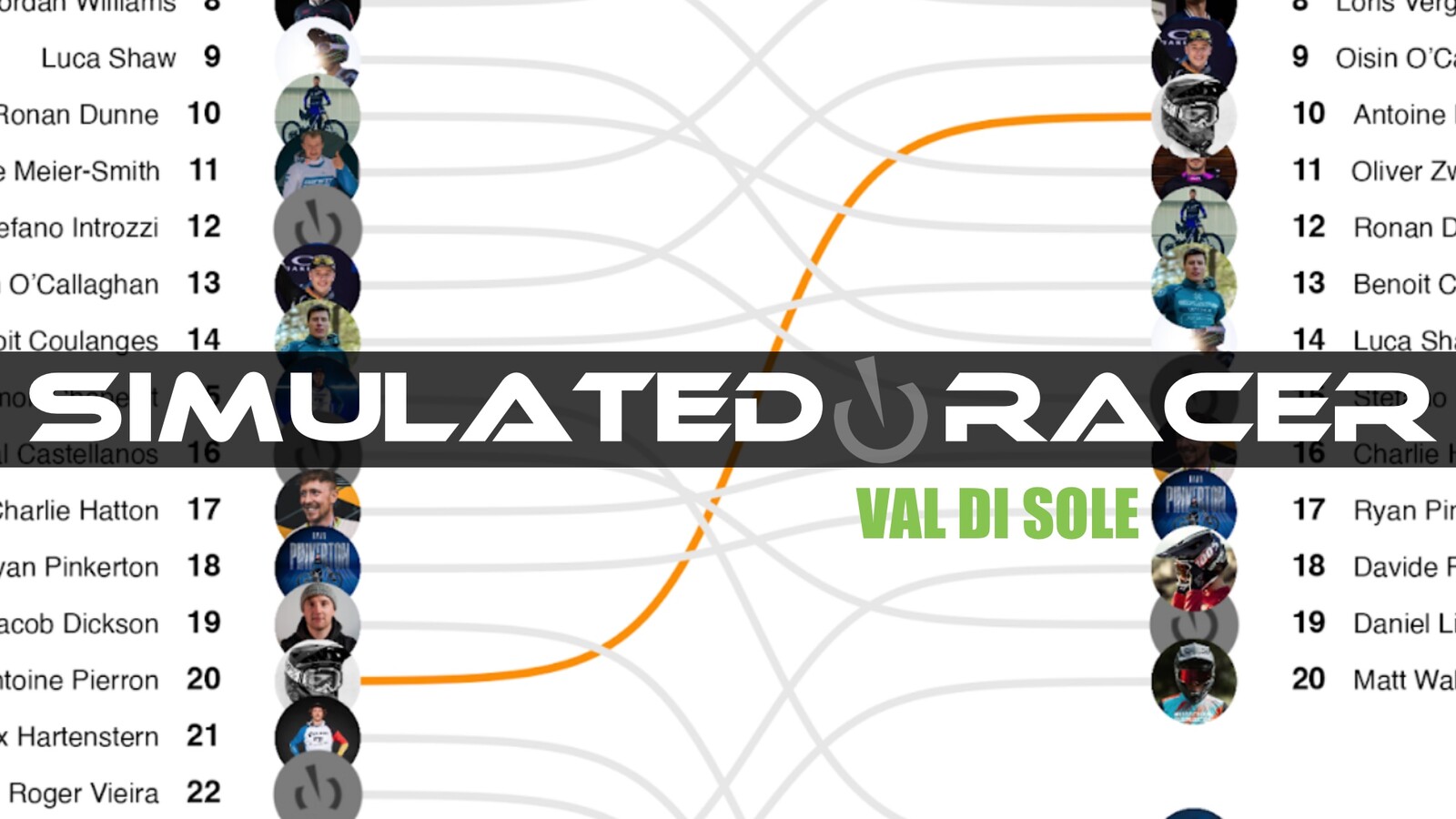
Welcome back to another round of Simulated Racer, the series where we dig into the World Cup race data to uncover what could have been. This week, we are going to dive into both the Elite Men's and Elite Women's data from Val di Sole to see if we can unearth some stories about where the race was won and who left time on the hill.
Just like previous installments, to calculate a true measure of potential, we've constructed each rider's "perfect run" by taking their quickest time from each of the five timed sections throughout the Val di Sole race weekend. With up to eight recorded runs (from timed training to finals), we had ample data to create this theoretical best-case scenario.
To demonstrate this concept, let's look at Jordan Williams data. His best recorded run was a 222.26s (3:42.26). But when we build his "perfect run" by combining his fastest splits (pulled from Timed Training 2, Qualifying Round 1 & 2, and Finals), he hits a theoretical 216.90s (3:36.90) – a gain of 5.36 seconds. Given that races this year have frequently been won or lost by razor-thin margins, it's interesting to think about the ripple effect this subtle improvement would have had on the overall results.

The eagle-eyed among you may have noticed that Jordan's fastest run was achieved in Timed Training 2. This isn't a mistake. Jordan had several crashes through both qualifying rounds, and watching his finals run, it looks like he laid down a solid run without any mistakes. But, he was still faster during timed training. Later in the article, we examine this in more depth.
The Time Left on the Track
Jordan wasn't alone in leaving time out on the hill. 96.8% of Elite Male riders (91 of 94) and 97.1% of Elite Female riders (33 of 34) had a faster theoretical best run than their actual fastest run of the weekend.


This shows the high variability in performance on this track and in downhill in general. I think this is what makes the sport so exciting to watch. So many riders have swaths of talent that they could pull out of the bag at any moment to piece together a winning run. To me, these statistics further highlight the importance of racecraft and the ability to tap into your inner potential.
Diving deeper into the data, we can also visualize which riders left the most time on the track:


Of the top 10 riders with the most time left on the track from between the Elite Men and Elite Women, there were five Italians on that list (Christian Hauser, Davide Palazzari, Loris Revelli, Gloria Scarsi, and Veronika Widmann), demonstrating they had the speed on their home track, but unfortunately, weren't able to piece it together on race day.
It is also interesting to note that Luke Meier-Smith and Jordan William's simulated fastest times would have beat Jackson's race-winning time. (but as we will see later, they wouldn't have beaten a simulated Jackson!)
Comparing the Elite Men and Elite Women above, ignoring the top entries due to crashes and mistakes in race runs, we can see that, in general, the women left less time on the track. This means the gulf between the Elite Women's actual best-recorded performance and their best theoretical performance is smaller than that of the Elite men. Indeed, if we compare how things actually unfolded versus how they could have unfolded, we see less variability in ranking in the Elite Women than the Elite Men:


We can break down the top 10 simulated race times by splits to recreate what the simulated races would have looked like:


The actual race results demonstrate that Dylan Maples and Thibaut Daprela were no fluke. They were looking fast all weekend and pieced it together when it counted most. That's even more impressive from Thibaut, who snapped his chain in the second corner yet still managed his fastest splits in sections 2, 3, and 5 of finals. These renowned chainless runs really suggest that losing the chain forces riders to pump and conserve speed more effectively.
In Jackson's post-race interview, he said, "I was confident in my run the whole way down, and I felt like I left nothing out there." We hate to be that guy, but if there is one thing that's always true, it's that time was still left on the hill somewhere. 5.36 seconds, to be precise (the difference between his Final's run time and his simulated time). This is not to take anything away from him. The opposite in fact. His run was incredible, and it's mind-blowing to think he could have taken an even bigger winning margin away from his competitors.
The Ultimate Rider
By combining the fastest split times from all riders, we can create a simulated "ultimate downhill rider." For the Elite Men, this hypothetical run clocks in at 212.23s (3:32.23), nearly seven seconds faster than Jackson Goldstone's winning time of 218.86s (3:38.86). For the Elite Women, this run clocks in at 243.28s (4:03.28), also coincidentally around seven seconds faster than Marine Cabirou's winning time of 250.31s (4:10.31). This demonstrates the significant untapped speed on the Val di Sole track, distributed among the elite riders.


The Real Story
Let's look at how the race actually unfolded. By analyzing the time lost to the leader in each section, we can pinpoint where the race was truly won and lost, offering a realistic contrast to our simulated "what if" scenarios.
For the Elite Men, Section 5 was the most pivotal of the race. Here, Jackson had the largest gap of any sector, at 0.751s, and the long right tail shows many riders lagging behind. The next largest gap was also reported by Jackson in Section 3 at 0.475 seconds.

For the Elite Women, Marine Cabirou won Section 4 by 0.460. Unlike the Elite Men, the rest of the sectors were much tighter, with the next biggest margin being 0.109s by Tahnee Seagrave in Section 1.

Speed Ramp Up
Earlier in the article, it was noted that Jordan Williams had his fastest run in Timed Training 2, being one of the few Elite Men where this was the case. Historically, it has always been joked that timed training is less than useless for predicting performance. But, given how tight racing is now, is that still the case?


The answer seems to be: it depends. For the Elite Women it seems to be the case that there is a relationship between their fastest timed training run and their qualifying and finals performance. For the Elite Men, this only seems to hold true for qualifying and not finals. In subsequent races, I will try to answer this question in a more rigorous manner, pooling data from across the races and fitting some statistical models.
Looking Ahead to La Thiule
La Thiule is upon us in just a few days, and if you're looking to make some savvy picks for your Vital Fantasy League, here are a few angles to consider:
- Insider advantage: Loic Bruni and Loris Vergier have had the opportunity to do some practice runs of La Thiule and help shape the track. One can imagine they will be entering this round already one step ahead.
- Steep tech: La Thiule is known for its natural steep and techy terrain. Given Marine Cabirou’s standout performance at Val di Sole, a track of similar flavor, she would be a sensible bet coming into this next round in winning form.
As ever, keep the feedback coming. Let us know what you like, what you think could be improved, and any ideas you would like to see explored for future races.
All the data and code used in this analysis are open-source and can be found here.
6/29/2025 3:13am




View replies to: Simulated Racer - Where Was The Race Won and Lost? - Val di Sole Analysis
Comments